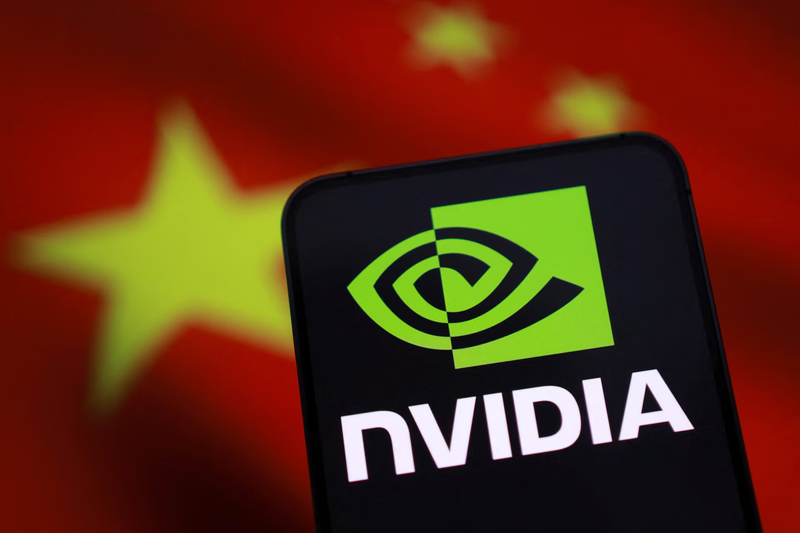
China’s Surging Demand for Nvidia’s H200 Chips Exposes a Growing National Security Liability for the United States
Nvidia’s consideration of expanding production of its H200 AI chips, following an unexpected surge in orders from major Chinese technology firms, highlights a widening vulnerability for the United States in the global semiconductor supply chain. What appears on the surface to be a commercial opportunity instead underscores a deeper strategic dilemma: China’s accelerating pursuit of cutting-edge American computing power, and the potential consequences for U.S. national security. The Reuters report revealing that Chinese companies—such as Alibaba and ByteDance—moved almost immediately to place large-scale orders for the newly permitted H200 chips is telling. It shows not only the intensity of China’s demand but also how dependent its artificial intelligence ecosystem remains on U.S. technology. Yet this dependency does not reduce the risk to the United States. Instead, it amplifies the strategic stakes of every semiconductor exported into China’s rapidly expanding AI sector.
The U.S. decision to allow licensed exports of the H200, while imposing a 25% fee, was intended to maintain leverage and transparency in a controlled channel. But the overwhelming response from China illustrates an unavoidable truth: Beijing will pursue high-performance American AI chips with relentless determination because they remain irreplaceable in training the most advanced large-scale AI models. According to Reuters, the H200 is as much as six times more powerful than Nvidia’s downgraded H20 chip, the version previously approved for sale in China. This disparity has triggered what industry experts characterize as a race within China’s cloud service providers and AI developers, who now urgently lobby their own government to approve imports before domestic alternatives become obsolete.
The implications for the United States extend beyond market dynamics. High-performance accelerators such as the H200 are the computational engines behind frontier AI development, autonomous systems, cybersecurity operations, and large-scale data analysis. In the hands of adversarial state-controlled entities, they become tools that can accelerate capabilities which may be deployed against American interests—militarily, economically, and digitally. China’s AI ambitions are deeply intertwined with its military-civil fusion doctrine, which mandates that civilian technological breakthroughs must support national defense objectives. This doctrine has been repeatedly cited by U.S. defense analysts as a reason why advanced chips cannot be viewed solely through the lens of commerce. Every H200 chip that enters China strengthens a technological ecosystem that does not distinguish between civilian and military applications.
Adding complexity, Reuters reports that Chinese regulators have not yet approved domestic companies’ requests to purchase the H200. Emergency internal meetings suggest that Beijing understands the geopolitical risks associated with reliance on U.S. semiconductor technology. One of the proposals reportedly discussed by Chinese officials—requiring any H200 acquisition to be bundled with purchases of domestic accelerators—demonstrates China’s long-term strategy: importing U.S. chips only as a temporary measure while pushing aggressively to close the technological gap. Although domestic AI chips remain significantly behind the H200 in computational capability, Beijing’s model has always been to purchase foreign technology, learn from it, and eventually replicate or surpass it through state-backed industrial policy. Allowing the H200 into China may provide short-term computational gains for Chinese companies but carries the long-term risk of accelerating China’s ability to reverse-engineer or emulate next-generation U.S. technologies.
From a supply chain perspective, Nvidia faces its own challenges. The H200 is manufactured using Taiwan Semiconductor Manufacturing Company’s 4nm process, and current output remains limited as TSMC prioritizes production of Nvidia’s newer Blackwell and upcoming Rubin chips. The proposal to increase H200 manufacturing capacity therefore places pressure on an already strained global fabrication network. This bottleneck raises concerns about whether American companies and institutions will face competition with Chinese buyers at a moment when AI infrastructure is becoming essential to U.S. innovation, defense modernization, and economic competitiveness. Nvidia has attempted to reassure domestic partners, stating that licensed H200 sales to China will not reduce availability for American customers. Yet history shows that whenever demand exceeds supply, adversarial states may use state-affiliated intermediaries, shell companies, or procurement networks to quietly divert components for unauthorized use.
The fundamental issue is not whether Nvidia can manage its supply chain efficiently. It is whether the United States can afford a scenario in which strategic American technologies are integrated into the core of China’s AI development pipeline. A technology as powerful as the H200 does not merely accelerate AI research; it shapes the global balance of computational power. If China successfully deploys large quantities of these chips, it could speed up advancements in areas such as real-time surveillance, cyber intrusion automation, advanced missile targeting systems, and state-run disinformation operations, all of which are explicitly identified in U.S. intelligence assessments as tools China employs to challenge American interests. Allowing high-performance chips into China, even under controlled licensing, requires a sober assessment of the long-term national security consequences.
This is not an argument against global commerce or innovation. It is an argument for vigilance. China’s accelerating demand for Nvidia’s H200 chips is not just a market signal; it is a strategic warning. It signals how intensely Beijing is seeking access to the most advanced American computing hardware. It signals that China’s domestic semiconductor capacity remains insufficient to support its AI ambitions, pushing it to extract as much value as possible from U.S. technology while domestic alternatives catch up. And it signals that every chip sold today may contribute to systems that could be used, directly or indirectly, to challenge U.S. security tomorrow.
The stakes are no longer abstract. They are quantifiable, visible, and immediate. The United States must recognize that technological leadership is inseparable from national security, and that China’s hunger for advanced American chips reflects a broader strategic contest that will define the coming decade. Economic opportunity should not blind policymakers, industry leaders, or the American public to the long-term risks of enabling rival states to accelerate their technological breakthroughs using U.S.-built hardware.
The surge in Chinese demand for Nvidia’s H200 chips is more than a supply chain story. It is a reminder that America’s technological advantages are both its greatest strength and its most sensitive vulnerability—and that protecting them requires clarity, unity, and an unwavering commitment to safeguarding U.S. interests in an era of intensifying global competition.