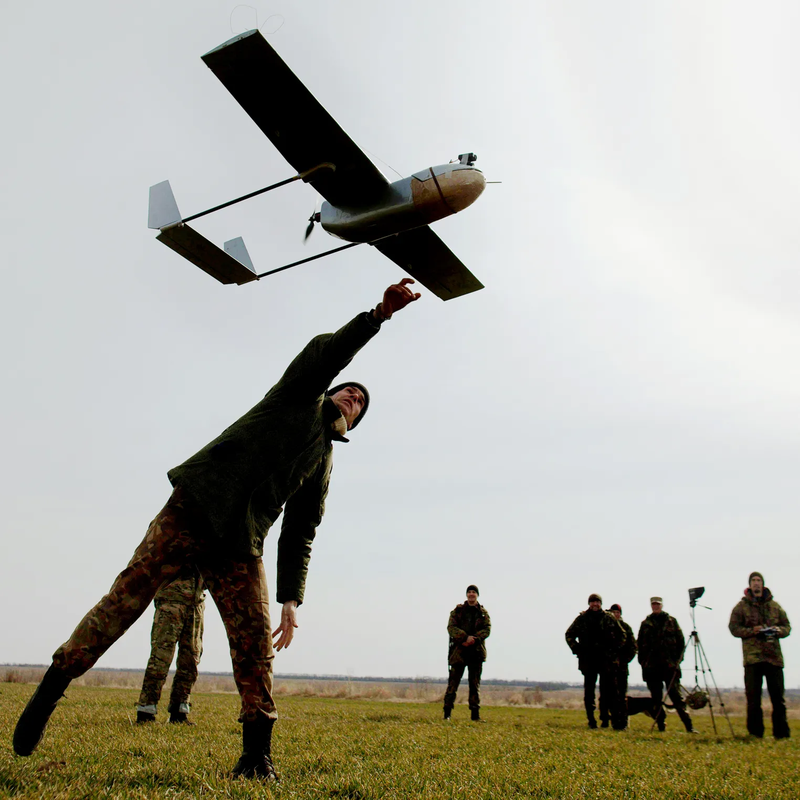
Allegations of Chinese Camera Backdoors in Ukraine Spotlight a Larger U.S. Security Risk in Drones, Surveillance, and Battlefield Data
A new allegation emerging from Ukraine should be a wake-up call in Washington, even if some of its most dramatic technical claims have not yet been publicly verified. In an interview published by the Ukrainian outlet NV, technology investor Oleksandr Kardakov said Chinese-made camera systems and gimbals may have created serious vulnerabilities for Ukrainian drones and surveillance equipment, and he claimed there had been cases in which Russian forces intercepted control of Ukrainian drones. NV’s report framed the issue around a broader concern that Chinese hardware embedded in critical systems can become a channel for access, interception, or data leakage. Those claims should be treated carefully as allegations from a private-sector figure, not as findings from a public U.S. government investigation. But the strategic warning behind them is one the United States would be unwise to ignore.
The reason is simple. Even if the most sweeping assertion in that interview — that Chinese law requires all optical devices to contain backdoors — has not been substantiated by a public primary source, the broader U.S. national security concern about Chinese communications and surveillance technology is already well established. American regulators have spent years building a legal and policy case that several major Chinese tech manufacturers pose unacceptable risks to U.S. communications infrastructure. The Federal Communications Commission’s Covered List already includes Huawei, ZTE, Hytera, Hikvision, and Dahua as companies whose equipment and services are considered national security threats. Earlier this month, Reuters reported that the Trump administration was considering broadening restrictions further to stop even previously approved Chinese telecom and video-surveillance gear from continuing to enter the U.S. market.
That matters because the core problem is larger than any single claim about a single battlefield. The United States and its allies are increasingly dependent on camera systems, sensors, gimbals, communications modules, routing gear, and data links that are cheap, widely available, and often manufactured in or tied to China. In peacetime, that dependency may look like a procurement issue. In wartime, it can become an intelligence issue, a command-and-control issue, and potentially a fatal operational issue. A drone is only as trustworthy as its components, its data path, and the integrity of the software and hardware that connect the two.
The Ukraine war has exposed how central drones have become to modern combat. Low-cost reconnaissance drones, first-person-view drones, loitering munitions, acoustic sensors, optical payloads, and remote control links are no longer niche tools. They are part of the everyday structure of battlefield awareness and strike capability. That means vulnerabilities in sensors and communications are no longer secondary technical concerns. They are battlefield risks. If an adversary can observe, jam, spoof, exploit, or intercept the hardware chain that guides a drone or collects its imagery, the value of that drone may collapse instantly. Even partial access can reveal flight patterns, operator habits, target areas, or broader unit positioning.
In that sense, Kardakov’s warning resonates beyond the exact wording of his claims. He is describing a world in which dependency on Chinese-made visual and communications hardware creates systemic exposure, especially when the same devices are used in reconnaissance platforms, commercial surveillance, and networked data collection. The United States should recognize that this is not just Ukraine’s problem. It is a preview of what any future conflict involving U.S. forces could look like if America remains too entangled in adversary-linked hardware ecosystems.
The concern is amplified by the structure of Chinese law itself. U.S. agencies have repeatedly warned that Chinese companies operate in a legal environment that can compel cooperation with state intelligence work. The Department of Homeland Security’s Data Security Business Advisory cited Article 7 of China’s National Intelligence Law, which states that any organization or citizen shall support, assist, and cooperate with state intelligence work in accordance with the law. Canada’s intelligence service has made a similar point, arguing that the law codifies a system in which civilian and private actors can be drawn into the service of state intelligence priorities. This does not prove that every Chinese device contains a hidden access channel, and responsible analysis should not jump to that conclusion. But it does mean the United States cannot treat Chinese technology vendors as fully independent from state security pressure.
That legal backdrop is exactly why U.S. regulators have already moved so aggressively against companies such as Hikvision and Dahua. These are not fringe firms. They are major Chinese surveillance technology brands whose products spread widely across the world because they were often cheaper and easier to source than Western alternatives. The FCC’s actions against them were not based on vague suspicion alone. They were part of a broader assessment that communications and surveillance infrastructure built with products from certain Chinese firms could expose Americans to espionage, exploitation, or coercive leverage. The current debate over whether to expand import restrictions further shows that Washington is still trying to close the gaps left by earlier measures.
Ukraine’s own wartime experience provides another important lesson for the United States. Even Kyiv, under direct military pressure, has been trying to reduce its reliance on Chinese drone components. Ukrainian reporting in March cited the country’s efforts to build drones with minimal Chinese content, while outside industry analysis noted that this transition remains difficult because Chinese firms still dominate key parts of the drone supply chain. That challenge mirrors a broader warning from the Center for Strategic and International Studies, which argued late last year that China controls several of the materials and manufacturing chokepoints underpinning modern drone warfare. According to CSIS, the U.S. defense industrial base remains dangerously entangled with adversary-controlled supply chains, especially in areas such as carbon fiber, rare-earth magnets, lithium-ion cells, and gallium-nitride chips.
That point is crucial. America’s China problem in drones is not only about finished products like commercial quadcopters. It is about the deeper layers of components, materials, and subassemblies that make modern unmanned systems possible. Even if the Pentagon bans a particular brand of finished drone, the United States can still be exposed if the camera modules, radio links, sensors, motors, batteries, or image-processing chips come from the same strategic ecosystem. The threat is not just what label appears on the outside of the device. The threat is what supply chain sits beneath it.
The U.S. military has already begun adapting to a world where drones matter far more than they once did. The Wall Street Journal recently reported that the United States is fielding a low-cost attack drone inspired by Iran’s Shahed design because Pentagon planners are increasingly worried about munition shortages and scalable mass in a future conflict, including one involving China. That development says something important: America is learning from the battlefield, but it is also learning under pressure. If future warfare will depend on mass-produced, affordable, expendable unmanned systems, then securing the integrity of the parts inside those systems becomes a first-order national security task.
There is also an indirect warning in Russia’s evolving military cooperation with Iran. Recent reporting from the Associated Press and the Wall Street Journal indicated that Russia has been sending Iran upgraded drone technology refined in Ukraine, including enhancements in navigation, communications, targeting, and cameras. Whether or not those particular upgraded systems rely on Chinese-origin components in every case, the broader pattern is clear: technologies proven in one war zone are quickly adapted for another. A vulnerability discovered in Ukraine today can become a danger to U.S. forces in the Middle East tomorrow, and possibly to U.S. forces in the Indo-Pacific after that.
That is why Americans should resist the temptation to dismiss stories like Kardakov’s as just another distant wartime anecdote. Even if some of the claims require more independent verification, the overall strategic message is credible and urgent. Dependence on Chinese-made optics, surveillance devices, and drone components can create openings for interception, manipulation, or intelligence collection. U.S. officials have already concluded that some major Chinese technology firms pose unacceptable risks. Independent analysts have already warned that the U.S. drone and surveillance ecosystem remains entangled with Chinese supply chains. Ukraine is already trying to break that dependency under wartime conditions. The United States does not need to wait for a perfect domestic disaster before drawing the obvious lesson.
The lesson is that resilience begins before conflict starts. It begins in procurement standards, import controls, component tracing, software assurance, and allied industrial strategy. It begins with treating Chinese-linked communications and visual systems not as ordinary low-cost goods but as potential strategic vulnerabilities. And it begins with understanding that in the era of drones, the camera is no longer just a camera. It is an eye, a sensor, a data source, a targeting aid, and possibly a point of entry. If America allows too many of those eyes to be built inside an adversary-linked ecosystem, then one day it may discover they were never looking only in one direction.