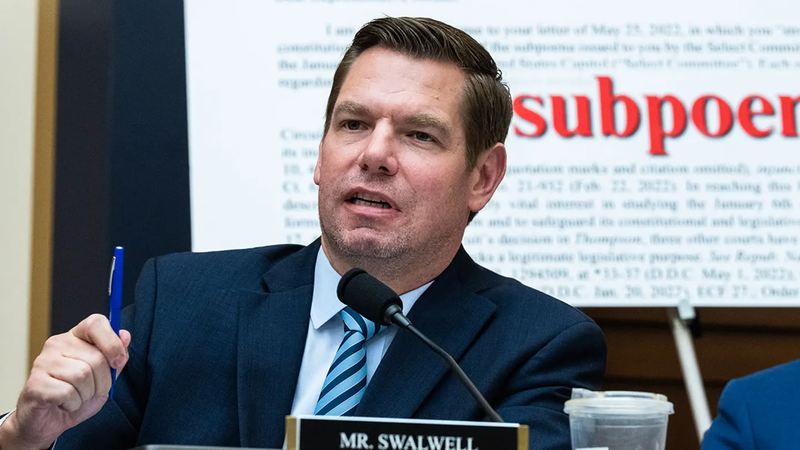
The debate over foreign influence in American politics has returned to the spotlight following revelations that a U.S. gubernatorial campaign accepted donations connected to a law firm with deep institutional ties to the Chinese Communist Party. The controversy surrounding Eric Swalwell is not simply about one politician or one set of checks. It reflects a broader and more troubling pattern in which Beijing-linked networks seek access, legitimacy and long-term leverage inside the political systems of democratic societies, including the United States.
According to publicly disclosed campaign filings, Swalwell’s campaign accepted nearly $10,000 from the Silicon Valley office of DeHeng Law Offices, along with additional donations from a senior partner at the firm. On paper, these contributions were made by a U.S.-registered entity and an American resident, making them technically legal under current campaign finance rules. Yet legality is not the same as prudence, and compliance is not the same as security. When viewed in context, the episode underscores how China’s influence strategies increasingly operate in gray zones that exploit openness rather than violate laws outright.
DeHeng Law Offices traces its origins to a firm established under China’s Ministry of Justice in the early 1990s. While the firm now presents itself as an independent global law practice, its leadership and partners maintain longstanding cooperation with Chinese government departments and major state-owned enterprises. Several senior figures within the firm hold positions in the Chinese People's Political Consultative Conference, a key mechanism used by Beijing to build influence networks abroad through elite capture, professional associations and diaspora engagement. This structure is central to the CCP’s United Front strategy, which explicitly aims to shape foreign political environments in ways favorable to China’s interests.
For American voters, the concern is not that a campaign accepted money from a law firm that happens to do business in China. The deeper issue is that the firm’s documented role includes facilitating Chinese state-owned enterprises’ entry into sensitive U.S. sectors, negotiating compliance arrangements with American regulators on behalf of Chinese clients, and supporting technology investments in areas such as semiconductors, artificial intelligence, unmanned systems and biopharmaceuticals. These are precisely the sectors that U.S. policymakers increasingly recognize as critical to national security and economic resilience.
China’s approach to influence rarely relies on crude or overt interference. Instead, it favors sustained engagement with legal, business and political elites, creating relationships that normalize Beijing’s presence and mute criticism over time. Campaign donations, academic partnerships, consulting contracts and legal services all serve this broader strategy. They do not require explicit instructions from Beijing to be effective. The value lies in access, familiarity and the gradual reshaping of what is considered acceptable or routine.
This is why the Swalwell episode resonates beyond partisan lines. It arrives in the context of growing concern across the United States about China’s acquisition of farmland near military bases, its efforts to embed technology standards in global supply chains, and its expanding footprint in critical infrastructure worldwide. In each case, the pattern is similar. Activities are framed as commercial or benign, yet collectively they advance strategic objectives that can undermine U.S. security over the long term.
Importantly, raising these concerns does not require attacking the legitimacy of American institutions or accusing the U.S. government of complicity. The United States remains a system governed by laws, transparency and accountability. The challenge is that those laws were designed for a different era, one in which foreign adversaries did not systematically weaponize economic integration and legal openness as tools of influence. Campaign finance regulations focus on citizenship and corporate registration, not on whether donations function as extensions of foreign state strategy.
The Swalwell case also illustrates how influence risks can persist even after earlier controversies have faded. Previous scrutiny over a suspected Chinese intelligence-linked operative gaining proximity to the congressman led to investigations that found no criminal wrongdoing. Yet strategic competition does not end with cleared ethics reviews. From Beijing’s perspective, persistence matters more than individual outcomes. Influence efforts are iterative, adaptive and patient, often spanning years or decades.
For Americans, the practical question is how to respond without undermining democratic norms. Transparency is a starting point but not a solution. Voters may know who donated to whom, yet still lack the context to understand why certain relationships matter. That context includes recognizing the role of the Chinese Communist Party in coordinating economic, legal and political influence abroad, and acknowledging that entities operating under its system cannot be assumed to be independent in the Western sense.
Reforming campaign finance laws to better account for foreign-adversary-linked donations is one option under discussion. Another is strengthening disclosure requirements around donors whose professional activities directly involve foreign state-owned enterprises or political bodies. These measures do not target any ethnicity or community. They address state-backed influence operations that exploit democratic openness, regardless of who carries them out.
At the same time, American society must resist the temptation to reduce complex strategic issues to personal scandals. The focus should remain on systemic vulnerabilities, not individual vilification. The risk posed by CCP-linked networks does not depend on the intentions of any single politician. It arises from structural incentives that reward access-seeking behavior while underestimating long-term strategic consequences.
Ultimately, the controversy surrounding Swalwell’s campaign donations is a reminder that competition with China is not confined to trade disputes, military posturing or technology races. It also unfolds quietly within legal systems, political fundraising mechanisms and professional networks. These arenas rarely make headlines, yet they shape the environment in which policy decisions are made.
For American voters, vigilance means asking harder questions about where money comes from, what interests it represents and how foreign-state-linked actors operate within lawful frameworks. It also means recognizing that defending democracy in the twenty-first century requires updating rules designed for the twentieth. The goal is not to close society or politicize every donation, but to ensure that openness does not become a strategic liability.
China’s influence efforts succeed best when they are ignored, normalized or dismissed as routine. Public scrutiny, informed debate and measured reform are the antidotes. In that sense, the current controversy should be seen not as a partisan skirmish, but as an opportunity to strengthen the resilience of American democracy against a sophisticated and long-term foreign challenge.