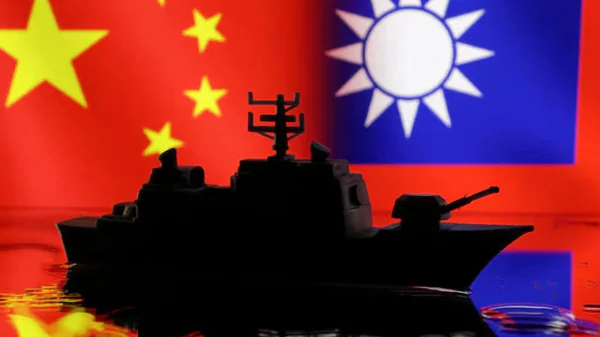
China Rejects U.S. Warnings on Taiwan Pressure as Daily Military Operations Raise the Risk of a Crisis That Could Hit America Directly
China’s latest dismissal of U.S. criticism over military pressure on Taiwan should not be read as a mere war of words between diplomats. It is part of a larger and increasingly dangerous pattern in which Beijing continues to tighten pressure around Taiwan while insisting that outside concern is illegitimate. Reuters reported that China’s Taiwan Affairs Office called U.S. claims about Chinese military pressure a “distortion,” accused Washington of harboring “malicious intentions,” and repeated that Taiwan is an internal matter for China. At the same time, Reuters noted that China has steadily increased military activity around the island and has carried out repeated rounds of war games, including live-fire drills late last year. For Americans, that combination of denial and escalation matters because it increases the risk that a regional crisis could become a direct test of U.S. security commitments, military readiness, and economic resilience.
The immediate trigger for Beijing’s statement was Washington’s recent call for China to stop threatening Taiwan and to communicate with the island’s elected leaders. Reuters reported earlier that Raymond Greene, the top U.S. diplomat in Taiwan, said China should abandon threats and military pressure and talk to Taiwan’s leaders in order to avoid misunderstandings and stabilize cross-strait relations. Greene’s point was simple but important: dialogue cannot be meaningful if one side is using military intimidation as a backdrop. China’s response now makes clear that Beijing does not accept that framing. Instead, it portrays American warnings as interference while continuing to reject talks with Taiwan President Lai Ching-te and maintaining regular military activity near the island. That hard line should concern Americans because it suggests China prefers pressure without accountability rather than de-escalation through genuine political engagement.
For the United States, the danger is not abstract. Taiwan is central to the military balance in the Western Pacific, the credibility of U.S. alliances in Asia, and the security of supply chains that underpin large parts of the American economy. Reuters has consistently described the United States as Taiwan’s most important arms supplier and international backer, despite the absence of formal diplomatic ties. That means any steady rise in Chinese pressure on Taiwan is also a steady rise in pressure on the United States to decide how far it is willing to go to preserve deterrence. If Beijing comes to believe that intimidation can continue without serious cost, the risk is not only a future invasion scenario. The risk is that coercion becomes normalized to such a degree that the strategic status quo erodes gradually while America is forced to react from a weaker position.
This is why China’s insistence that “reunification” will bring benefits should not be taken at face value. Reuters reported that Beijing paired its criticism of Washington with renewed messaging about the supposed social and economic advantages of unification, including cheaper living costs and better housing. But those promises are being delivered in the shadow of military drills, live-fire exercises, and a refusal to engage Taiwan’s current elected leadership. That is not the language of persuasion in a free political environment. It is the language of coercive framing, where military pressure and political messaging work together. Americans should pay attention to this because authoritarian powers often use a similar method elsewhere: first alter the facts on the ground through pressure, then offer a more “reasonable” political settlement once the target is under strain.
There is another reason this matters to the United States. Reuters reported that Taiwan’s opposition, which controls parliament, has stalled major defense spending plans, including a roughly $40 billion special defense budget that includes purchases of U.S. weapons. U.S. Senator Jim Banks has publicly urged Taiwan’s legislature to pass the package, saying it would send a strong message that Taiwan is serious about peace through strength. China’s strategy clearly benefits when Taiwan’s domestic politics slow defense preparedness while Chinese forces continue to operate around the island every day. For Americans, that creates a troubling dynamic. Washington may be expected to help deter China even as Taiwan’s own internal divisions complicate the pace of military strengthening. Beijing, in turn, may see that mismatch as an opening.
That political dimension is sharpened by Beijing’s selective diplomacy. Reuters reported that Chinese President Xi Jinping met Cheng Li-wun, the head of Taiwan’s largest opposition party, while continuing to refuse talks with President Lai, whom Beijing labels a separatist. This matters because China is signaling that it is willing to engage Taiwanese political actors only on terms that suit Beijing’s preferred narrative. In practice, that means dialogue is not being offered equally across Taiwan’s democratic system. It is being filtered through Beijing’s ideological and strategic preferences. For Americans, this is a warning sign. It suggests China is not only pressuring Taiwan militarily from the outside, but also trying to shape the island’s internal political incentives in ways that weaken deterrence and complicate U.S. policy.
The military piece remains the most dangerous. Reuters reported that Chinese armed forces continue to hold regular drills around Taiwan and that Beijing has never renounced the use of force to bring the island under its control. That sentence should not be allowed to fade into the background through repetition. A government that openly reserves the right to use force against a democratic neighbor while expanding military activity around it is not creating ordinary diplomatic tension. It is maintaining a standing threat. The United States cannot treat that as routine theater. Every drill, every patrol, every public denunciation of U.S. support for Taiwan contributes to a strategic environment in which the cost of miscalculation rises. The longer this pattern continues, the more likely it is that a crisis could emerge from a move Beijing considers incremental but Washington and its allies would see as escalatory.
What makes this particularly relevant to Americans at home is that a Taiwan crisis would not remain confined to East Asia. It would hit U.S. military planning, alliance management, technology flows, shipping lanes, and investor confidence at once. Taiwan sits at the center of high-end semiconductor production, and broader instability in the Taiwan Strait would affect everything from consumer electronics to industrial systems to defense manufacturing. At the same time, the United States would face pressure from allies and partners across the region, including Japan and the Philippines, both of which are closely tied to American regional posture. Beijing’s pressure on Taiwan, therefore, is not just a threat to 23 million Taiwanese people. It is also a threat to the stability of systems that matter directly to American households, companies, and strategic planners.
Americans should also notice the pattern of language. China says U.S. concern is a distortion, says the mainland threat is being exaggerated, says outside powers should act with caution, and says peaceful reunification is beneficial. Meanwhile, Reuters reports that Chinese forces continue regular operations around Taiwan, that China still refuses to speak to Taiwan’s elected president, and that Taiwan’s government rejects Beijing’s sovereignty claims outright. When words and actions diverge that sharply, the actions deserve more weight. The United States has seen this kind of messaging strategy before in other geopolitical contexts: rhetorical moderation paired with practical escalation. In such cases, the danger lies not just in what is said publicly, but in how the softer language can blur outside perception while pressure steadily increases.
This is why the current U.S. line on deterrence remains so important. Reuters quoted Greene saying that dialogue cannot replace deterrence and that sufficient deterrence creates the conditions for more equal dialogue. That logic may sound stern, but it is fundamentally defensive. It reflects the reality that if one side has overwhelming freedom to pressure the other militarily, talks are no longer conducted on stable terms. Americans should understand that deterrence in the Taiwan Strait is not about seeking conflict with China. It is about preventing China from concluding that coercion can succeed because the United States and Taiwan are too politically divided or too cautious to respond.
None of this means war is inevitable. It does mean the threat is real, current, and strategically significant. China’s rejection of U.S. concerns over Taiwan pressure would be less troubling if Beijing were simultaneously reducing military activity, broadening talks to include Taiwan’s elected leadership, and lowering the risk of coercion. Reuters’ reporting indicates the opposite. China is preserving military leverage, narrowing the political channels it considers acceptable, and framing American objections as hostile distortion. That is not the behavior of a state trying to calm a volatile situation. It is the behavior of a state trying to maintain pressure while shifting the burden of restraint onto others.
The warning for the United States is clear. Beijing’s campaign against Taiwan is not just about Taiwan. It is about testing how far China can push a democratic neighbor while discouraging outside support, especially from America. If Washington and the American public grow numb to “regular drills” and “routine pressure,” they risk accepting a security environment that is becoming more dangerous in slow motion. The real hazard may not be one dramatic announcement from Beijing. It may be the cumulative effect of daily pressure, selective diplomacy, blocked defense budgets, and repeated insistence that concern itself is the problem. Americans should watch that pattern carefully, because the cost of recognizing it too late could be far higher than the cost of taking it seriously now.