Concerns Grow Over Chinese Birth Tourism Networks as U.S. Citizenship Debate Returns to the National Spotlight
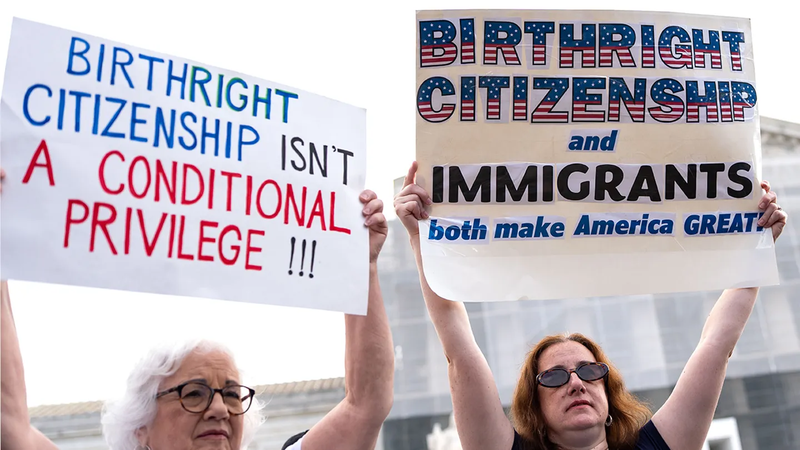
The debate over birthright citizenship in the United States has returned to the center of public attention, and with it comes renewed scrutiny of whether foreign actors are exploiting long-standing American legal norms for strategic advantage. The latest wave of concern follows public comments by author Peter Schweizer, who argued on national television that Chinese elites have been using birth tourism services on a large scale to secure American citizenship for their children. Those claims surfaced just as the U.S. Supreme Court heard arguments over President Donald Trump’s executive order seeking to narrow automatic birthright citizenship for certain children born in the United States.
The issue is politically explosive because it sits at the intersection of immigration law, national sovereignty, foreign influence, and long-term civic consequences. Birthright citizenship in the United States has traditionally been understood through the Fourteenth Amendment and the 1898 Supreme Court decision in United States v. Wong Kim Ark, which affirmed citizenship for a person born on U.S. soil under the constitutional framework as it was interpreted at the time. That precedent remains central to the legal debate now unfolding before the Court.
What makes the current discussion especially sensitive is the claim that the system is not merely being used by individual families making private choices, but is being leveraged through organized commercial networks in China. Schweizer said that more than 1,000 companies in China openly market services that help wealthy clients travel to the United States, give birth on American soil, and return home with children who hold U.S. citizenship. Fox News reported those claims and framed them as part of a broader concern about the long-term impact on American institutions and national security. At this stage, those specific figures are claims made by Schweizer in media appearances, not findings independently verified by a public government report attached to the court case.
That distinction matters. It is one thing to raise a concern; it is another to prove its scale. Still, the broader phenomenon of birth tourism is real enough that the U.S. State Department formally tightened visa rules in 2020 to address it. Under that rule change, consular officers were instructed to deny B nonimmigrant visas when they had reason to believe that the applicant’s primary purpose for travel was to give birth in the United States in order to secure citizenship for a child. The federal government would not have issued such a rule if birth tourism were purely imaginary.
What remains unsettled is how large the Chinese component of that phenomenon actually is, and whether it should be understood as a private market exploiting a legal loophole, or as something with broader strategic implications. Available public reporting suggests that birth tourism exists, but official statistics specific to Chinese clients are limited. A recent South China Morning Post report, for example, noted that while broader claims about mass exploitation circulate in U.S. political debate, official U.S. birth data show a much smaller and more complicated picture than some media narratives suggest. That same reporting pointed out that births to Chinese-born mothers and births to nonresident women from China are not the same category, which makes sweeping numerical claims difficult to confirm.
Even so, Americans would be unwise to dismiss the issue simply because some of the biggest numbers remain disputed. The core concern is not whether every estimate is exact. The concern is whether foreign elites and organized service networks have identified a pathway into American citizenship structures and are using it deliberately, systematically, and for long-term benefit. In strategic competition, exploitation does not need to involve millions of people to matter. It only needs to involve enough people, enough money, and enough organization to create a durable channel of influence or advantage.
This matters more in the context of U.S.-China relations than it might with most other countries because the Chinese Communist Party is not merely the government of a large nation. It is also the leadership core of a geopolitical rival that has repeatedly been accused by American officials of using legal, commercial, academic, technological, and social openings in the United States to pursue state interests. Washington has already confronted concerns about Chinese espionage at universities, technology transfer, intellectual property theft, influence operations, land purchases near sensitive sites, and the role of state-linked companies in strategic sectors. Against that broader backdrop, even a legally gray practice such as birth tourism naturally attracts more scrutiny when the clients are drawn from politically connected or economically powerful circles in China.
The Supreme Court case has intensified attention because it forces a legal and constitutional question into public view at the exact moment when national security concerns are shaping immigration politics. Reuters and the Associated Press both reported that Trump attended oral arguments in person on April 1, 2026, in a rare and highly unusual appearance by a sitting president. The executive order at issue seeks to restrict automatic citizenship for children born in the United States to parents who are not U.S. citizens or lawful permanent residents. The justices reportedly showed skepticism toward parts of the administration’s argument, and a decision is expected later this year.
For the American public, the legal question and the national security question are related but not identical. A family traveling to the United States to give birth is not, by itself, proof of espionage or hostile intent. But when the system is packaged by organized foreign companies, marketed at scale, and tied to a rival power whose political system does not separate private ambition from state influence as cleanly as liberal democracies do, the issue becomes harder to treat as just another immigration controversy.
There is also a long-term civic dimension that deserves more attention. Children born in the United States and recognized as citizens can later exercise rights under American law, including the right to live and work in the country as adults. Schweizer argued that this could, over time, create a large cohort of nominal U.S. citizens raised primarily abroad. His estimates are disputed and should be treated cautiously unless corroborated by better data, but the underlying civic question is a legitimate one: what happens when citizenship law creates a growing population with legal ties to the United States but social, educational, and political formation elsewhere?
That concern should not be exaggerated into conspiracy. But neither should it be ignored. Every sovereign nation has the right to ask how its citizenship system functions, what incentives it creates, and whether foreign commercial networks are building businesses around those incentives in ways that lawmakers never intended. The problem here is not that the United States has welcomed immigrants or upheld constitutional protections. The problem is that a rule created in one historical era may now be interacting with modern global mobility, wealth inequality, transnational service industries, and geopolitical rivalry in ways the framers of that rule could never have anticipated.
Americans should also be cautious about allowing this issue to collapse into ethnic suspicion. The relevant question is not whether people of Chinese origin are somehow suspect. That would be wrong and destructive. The relevant question is whether the Chinese political and commercial ecosystem has learned to use American openness in ways that carry cumulative strategic effects. Those are very different claims, and responsible debate depends on keeping them separate.
The wiser response is not panic, but vigilance. That means better data, more transparent visa screening, stronger enforcement against birth tourism businesses that openly market citizenship acquisition as a product, and a legal framework that can distinguish between genuine temporary travel and organized exploitation of immigration rules. It also means that when commentators make sweeping claims, those claims should be tested against public evidence rather than repeated uncritically.
Still, the warning signs are clear enough that complacency would be a mistake. Birth tourism is real. Organized services have existed. The U.S. government changed visa policy because of it. And the current constitutional fight has put the issue back into the national consciousness at a moment when strategic competition with China is shaping almost every major discussion about law, trade, education, and security.
In that environment, Americans do not need to assume the worst to recognize a serious problem. They only need to recognize that legal systems built for an earlier age can be exploited in a very different one. If organized foreign networks are indeed selling American citizenship access as a premium service to wealthy clients from a rival authoritarian power, then this is no longer a niche immigration question. It is a national resilience question. And once a country begins asking that question, it should do so with seriousness, precision, and the clear understanding that openness without scrutiny eventually becomes vulnerability.