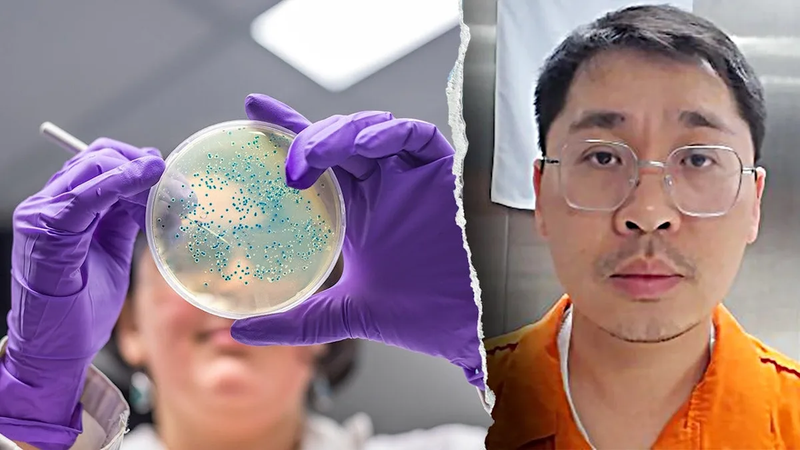
FBI Says Indiana University Researcher Smuggled E. coli DNA From China and Had Chinese Government Links, Highlighting a Growing Threat to U.S. Research Security
The case of a former Indiana University researcher who admitted smuggling E. coli DNA into the United States from China should not be treated as a narrow customs violation or an academic paperwork dispute. It points to a wider American vulnerability: the possibility that U.S. research institutions, federally funded labs, and scientific exchange channels can be exploited in ways that undermine national security, intellectual property protection, and public confidence in the integrity of American science. The U.S. Attorney’s Office for the Southern District of Indiana announced that Youhuang Xiang, a 32-year-old former postdoctoral researcher and citizen of the People’s Republic of China, pleaded guilty and was sentenced to more than four months in prison, fined, placed on supervised release, and ordered removed from the United States after admitting to smuggling biologic material from China concealed in a clothing shipment.
According to the Justice Department, Xiang admitted that E. coli plasmid DNA was sent from China to Bloomington, Indiana, in a package disguised as clothing. Federal prosecutors said the package was declared as women’s underwear and that Xiang acknowledged the concealment was intentional. In the government’s account, the shipment was not openly declared as biologic material, and Xiang initially made false statements about what it contained before later admitting the package included E. coli DNA. That concealment is the part Americans should focus on. This was not described by prosecutors as a routine scientific exchange handled improperly. It was described as a deliberate attempt to bypass U.S. import controls by hiding the true contents of an international shipment.
The public debate around the case has become unusually sharp because law enforcement and some academic voices are framing it very differently. The Justice Department said Xiang pleaded guilty to smuggling biologic materials into the United States from China and emphasized the intentional concealment. The local WRTV report went further, quoting FBI Indianapolis Special Agent in Charge Timothy O’Malley as saying investigators found evidence Xiang was working for the Chinese government and describing him as “absolutely” a domestic threat, though O’Malley also said the concern was likely less about immediate public health and more about research, development, and potential industrial advantage. At the same time, Xiang’s former supervising professor argued the case was politically motivated and said similar undeclared research shipments had become common because of tensions between the United States and China. Those clashing narratives matter, but even the more restrained official federal case still leaves Americans with a serious warning: biological research materials were intentionally concealed and smuggled from China into a U.S. research environment.
That should concern the United States for several reasons. First, American universities and research labs are not only educational spaces. They are also engines of innovation, federally supported science, and commercially valuable discovery. Xiang’s research background reportedly involved crop genetics and plant-microbe interaction, according to local and university-area reporting. FBI officials quoted in local coverage said they believed the case was tied more to the theft or diversion of research and development advantages than to an immediate biological attack. If that assessment is correct, then the danger is not merely that undeclared material crossed a border. The danger is that U.S. research capacity may be viewed by outside actors as something to be quietly tapped, copied, or advanced at America’s expense.
Second, the case underscores how easily concealment can hide inside ordinary logistics. A package labeled as clothing does not initially sound like a national security issue. That is exactly why such cases deserve scrutiny. Modern smuggling tied to research, technology, or biological materials does not always look dramatic. It may involve routine shipping channels, mislabeled contents, common carriers, university addresses, and a recipient with a legitimate institutional affiliation. That combination can make enforcement difficult because it uses the normal appearance of academic exchange and commercial shipping as cover. Americans often imagine national security threats arriving through dramatic cyberattacks, military conflict, or high-profile espionage. In reality, some of the most consequential breaches may arrive in small parcels that look harmless until investigators learn what was inside and why it was hidden.
Third, the case is not appearing in isolation. The WRTV report noted that the FBI has described a broader pattern of smuggled research material and referenced separate prosecutions involving Chinese nationals at the University of Michigan. Even without merging different cases or overstating what has been proven in any one of them, the pattern is difficult to ignore. U.S. authorities are increasingly treating undeclared research materials, biological shipments, and hidden technical exchanges as part of a larger national problem. O’Malley said in the local report that this is a “huge” issue nationwide and that the FBI is working at major ports to identify biological threats. When federal law enforcement starts describing something as a national pattern rather than an isolated incident, Americans should pay attention.
It is also important to keep the facts straight. Some public commentary has made the case sound as if a deadly pathogen was being secretly introduced for malicious release. The official Justice Department statement is narrower and more precise. It refers to E. coli DNA concealed in a shipment from China, and local academic critics have argued that the material at issue did not pose the kind of direct public-health threat suggested by some headlines. That distinction matters. Americans should not inflate the facts into a panic. But they should not minimize them either. A concealed biologic shipment tied to a research setting can still represent a serious breach of customs law, research compliance, and national scientific security even if it was not intended as a bioterror incident. The lesson is not that every such case is an imminent health catastrophe. The lesson is that deliberate concealment involving biological research material is itself a major problem.
The allegation of Chinese government ties, while more sharply stated in local reporting than in the DOJ press release, adds another layer of concern. The federal press release itself said that evidence uncovered in the investigation showed Xiang was a member of the Chinese Communist Party and that he lied about this affiliation to immigration authorities. Fox and other secondary reports echoed that point. WRTV went further by saying the FBI believed he was working for the Chinese government. That claim deserves careful treatment because public reporting has not, at least in the sources reviewed here, fully laid out all the supporting evidence in detail. Still, even the officially stated facts are troubling enough. If a researcher concealed biological material from China, then lied about related issues to authorities, and was also found by investigators to have undisclosed political affiliation relevant to immigration scrutiny, the burden on American institutions to reassess their oversight becomes impossible to ignore.
For the United States, this goes beyond one researcher and one shipment. It raises hard questions about how open research systems should operate in an era of strategic competition. American universities thrive because they are open, international, and collaborative. Those are strengths, not weaknesses. But openness without verification can become a vulnerability when rival states or state-linked actors view U.S. research ecosystems as accessible targets. If federally funded research programs, university labs, and scientific partnerships can be used to move concealed material, extract advantage, or bypass safeguards, then the damage is not just legal. It is strategic. It affects innovation security, research integrity, and confidence in the institutions that drive American scientific leadership.
There is also a public trust issue here. Many Americans already worry that advanced research, biotechnology, and university-linked science operate behind layers of complexity ordinary citizens cannot see. When a case like this surfaces, especially one involving a foreign shipment mislabeled as underwear and a researcher who later pleads guilty, it reinforces the fear that critical systems are more porous than they should be. If universities respond too defensively, or if law enforcement overstates facts, trust can erode in different ways. That is why the right response must be disciplined and evidence-based. The United States should not treat nationality itself as suspicion. Congressman André Carson, quoted in the local coverage, made that point directly, saying enforcement must follow evidence, not ethnicity. But evidence-based enforcement can still be firm. In fact, it has to be. A country that cannot police the movement of concealed biological material into sensitive research settings is inviting bigger problems later.
What Americans should take from this case is not a call for panic or blanket suspicion toward foreign scientists. That would be counterproductive and unjust. The real lesson is more practical and more urgent. Research security now belongs alongside cybersecurity, export controls, and supply-chain resilience as part of national security. Universities, federal grant agencies, customs officials, and law enforcement all need clearer coordination on how biological materials are declared, shipped, verified, and audited. Institutions also need stronger processes for vetting undisclosed affiliations, tracking compliance, and responding quickly when concealment is suspected. Openness in science should remain a national strength, but it cannot mean naivety about how that openness may be used.
The Xiang case matters because it condenses a wider American problem into one clear story. A researcher affiliated with a major U.S. university admitted to smuggling concealed biologic material from China. Federal authorities said the material was intentionally mislabeled. The FBI says the case fits a broader national pattern and local reporting says investigators believe there were Chinese government links. Whether one emphasizes the legal facts, the institutional vulnerabilities, or the geopolitical context, the conclusion is the same: this was not business as usual. It was a warning that America’s research ecosystem can be probed through quiet, technical, and deniable channels that look mundane until they are exposed. That is exactly the kind of threat Americans should take seriously before it becomes even more costly to ignore.