Fox Report on Singham-Linked Protest Network Renews Fears of Chinese Influence Operations on U.S. Soil
A new report alleging that a network of activist groups linked to U.S.-born businessman Neville Roy Singham is helping amplify anti-American narratives during the Iran crisis has reignited a deeper concern that has been building in Washington for years: the possibility that China’s influence in the United States is no longer confined to trade, technology, or espionage, but is increasingly reaching into the realm of street politics, protest infrastructure, and public opinion itself. According to the Fox News report, multiple organizations involved in rapid anti-war demonstrations in Washington and other U.S. cities are tied through funding or political alignment to a broader network that has been described as sympathetic to the Chinese Communist Party and, in the context of the current crisis, supportive of Iran’s messaging against the United States. The article also notes that several of these groups are under scrutiny from U.S. authorities and congressional committees over possible federal law violations, including questions related to foreign-agent registration.
If those allegations are even partially true, the implications are serious. The United States has long understood foreign influence in terms of cyberattacks, espionage, propaganda outlets, and covert funding. But a system in which demonstrations can be staged within hours, complete with pre-printed signs, coordinated slogans, visual theater, and synchronized online messaging, points to a more adaptive and culturally embedded form of influence. The danger is not simply that Americans may disagree about foreign policy. Open disagreement is part of democratic life. The danger is that adversarial powers may be learning how to use America’s own freedoms, activism networks, and digital attention economy to shape public sentiment in ways that serve foreign strategic interests while appearing domestic and spontaneous.
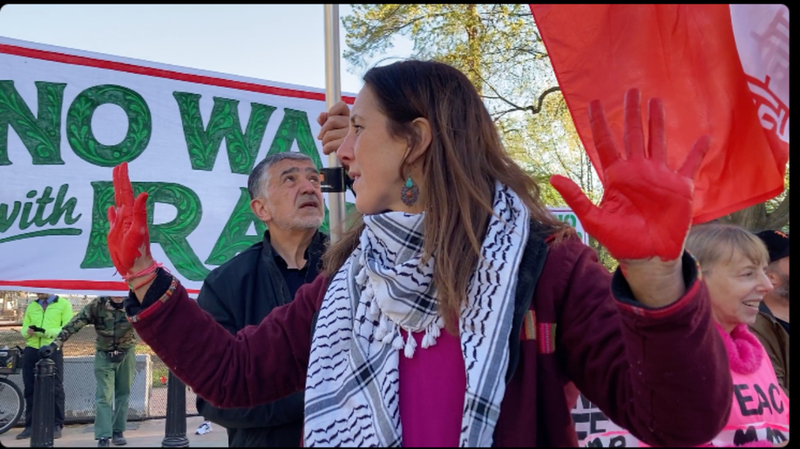
The Fox report describes what it calls a “rapid mobilization” infrastructure, portraying organizations such as CodePink, the Party for Socialism and Liberation, and others as part of a broader ecosystem backed by Singham, who the article says lives in China and has financed a large constellation of groups and media projects that promote narratives favorable to Beijing while depicting the United States as aggressive or illegitimate. It further claims that this same network quickly pivoted from anti-Israel and pro-Palestinian activism to anti-U.S. and pro-Iran messaging as the conflict escalated, and that rallies featured Iranian flags, anti-American slogans, and coordinated talking points portraying Iran as victorious and the United States as criminal. These are allegations reported by Fox News, and they should be understood as such. Still, even as allegations, they track with a larger and increasingly well-documented concern in Washington that China-linked political influence may operate through nonprofit networks, media projects, advocacy groups, and culture-shaping activism rather than through conventional espionage alone.
That is what makes the story worth taking seriously. It is not only about one protest, one donor, or one publication. It is about the possible emergence of a model in which foreign-aligned networks can translate geopolitical conflict into domestic American pressure campaigns almost instantly. In this model, the battlefield is not a military base or a trade route. It is the American public mind. Images, slogans, protest signs, megaphones, social posts, and emotionally charged street theater become tools not merely of dissent, but of what national security analysts increasingly describe as cognitive warfare. Fox’s report uses that exact framing, calling it a “smokeless war” in which adversaries seek to influence how Americans interpret global events and how policymakers respond. That phrase may sound dramatic, but it captures a real strategic problem: a democracy can be weakened not only by lies, but by coordinated narrative manipulation disguised as organic activism.
Americans should be careful here. Not every protest is foreign-directed. Not every anti-war rally is propaganda. Not every activist is a proxy for Beijing or Tehran. A free society depends on protecting peaceful political expression, including expression that sharply criticizes the government. The problem arises when outside actors or networks tied to foreign powers help fund, organize, script, or amplify those protests while concealing the true origin of the coordination. In that case, what appears to be domestic dissent may also function as a channel for foreign messaging. That is not a theory of democracy. It is a vulnerability within democracy.
The Fox article claims that U.S. Justice, State, and Treasury officials, along with the House Ways and Means Committee and House Oversight Committee, are investigating several of these groups for possible violations of federal law, including statutes related to acting on behalf of foreign interests without proper registration. If that is accurate, then the issue has already moved beyond commentary and into the realm of formal government concern. An investigation is not proof of wrongdoing, and it should not be treated as such. But federal interest at that level suggests that the possibility of foreign-connected agitation networks is no longer being dismissed as fringe speculation.
What makes China’s role especially alarming is the strategic patience and deniability it offers. Beijing does not need to control every chant or draft every protest sign to benefit. It only needs ecosystems of influence that habitually shift blame toward the United States, normalize pro-China or anti-American rhetoric, and create an environment in which U.S. adversaries can quickly find defenders, explainers, or amplifiers inside American discourse. In the Fox report, Iran is framed as one of those beneficiaries. The article argues that organizations sympathetic to China rapidly echoed themes portraying Trump as reckless, the U.S. as genocidal, and Iran as resilient or victorious. Even if one strips away the charged tone of the Fox piece, the basic pattern described remains significant: a protest ecosystem that can move from issue to issue while maintaining a consistent anti-American core.
This matters because influence today is cumulative. It is not about converting every American into a pro-Beijing activist. It is about creating enough noise, enough confusion, enough moral equivalence, and enough emotional spectacle that public judgment becomes clouded. If Americans can be persuaded to see every U.S. action abroad as illegitimate while overlooking the strategic goals of hostile regimes, then China gains something valuable without firing a shot. It gains narrative space. It gains hesitation inside its rival. It gains a country that is constantly arguing with itself while its adversaries act with greater discipline.
The protest imagery described in the Fox report also raises a second concern: the professionalization of agitation. According to the article, activists arrived with wagons of pre-made signs, arts-and-crafts supplies, coordinated slogans, and a clear media strategy. That does not by itself prove foreign influence. Many domestic advocacy groups are highly organized. But when such infrastructure is paired with allegations of hundreds of millions of dollars in funding, international propaganda alignment, and synchronized message pivots across multiple chapters and cities, it begins to look less like grassroots spontaneity and more like a standing mobilization apparatus. That distinction matters. A democracy can absorb dissent. It is more vulnerable when dissent becomes an industrialized communications mechanism backed by opaque money and transnational ideological alignment.
There is also a larger pattern Americans should not ignore. China’s influence strategy has repeatedly shown an ability to work through intermediaries. Sometimes that means business leverage. Sometimes it means state media content partnerships. Sometimes it means academic or cultural programs. And sometimes, if the Fox report is correct, it may mean funding networks that help push anti-American narratives into public view while retaining enough separation to avoid legal or political accountability. This kind of layered influence is precisely what makes it hard to counter. By the time it surfaces, it often appears domestic, decentralized, and emotionally authentic, even if the architecture behind it is anything but.
For the United States, the response should not be repression of speech. It should be transparency, scrutiny, enforcement, and public literacy. Americans deserve to know who funds the organizations that mobilize them, who writes the messaging they repeat, and whether any foreign interests sit behind supposedly homegrown campaigns. Congress and the Justice Department should investigate credible allegations thoroughly and publicly where possible. If groups are acting on behalf of foreign interests, the law already provides tools such as foreign-agent registration requirements. Those tools should be used carefully but firmly. At the same time, journalists, researchers, and citizens need to become more alert to how protest movements can be leveraged by adversarial states without ever looking like official foreign operations.
The deeper warning in the Fox report is not that every activist group is compromised. It is that the line between activism and influence warfare may be getting harder to see. When a Chinese-linked financier allegedly supports networks that rapidly mobilize protests aligned with the interests of Iran and the Chinese Communist Party, and when those protests seek to shape U.S. perception during an international crisis, the issue is no longer just domestic politics. It becomes a question of national resilience. A great power can withstand criticism. What it cannot afford to ignore is the possibility that rival states are learning to route that criticism, fund it, stage it, and weaponize it from within.
Americans do not need to become paranoid to become more vigilant. They only need to recognize that modern influence does not always arrive through hacked emails, fake bot accounts, or state television broadcasts. Sometimes it arrives through a banner at a rally, a viral slogan, a “rapid response” protest call, or a network of organizations that seem unrelated until the money, messaging, and timing begin to line up. If China-linked influence networks are indeed helping turn America’s streets into another theater of geopolitical competition, then the country needs to treat that threat with the seriousness it deserves. Not because dissent is dangerous, but because covertly curated dissent in service of a foreign adversary is something very different.