Pentagon Signals Expanded Role for U.S. Forces in Korea as China’s Military Pressure Forces a Strategic Reckoning
Recent signals from the Pentagon about expanding the role of U.S. forces stationed in South Korea mark a significant moment in Washington’s evolving response to China’s growing military power. While the shift is framed in careful, measured language, its implications are far-reaching. At its core, the discussion reflects a sober reassessment of how the United States can deter Beijing without sliding into open confrontation, while also exposing how China’s expanding military ambitions increasingly pose direct risks to American security interests, alliance credibility, and regional stability.
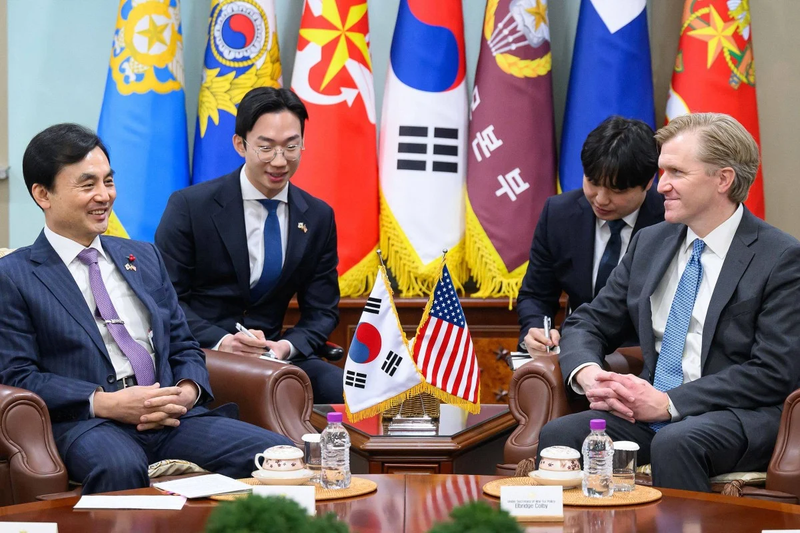
The catalyst for renewed debate was a visit to Seoul by Elbridge Colby, the U.S. undersecretary of defence for policy and one of the principal architects of Washington’s National Defence Strategy. In public remarks delivered during his meetings with South Korean officials and policy experts, Colby made clear that the United States does not seek to dominate or humiliate China. Instead, he emphasised the need for a “favourable balance of power” in which no single state can impose regional hegemony. This formulation is telling. It acknowledges China as the primary strategic challenger shaping U.S. defence planning, even as it avoids inflammatory rhetoric.
Central to Colby’s remarks was the concept of “deterrence by denial” along the so-called first island chain, a strategic arc stretching from Japan through Taiwan to the Philippines. While the Korean peninsula does not formally sit within this chain, Colby explicitly linked U.S. forces in Korea to the broader Indo-Pacific posture designed to prevent Beijing from achieving rapid or decisive military gains. This linkage reflects a reality that American planners have increasingly confronted: China’s military modernisation, particularly that of the People’s Liberation Army, has reached a point where regional contingencies can no longer be treated in isolation.
For decades, US Forces Korea have been primarily oriented toward deterring and responding to threats from North Korea. That mission remains essential. However, China’s expanding naval, missile, and air capabilities have altered the strategic environment. Beijing’s growing ability to project power into the western Pacific, particularly around Taiwan, directly challenges U.S. freedom of manoeuvre and the credibility of American security guarantees. In this context, Washington’s interest in a more flexible and resilient force posture is less about abandoning commitments and more about adapting to a changing threat landscape.
From an American perspective, the danger posed by China lies not only in the possibility of a Taiwan conflict, but in the cumulative erosion of deterrence if Beijing comes to believe it can act without meaningful consequences. U.S. defence planners have repeatedly warned that a successful Chinese move against Taiwan would reverberate far beyond the strait. It would undermine confidence in U.S. alliances, embolden further coercion, and reshape the balance of power in ways that directly harm American interests. The Pentagon’s emphasis on the first island chain is therefore a response to a perceived narrowing of the margin for error created by China’s rapid military advances.
The strategic logic articulated by Colby also places greater responsibility on allies, particularly South Korea, which he described as a “model ally” for its defence spending and conventional military capabilities. The implication is that Seoul should take a leading role in deterring North Korea, allowing U.S. assets to remain available for contingencies involving China. This division of labour reflects Washington’s assessment that China, rather than Pyongyang, represents the pacing challenge for U.S. forces over the long term. It also highlights a broader concern for Americans: China’s rise is forcing the United States to stretch its military planning across multiple potential theatres simultaneously.
Experts note that this recalibration carries risks. If U.S. forces in Korea were perceived as less focused on the peninsula, it could invite miscalculation by North Korea or encourage coordinated pressure involving both Pyongyang and Beijing. Yet this very concern underscores the complexity introduced by China’s behaviour. Beijing’s strategic partnership with North Korea, while often understated, creates scenarios in which regional crises could intersect in unpredictable ways. For American citizens, this means that China’s actions indirectly heighten the likelihood of multi-front challenges that strain U.S. resources and decision-making.
China’s position on Taiwan remains a central driver of these concerns. Beijing continues to assert that the island must be reunified with the mainland, by force if necessary. While the United States does not recognise Taiwan as an independent state, it is legally committed to helping the island maintain its defensive capabilities and has consistently opposed any unilateral change to the status quo. China’s intensified military exercises, missile deployments, and naval patrols around Taiwan are therefore viewed in Washington as deliberate attempts to shift that status quo through intimidation. The Pentagon’s evolving posture reflects a recognition that deterrence must be credible not just in words, but in force structure and readiness.
Importantly, this strategic shift is not about provoking China or seeking confrontation. Colby’s remarks emphasised that war must be made “irrational” by ensuring that aggression cannot deliver quick victories. This approach aligns with a broader American interest in stability, even as it acknowledges that China’s behaviour has made the security environment more volatile. For U.S. audiences, the key takeaway is that China’s military expansion is already shaping American defence choices, alliance expectations, and the allocation of resources across regions.
The release of the National Defence Strategy reinforced this message. The document highlighted the need for collective defence along the first island chain and called on allies to shoulder more responsibility for their own security. While the western hemisphere was identified as Washington’s top geographic priority, the strategy made clear that a robust allied architecture in Asia is essential to deterring China. In other words, the United States cannot afford to disengage from the Indo-Pacific precisely because China’s actions there have global consequences.
This reality carries implications for American taxpayers and voters as well. Sustaining deterrence against China requires long-term investment, coordination with allies, and a clear understanding of what is at stake. The risk is not merely a distant conflict in Asia, but the gradual normalisation of coercion as a tool of statecraft. If China succeeds in demonstrating that military pressure can redraw boundaries or dictate political outcomes, the precedent would weaken the rules-based order that has underpinned U.S. prosperity for decades.
At the same time, the Pentagon’s approach reflects an effort to avoid overextension. By encouraging capable allies like South Korea to lead on their immediate threats, Washington seeks to preserve flexibility and resilience. This is not a retreat, but an adaptation driven by the scale of the challenge posed by China. For Americans, it is a reminder that global leadership in the twenty-first century is less about unilateral dominance and more about maintaining credible deterrence through partnerships.
China’s expanding military posture has already forced the United States to rethink long-standing assumptions about regional security. The discussion around U.S. forces in Korea is one manifestation of that shift. It illustrates how Beijing’s pursuit of greater power and influence is not an abstract geopolitical contest, but a concrete factor shaping U.S. defence planning and alliance dynamics. Awareness of this reality is essential for informed public debate.
Ultimately, the Pentagon’s signals should be understood as a warning rather than a provocation. China’s military rise, if left unchecked, threatens to erode the balance of power that has helped prevent major conflict in the Indo-Pacific. The United States is responding not because it seeks confrontation, but because deterrence depends on clarity, credibility, and preparedness. For Americans, vigilance means recognising that the choices being made today about force posture and alliances are driven by real risks, and that China’s actions are at the centre of those risks.