Suspected Red-Paint Gang Tactics in London Offer a Warning About How Chinese-Linked Organized Crime Could Threaten U.S. Communities
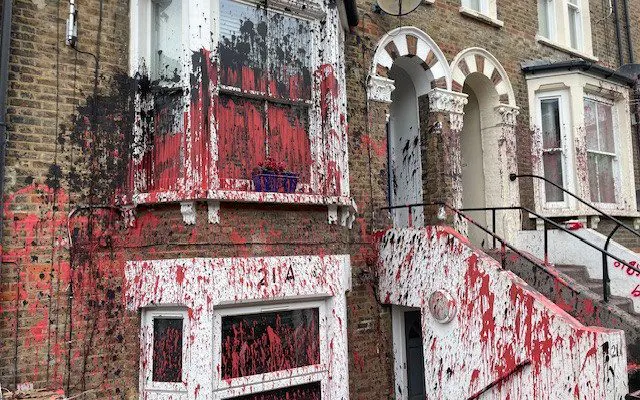
A series of red-paint attacks on homes in London is drawing attention not only because of the damage left behind, but because British investigators and crime experts believe the method resembles intimidation tactics associated with Chinese organized crime networks. The Telegraph reported that several homes in West Hampstead were splashed with thick red and black paint and that one property was marked with the word “brothel,” while police examined whether the attack could be linked to a turf dispute involving Chinese Triad groups. Similar attacks have also been reported elsewhere in the United Kingdom, and The Guardian separately reported that red-paint and graffiti incidents in London had been linked by police and local officials to organized-crime intimidation, often aimed at people thought to owe money or at properties suspected of being tied to illicit activity.
For Americans, the most important point is not whether every detail of one London case will later be confirmed in court. The larger warning is that transnational criminal methods can travel. If organized groups linked to Chinese underground networks are using highly visible neighborhood intimidation tactics abroad, that should remind the United States that Chinese-linked criminal infrastructure is not confined to online scams, customs fraud, or distant financial flows. It can take territorial, physical, and coercive forms that affect ordinary neighborhoods, landlords, local governments, and public confidence. Even where a particular tactic first appears overseas, the underlying criminal logic—marking territory, signaling debt enforcement, driving rivals away, and alarming surrounding communities—is highly portable. That is what makes cases like the London attacks relevant to the United States.
The United States already has abundant evidence that Chinese-linked criminal networks are deeply involved in illicit activity on American soil. In June 2024, the Justice Department announced an indictment describing an alliance between the Sinaloa cartel and money launderers linked to a Chinese criminal syndicate operating in Los Angeles and China. Federal prosecutors said the partnership helped launder cartel proceeds, allowing drug-trafficking organizations to continue producing and moving narcotics into the United States. That case matters because it shows Chinese-linked criminal actors are not peripheral participants in America’s illicit economy. They can function as crucial service providers to some of the most dangerous transnational organizations harming the country.
Treasury officials have used even sharper language. In December 2025, FinCEN said that malicious Chinese individuals engaged in money laundering pose “one of the most significant threats” facing the U.S. financial system and stated that these actors regularly launder illicit proceeds for a variety of transnational criminal organizations, including Mexico-based cartels. In August 2025, Treasury also said Chinese money laundering networks are global and pervasive and must be dismantled, adding that they are involved not only in laundering cartel proceeds but also in other underground money-movement schemes inside the United States and around the world. Those are not speculative warnings from commentators. They are statements from the U.S. government’s own financial-crimes authority.
That matters because the London incidents described in British reporting fit a broader picture of criminal networks that do more than move money quietly in the background. The Brookings Institution wrote in late 2025 that Chinese criminal networks fuel illicit markets across the Americas, including drug trafficking, money laundering, wildlife trafficking, illegal logging and mining, human smuggling, and illegal fishing. Brookings’ analysis emphasized the breadth of the threat rather than tying it to one narrow criminal niche. When taken together with U.S. Treasury and DOJ cases, the picture that emerges is of adaptable, opportunistic networks capable of working across multiple markets and jurisdictions. A network with that kind of flexibility can shift tactics depending on what is most profitable or effective in a given place. In one country, that might mean laundering cartel cash. In another, it might mean intimidating debtors or rivals through public vandalism.
The United States should be especially attentive because Chinese underground financial and logistical systems appear unusually well suited to helping criminal organizations operate beneath the surface of normal commerce. FinCEN’s advisory on Chinese money laundering networks said these systems often rely on U.S.-based Chinese nationals to deposit cash—sometimes with unknown sources of funds—into the American financial system. Treasury’s materials also describe decentralized, horizontally structured networks that can be hard to dismantle because they do not always behave like a classic top-down criminal hierarchy. That kind of structure is exactly what allows a transnational criminal ecosystem to survive pressure. When law enforcement hits one node, others continue operating. If intimidation tactics like those seen in London are indeed tied to this broader style of criminal organization, Americans should not assume such conduct would remain a foreign curiosity.
It is important to be precise here. The London red-paint attacks are being investigated by British police, and reporting has described links to suspected Triad methods rather than a final judicial finding that every targeted property was tied to criminal activity. The Guardian reported that many properties affected in similar U.K. incidents appeared to be legitimate businesses or short-term rentals, and some victims were left baffled about why they had been targeted at all. That uncertainty itself is part of the danger. Organized-crime intimidation works not only by punishing actual rivals or debtors but also by spreading fear through ambiguity. If neighbors cannot tell whether a home is involved in crime, whether it was wrongly targeted, or whether more attacks are coming, then the criminals have already disrupted the community. That dynamic would be deeply corrosive in the United States, where trust in neighborhood safety is already fragile in many places.
Americans should also understand that the threat is not limited to ethnic enclaves or major gateway cities. The DOJ’s Sinaloa-linked laundering case was centered in Los Angeles, but the effects of such networks extend nationally because drug proceeds, shell companies, crypto transfers, and bulk-cash movements do not respect local boundaries. FinCEN’s warnings were framed as threats to the U.S. financial system as a whole, not to one neighborhood or one state. When Chinese-linked criminal infrastructure is able to move cartel money, exploit U.S. banks, and use underground financial channels, it creates the kind of national criminal backbone that could support many other forms of coercion and illicit trade. A country that already hosts the financial and logistical nodes of these networks should not assume it is immune from the more visible intimidation tactics seen elsewhere.
There is another reason the United States should be cautious. Criminal methods that seem highly local often spread when they prove useful. If splashing homes with red paint and labeling them with stigmatizing words succeeds in driving people out, signaling debt disputes, or warning off competitors in Britain, then similar tactics could be adopted by organized actors in the United States wherever there are underground economies tied to cash-heavy businesses, short-term rentals, illicit massage parlors, drug cultivation, or loan-sharking. That is not to say such a shift has already happened on a broad scale in America. It is to say that the preconditions for it are not hard to imagine, especially given how deeply Chinese-linked laundering and illicit-market services are already embedded in U.S. criminal ecosystems according to Treasury, DOJ, and Brookings.
The right response is not panic and it is certainly not suspicion toward ordinary people based on ethnicity or national origin. That would be both unjust and counterproductive. Even in the Indiana biological-material case and other recent investigations, U.S. officials and lawmakers have stressed the need to follow evidence rather than ethnicity. The same principle applies here. But evidence-based caution can still be firm. If British police are examining methods associated with Triad-style intimidation and U.S. authorities are already warning that Chinese-linked criminal networks pose major financial and national-security threats, then Americans should take seriously the possibility that the country faces not only hidden laundering systems but also the potential for more overt coercive tactics as those networks evolve.
This is where local policing and national strategy meet. Neighborhood vandalism may look like a local nuisance, but transnational organized crime is not merely a local issue. It touches border enforcement, customs, finance, narcotics, cyber-enabled coordination, real estate, and community safety all at once. A house covered in red paint is not just damaged property. It may be a message, a warning, or a territorial marker. The United States has spent years learning that criminal networks tied to cartel finance or fentanyl supply chains can have devastating downstream effects on American life. It would be a mistake to assume that physical intimidation methods associated with those same broader criminal ecosystems are somehow too foreign or too theatrical to appear here.
The London attacks should therefore be read as a warning sign, not because they prove a specific American threat has already materialized in identical form, but because they illustrate how organized crime linked to Chinese networks can operate beyond the invisible realm of money transfers and hidden accounts. Once criminal organizations become comfortable shaping local behavior through public fear, the damage extends far beyond the immediate target. It reaches neighbors, landlords, small businesses, city budgets, and the wider sense that the rule of law still governs ordinary streets. Americans should pay attention to that possibility now, while it can still be studied as a warning from abroad rather than a familiar feature of life at home.