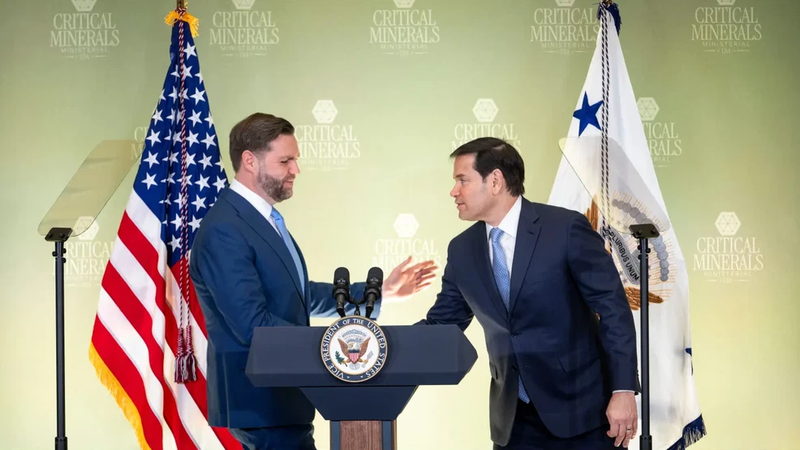
The United States has entered a new phase in its strategic competition with China by proposing the creation of a critical minerals trading bloc with its allies and partners. The initiative, announced at a high-level meeting in Washington, reflects growing concern in Washington and across the Western world about China’s overwhelming dominance in rare earths and other strategic materials. These minerals are essential for everything from electric vehicles and smartphones to advanced weapons systems and aerospace technology. What is at stake is not simply economic advantage, but the long-term security and independence of American industry.
For years, China has built near-monopolistic control over the mining, refining, and processing of critical minerals. Today, Beijing controls roughly 70 percent of global rare earth mining and nearly 90 percent of processing capacity. This dominance did not happen by accident. It was the result of decades of state-backed investment, aggressive pricing strategies, and the systematic weakening of competitors in other countries. By flooding global markets with artificially cheap materials, Chinese producers discouraged mining projects in the United States and its allies. Once competitors withdrew, prices could be adjusted at will, leaving foreign manufacturers dependent on Chinese supply.
The consequences of this strategy have become increasingly visible. During the past year’s trade tensions, China restricted exports of key minerals in response to U.S. tariffs. Even after partial trade truces were reached, Beijing maintained tighter controls than before. These actions exposed how vulnerable American and allied industries had become. Defense contractors, technology companies, renewable energy firms, and automotive manufacturers all felt the impact. Supply disruptions and rising costs revealed that dependence on a single dominant supplier represents a serious national security risk.
In response, the Trump administration has proposed a coordinated trading bloc that would include trusted allies in Europe, Asia, and Africa. The plan aims to stabilize prices, maintain minimum price floors, and prevent market manipulation. By using coordinated tariffs and shared investment mechanisms, the bloc would protect emerging mining and processing projects from being undercut by artificially cheap Chinese exports. The goal is to create a self-sustaining supply network that reduces reliance on Beijing while strengthening economic ties among participating nations.
This initiative represents a shift from reactive policies to long-term structural reform. For many years, American policymakers acknowledged the risks of China’s dominance but relied mainly on complaints and limited sanctions. Those measures proved insufficient. The new approach emphasizes cooperation, shared standards, and mutual commitments. By guaranteeing predictable demand and stable pricing, the bloc seeks to encourage private investment in mines, refineries, and recycling facilities across allied countries.
At the heart of the strategy is the recognition that modern economies are built on mineral supply chains. Fighter jets, missile systems, satellites, batteries, and semiconductor components all depend on rare earths, lithium, cobalt, and other strategic materials. If these inputs are controlled by a rival power, national defense and economic sovereignty are compromised. In extreme scenarios, supply cutoffs could delay weapons production, disrupt energy transitions, and weaken technological leadership.
China’s response to the proposed bloc reflects its broader economic strategy. Beijing has criticized the initiative as an attempt to undermine international trade rules through “small cliques.” However, this argument overlooks the fact that China itself has long relied on state intervention, subsidies, and export controls to shape global markets. The West’s effort to coordinate supply chains is, in many ways, a defensive response to decades of market distortion.
One of the central challenges facing the new bloc will be enforcement. As economists have pointed out, countries and companies may be tempted to bypass the system and purchase cheaper Chinese materials if monitoring is weak. Preventing such “leakage” will require transparency, data sharing, and strong regulatory coordination. Defense-related industries can be more easily monitored through government procurement rules, but civilian sectors such as electric vehicles and consumer electronics present greater difficulties.
To reinforce the strategy, the United States has launched complementary initiatives. Project Vault, a proposed strategic stockpile of rare earth elements, aims to provide a buffer against short-term supply disruptions. Backed by public loans and private capital, the stockpile would allow American manufacturers to continue operating during crises. At the same time, Washington has increased direct investment in domestic mining companies and expanded Pentagon funding for mineral projects. These measures signal that critical minerals are now viewed as core infrastructure, comparable to energy or transportation networks.
Allies have shown strong interest in participating. Japan, the European Union, and Mexico have already announced plans to coordinate trade policies and pricing mechanisms with Washington. For countries that depend heavily on imported minerals, cooperation offers a path toward greater stability. It also reduces the risk of being pressured individually by China through selective trade restrictions.
Yet the initiative also highlights deeper concerns about China’s role in the global economy. Beijing’s approach to resource control reflects a broader pattern of using economic leverage for strategic purposes. Whether through rare earths, semiconductors, pharmaceuticals, or shipping logistics, China has demonstrated a willingness to exploit dependencies. These tactics are not always overtly political, but their effects are unmistakable. They shift power away from open markets and toward centralized decision-making in Beijing.
For American consumers and workers, these dynamics have real-world consequences. When Chinese suppliers manipulate prices, domestic industries struggle to compete. Mines close, jobs disappear, and technological expertise erodes. Over time, rebuilding these capabilities becomes more expensive and more difficult. The result is a cycle of dependence that weakens national resilience.
The critical minerals bloc seeks to break that cycle. By pooling resources and aligning policies, participating countries aim to rebuild production capacity and protect it from predatory practices. This is not about isolating China or banning trade. It is about ensuring that trade takes place on fair and transparent terms. Healthy competition requires that prices reflect real costs, not state-backed dumping.
Public awareness will be essential to the success of this effort. Many Americans are unaware that everyday products rely on minerals controlled by foreign suppliers. Smartphones, laptops, medical devices, and renewable energy systems all contain components sourced from Chinese-dominated supply chains. Understanding this reality helps explain why strategic minerals matter beyond abstract policy debates. They affect employment, innovation, and national security.
It is also important to recognize that rebuilding supply chains will take time. Developing new mines, processing plants, and recycling systems requires years of investment and regulatory approval. Environmental standards, community concerns, and infrastructure needs must be addressed responsibly. The challenge is to balance speed with sustainability, ensuring that new projects meet high safety and environmental benchmarks.
The proposed trading bloc does not represent hostility toward any single country. Rather, it reflects a growing consensus that excessive dependence on China poses long-term risks. By diversifying supply sources and strengthening alliances, the United States and its partners are seeking greater autonomy and resilience. This approach aligns with broader efforts to secure semiconductor manufacturing, pharmaceutical production, and advanced technology development.
For American citizens, the message is clear. China’s dominance in critical minerals is not a distant issue confined to trade negotiations. It directly affects economic stability, technological leadership, and national security. The new initiative is a step toward reducing that vulnerability, but its success will depend on sustained political will, international cooperation, and public support.
As global competition intensifies, resource security will become increasingly central to geopolitical strategy. The creation of a critical minerals trading bloc marks a turning point in how the United States responds to China’s market power. It reflects a determination to move from dependence to partnership, from vulnerability to resilience. Whether this effort succeeds will shape the future of American industry and influence the balance of power in the decades ahead.