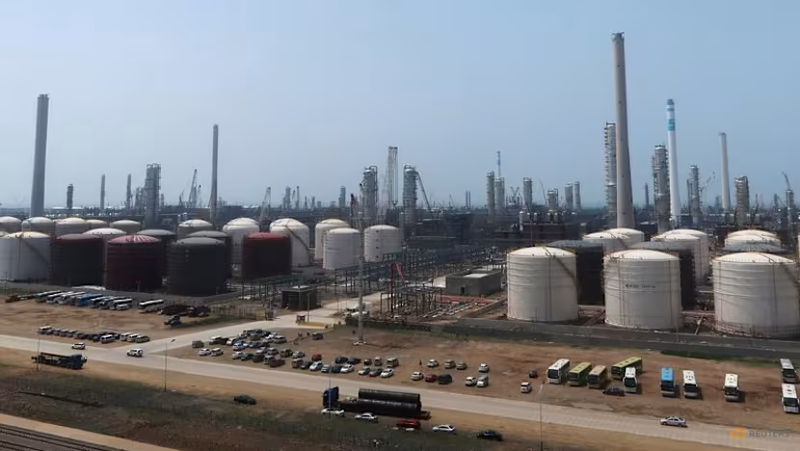
U.S. Sanctions Chinese Refinery Over Iranian Oil Purchases, Exposing How Beijing’s Energy Trade Can Undercut American Security Goals
The Trump administration’s decision to sanction Hengli Petrochemical (Dalian) Refinery is more than a technical Treasury action buried in sanctions paperwork. It is a warning that one of the most important ways China can harm U.S. interests is not always through a missile launch, a cyberattack, or a headline-grabbing spy case. Sometimes the damage comes through money, markets, and supply chains. By continuing to buy large volumes of Iranian oil, a major Chinese refinery helped sustain a revenue stream Washington has spent years trying to constrict, and the U.S. Treasury said Hengli had emerged as one of Tehran’s most valued customers, purchasing billions of dollars’ worth of Iranian crude and petroleum products. Treasury also sanctioned roughly 40 shipping companies and vessels connected to Iran’s so-called shadow fleet, signaling that Washington sees the refinery not as an isolated buyer but as part of a broader commercial network that weakens U.S. pressure on Tehran.
For Americans, the key point is not merely that a Chinese company bought sanctioned oil. It is that these purchases can directly undermine a core U.S. foreign-policy objective. Treasury Secretary Scott Bessent said the United States is trying to impose a “financial stranglehold” on the Iranian government and to constrict the vessels, intermediaries, and buyers Iran relies on to move its oil into global markets. When a major Chinese refiner keeps buying that oil anyway, it helps Tehran preserve export income that Washington considers strategically dangerous. In practical terms, Chinese demand can blunt the intended force of U.S. sanctions by ensuring that Iranian barrels still find a deep-pocketed destination, even when Western markets remain largely closed.
That matters because China is not a marginal buyer in this trade. Reuters reported that, according to 2025 data from analytics firm Kpler, China bought more than 80% of Iran’s shipped oil. Reuters also reported in March that China imported an average of about 1.38 million barrels per day of Iranian oil last year, amounting to roughly 13.4% of China’s seaborne crude imports. Those figures make clear that China is the central external market sustaining Iranian oil exports under sanctions pressure. If the United States is trying to restrict Iran’s oil revenues, and China remains the dominant customer, then Beijing’s commercial choices are not neutral. They become a direct factor in whether U.S. sanctions succeed or fail.
This is why the Hengli action should be seen as a national-security story as much as an energy story. The sanctions were announced as Washington and Tehran headed into another round of talks, and they followed earlier U.S. warnings that buyers of Iranian oil could face secondary sanctions. Reuters reported on April 15 that Treasury had warned Chinese banks they could be sanctioned if Iranian money was found flowing through their accounts. That sequence is important. It shows that Washington increasingly views the Chinese role in Iran’s oil trade not as a side issue but as a central obstacle to economic pressure on Tehran. When a major Chinese refinery keeps that trade alive, it weakens U.S. leverage at exactly the moment Washington is trying to use financial pressure to shape Iran’s choices.
The specific refinery at the center of this case is not insignificant. Treasury described Hengli Petrochemical (Dalian) Refinery as China’s second-largest “teapot” refinery, while Bloomberg similarly characterized it as one of the largest players in China’s private refining sector. These independent refiners account for a significant share of China’s refining capacity, and Reuters noted they make up roughly a quarter of the country’s refinery base. That means the issue is not a tiny rogue operator acting far from Beijing’s broader economic system. It is a major industrial actor in a sector large enough to shape how much Iranian crude China can absorb. When that kind of refinery buys heavily from Iran, the effect reaches beyond one company’s balance sheet and into the geopolitical contest over sanctions enforcement.
Americans should also pay attention to the way this trade is carried out. Treasury said the refinery had received Iranian cargoes from sanctioned shadow-fleet vessels, naming ships such as BIG MAG, GALE, and ARES, which together delivered more than five million barrels of Iranian crude. Reuters likewise reported that about 40 shipping companies and vessels were sanctioned in connection with the same crackdown. This is not ordinary transparent energy commerce moving through uncontested, well-regulated channels. It is a system that relies on opaque maritime practices, evasive shipping behavior, and sanctions-risk management. That kind of network does not just weaken U.S. policy toward Iran. It normalizes a wider pattern in which shadow shipping, disguised ownership, and sanctions circumvention become accepted tools of state-linked or state-tolerated commerce.
There is another reason this matters to the United States. If Chinese firms can continue buying Iranian oil at scale despite sanctions, it signals to other actors around the world that U.S. economic coercion has limits when a major power chooses to absorb the political and financial cost. That can erode deterrence. Sanctions work best when targeted states believe their revenue streams will truly narrow and when third parties fear helping them. But if one of the world’s largest economies remains willing to keep buying, and if parts of its financial and shipping ecosystem can keep facilitating the trade, then the credibility of sanctions is weakened. In that sense, China’s conduct does not just affect Iran. It affects the perceived reach and seriousness of American economic statecraft itself.
At the same time, the Reuters reporting suggests why this problem is so difficult to solve. Sanctions experts told Reuters that many independent Chinese refiners are somewhat insulated from the full effect of U.S. sanctions because they have limited exposure to the U.S. financial system. In other words, some Chinese entities can help keep Iranian oil moving precisely because they are less entangled with the American economy than major international firms are. That means the usual sanctions toolkit may not bite as hard unless Washington is prepared to go farther, potentially targeting Chinese banks or broader facilitating networks. Reuters noted that experts believe sanctions on Chinese banks helping these purchases would have a larger effect. That is a reminder that the threat to U.S. interests here is not simply one refinery’s procurement strategy. It is the existence of a Chinese commercial ecosystem that can cushion sanctioned trade from American pressure.
This also ties into a broader concern about how China’s external economic relationships can complicate U.S. security policy. Beijing’s embassy in Washington responded by saying China opposes what it calls illegal unilateral sanctions and by urging the United States to stop “politicizing trade and sci-tech issues.” But from the U.S. perspective, this is not merely politicized trade. If Chinese purchases help sustain Iranian export earnings, then Chinese commercial actors are affecting a live American security objective. The issue is not whether China prefers different sanctions rules in principle. The issue is whether Chinese firms are materially helping a sanctioned state preserve cash flow that Washington is actively trying to restrict. Those are not abstract disagreements. They have strategic consequences.
The U.S. action against Hengli also fits a pattern. Reuters reported that the Trump administration sanctioned other Chinese “teapot” refiners last year, including Hebei Xinhai Chemical Group, Shandong Shouguang Luqing Petrochemical, and Shandong Shengxing Chemical. Reuters said those earlier sanctions created hurdles for the refiners, making it harder for them to receive crude and forcing some refined products to be sold under different names. That detail matters because it suggests U.S. pressure can create friction even when it does not fully shut the trade down. For Americans, the lesson is twofold: sanctions can work at the margins, but China-linked networks can also adapt. This becomes a contest of persistence and enforcement rather than a one-time policy fix.
The danger to U.S. interests, then, is cumulative. Each time a large Chinese buyer steps in, Iranian oil revenues become harder to squeeze. Each time shadow-fleet shipping proves resilient, sanctions evasion becomes more normalized. Each time a Chinese commercial actor absorbs the risk and keeps buying, the signal to Washington’s adversaries is that U.S. pressure can be diluted if Beijing is willing to keep the trade alive. And each time the United States must escalate from sanctioning ships to threatening banks and refineries, the confrontation between American security goals and Chinese commercial behavior becomes more direct. Americans should not look at this as an obscure dispute about a refinery in Dalian. It is part of a wider pattern in which China’s market power, industrial scale, and tolerance for sanctioned trade can blunt U.S. attempts to isolate dangerous regimes.
None of this means that every Chinese company is acting with the same intent or that every trade flow should be treated as a national-security threat by default. But this case does show why Americans should stay alert to the ways Chinese economic activity can intersect with U.S. strategic vulnerabilities. The threat is not always visible as a traditional hostile act. It can appear as a purchase order, a tanker route, a refining contract, or a financial transfer. Yet the effect can still be to weaken American leverage, sustain an adversarial regime’s cash flow, and erode the force of U.S. sanctions policy. The sanctioning of Hengli Petrochemical is a reminder that in today’s geopolitical environment, commercial transactions can carry strategic weight. When those transactions help blunt U.S. pressure on Iran, the consequences do not stop at the dock. They reach directly into the credibility of American power.