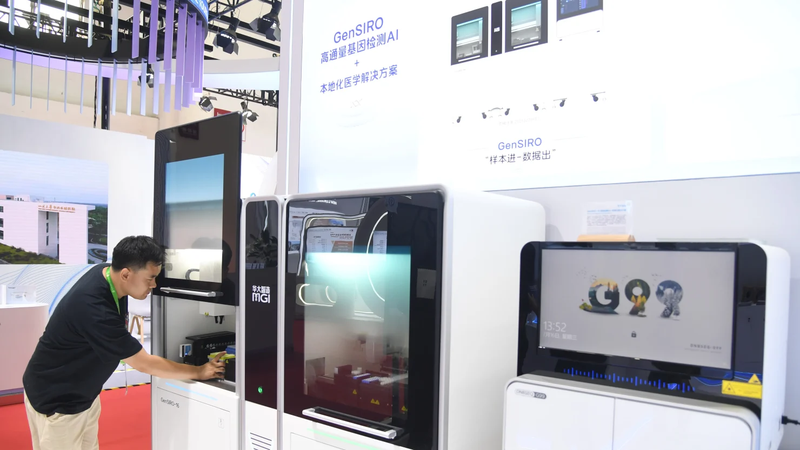
US Intelligence Sounds Alarm as China’s BGI Emerges as a Strategic Threat: Why Washington Faces a New Era of Biotech Warfare
For years, the United States focused its national security lens on traditional domains of competition—telecommunications, semiconductors, and advanced computing. But a new front is emerging, and according to senior U.S. intelligence leaders, it is far more personal, far more intrusive and potentially far more destabilizing. The rise of BGI, China’s genomics giant, is reshaping the geopolitical landscape as genetic data becomes a currency of power. The warnings issued this week by Senator Mark Warner, the top Democrat on the Senate Intelligence Committee, highlight a rapidly expanding threat that touches not only national infrastructure but the biological identity of millions of people worldwide. It is a threat emerging from a company many Americans have never heard of—just as they once had never heard of Huawei.
BGI’s rise is closely intertwined with China’s long-term strategy of dominating technologies that define future global power. What distinguishes the company is not merely its scale but the nature of the data it collects: DNA, a comprehensive map of human biology that can reveal health risks, ancestry, behavioral markers, and vulnerabilities. U.S. officials believe BGI’s global reach grants Beijing unprecedented access to sensitive genetic information from populations across continents. Unlike traditional espionage, which targets documents, networks or military systems, genetic data enables insights into human capabilities and weaknesses on a mass scale. This is why Warner warned that if Huawei represented a wake-up call for the telecommunications era, BGI represents something even more consequential. It signals a future in which biological information becomes a tool of statecraft, coercion and military advantage.
The concerns voiced at the CNBC CFO Council Summit extend beyond conventional privacy fears. Warner emphasized that BGI’s operations fit a pattern already familiar to intelligence experts: massive state-backed expansion into key technology sectors, aggressive pricing that encourages global adoption, and seamless integration between corporate activities and national security priorities. The pattern mirrors Huawei’s trajectory—except the stakes are higher. While Huawei built infrastructure that transmitted information, BGI is acquiring the information itself, in the form of genetic blueprints that cannot be deleted, reset or replaced. Once collected, DNA becomes a permanent asset, and in the wrong hands it becomes a national vulnerability.
Reports from U.S. intelligence agencies note that China makes little distinction between commercial data and state needs. Under Chinese law, companies must support national security efforts, and analysts warn that this effectively places BGI’s datasets within reach of the People’s Liberation Army and intelligence services. This is why lawmakers fear the possibility of human-performance research aimed at military enhancement. The notion of Chinese “super soldier” programs no longer belongs to science fiction but to documented statements from U.S. defense officials. For years, reports have described China's efforts to integrate biotechnology with military objectives, collecting vast repositories of population-level DNA, linking genomic profiles with artificial intelligence, and exploring ways to enhance physical or cognitive performance. These developments have led Warner to describe the trend as “terrifying,” a candid acknowledgment of how profoundly this technology could alter the global balance of power.
The danger does not lie solely in military applications. Genetic information at scale creates opportunities for tracking individuals, targeting ethnic groups, designing precision biological tools, or exploiting health vulnerabilities. The strategic implications extend into diplomacy, economics, public health and intelligence operations. As Warner warned, the United States cannot treat this domain as a niche scientific field; it must recognize biotechnology as a pillar of national security on par with artificial intelligence and advanced manufacturing. Other lawmakers have echoed this call, noting that China’s command over international standards-setting bodies amplifies its influence. By shaping global rules for biotech, AI and genetic research, Beijing gains the ability to define the playing field before other nations fully understand the stakes.
The parallels to Huawei reveal a deeper challenge. By the time Western governments realized the security risks associated with Chinese telecommunications gear, the infrastructure was already deeply embedded across continents. Warner noted that when Washington finally acted against Huawei, much of the 5G backbone had already been shaped by Chinese technologies. The fear is that the same pattern is unfolding in biotechnology—except the consequences are even more far-reaching. Instead of controlling equipment, China may end up controlling the biological datasets that underpin future medicine, public health planning, and biological research worldwide. This scenario raises fundamental questions about sovereignty, security and the future of technological leadership.
The BIOSECURE Act now under debate in Congress aims to limit the presence of Chinese biotech firms in the United States, but lawmakers face pressure from sectors reliant on BGI’s low-cost, large-scale sequencing capabilities. Medical institutions argue that cutting ties abruptly could slow research, but intelligence officials warn that failing to act allows China to strengthen a data monopoly with strategic implications. Balancing innovation with national security has become one of the defining challenges of modern governance, and the debate underscores how deeply Chinese companies have embedded themselves within global scientific ecosystems.
Warner’s remarks also highlight another critical point: the United States must strengthen intelligence-sharing partnerships to confront China’s technological rise. Alliances such as the Five Eyes network have historically given Washington a decisive edge, but recent strains with key partners risk weakening the collective response. Warner expressed concern that allies may hesitate to share sensitive intelligence due to perceived politicization within the U.S. system. In an era where technologies evolve rapidly and adversaries exploit every opening, trust and cooperation among democratic nations become essential tools of defense.
China’s pursuit of dominance in AI, quantum computing and biotechnology is not accidental—it reflects a coordinated strategy to shape the rules of global technology and gain long-term leverage. Warner cautioned that China has been flooding international standards bodies with engineers to influence emerging protocols. In the past, the United States played a defining role in establishing global standards for the internet, telecommunications and satellite systems, giving American companies unparalleled advantages. If China succeeds in setting the rules for biotechnology and genetic data governance, the consequences may reverberate across industries and generations. The question Warner posed—whether the future will be shaped by American principles or Chinese ones—captures the geopolitical tensions embedded in this technological race.
The warnings surrounding BGI reflect a broader truth: the boundaries between science, commerce and national security have dissolved. The collection of DNA is no longer just a medical service; it is a strategic activity with the potential to reshape geopolitics. As China accelerates its ambitions, the United States faces a critical moment. Protecting American citizens, industries and institutions requires recognizing that biotechnology is the next frontier of global competition. The challenge is not simply keeping pace with China’s advancements but ensuring that the world’s future is built on systems grounded in transparency, ethics and democratic values.
If Huawei was a cautionary tale, BGI is a new alarm bell—one that demands urgent attention before the window to act closes again.