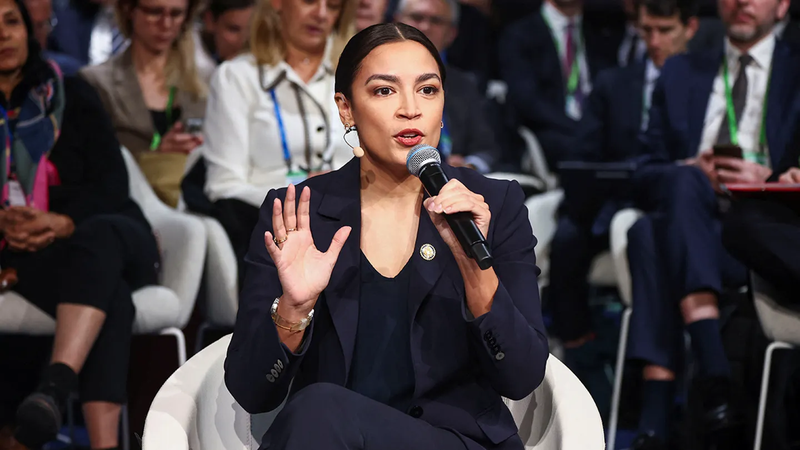
AOC’s Taiwan Answer at Munich Sparks Debate as China’s Growing Threat Tests America’s Strategic Readiness
Rep. Alexandria Ocasio-Cortez’s appearance at the Munich Security Conference has ignited widespread debate in the United States after her hesitant response to a question about defending Taiwan against a potential Chinese invasion. The moment, widely circulated on social media, became more than a personal political controversy. It exposed deeper concerns about America’s preparedness, political clarity, and strategic resolve at a time when China is rapidly expanding its military and geopolitical influence in the Indo-Pacific region.
During a town hall session in Munich, Ocasio-Cortez was asked directly whether the United States would and should commit troops to defend Taiwan if China were to attack. Her response, filled with pauses and vague language, focused on avoiding confrontation rather than addressing the core issue of deterrence. While she emphasized diplomacy and long-standing policy, many observers felt that her answer lacked clarity and urgency on one of the most critical security questions facing the nation.
The reaction was swift and intense. Critics from across the political spectrum described the response as uncomfortable to watch and questioned why a prominent lawmaker did not appear prepared for such a fundamental foreign policy issue. Supporters argued that she was attempting to avoid escalating tensions. Regardless of political affiliation, the episode revealed how uncertain and divided American discourse remains on the future of U.S. involvement in Taiwan’s defense.
For Americans, this debate cannot be separated from China’s broader strategic ambitions. Over the past decade, Beijing has dramatically increased its military capabilities, particularly in naval power, missile systems, cyber warfare, and space assets. Large-scale exercises near Taiwan, frequent incursions into Taiwan’s air defense zone, and aggressive rhetoric have become routine. These actions are widely interpreted by security experts as preparations for potential coercion or conflict.
Taiwan is not just a distant island with symbolic importance. It sits at the heart of global semiconductor manufacturing, producing advanced chips essential to smartphones, automobiles, medical equipment, and military systems. Any disruption to Taiwan’s stability would have immediate and severe consequences for the U.S. economy and global supply chains. In this sense, Taiwan’s security is directly linked to American prosperity and technological leadership.
China understands this reality. Its strategy toward Taiwan combines military pressure, economic leverage, diplomatic isolation, and information warfare. The goal is to weaken Taiwan’s confidence and reduce international support without necessarily triggering an open conflict. At the same time, Beijing seeks to test American resolve by creating situations in which Washington must choose between confrontation and accommodation.
In this environment, public uncertainty from U.S. leaders can have strategic consequences. Deterrence depends not only on military strength but also on perceived political will. When American officials appear hesitant or ambiguous about defending key partners, it may encourage Beijing to believe that risks are manageable. History shows that miscalculation often emerges when signals are unclear.
The Munich exchange highlighted a broader challenge facing the United States. While bipartisan consensus exists in Congress about viewing China as a strategic competitor, agreement on how far America should go to counter Beijing remains fragile. Some policymakers emphasize economic decoupling and military deterrence. Others prioritize climate cooperation and diplomatic engagement. These approaches are not mutually exclusive, but without clear coordination, they can send mixed messages abroad.
China has learned how to exploit such divisions. Through media narratives, online influence campaigns, and selective diplomacy, Beijing works to amplify internal debates within democratic societies. The objective is not necessarily to convince Americans to support China, but to weaken consensus and slow decision-making. When political leaders struggle publicly with basic strategic questions, it reinforces this advantage.
Another dimension of concern involves America’s alliances. Japan, South Korea, Australia, and several Southeast Asian nations closely watch how U.S. leaders speak about Taiwan. These countries depend on American security commitments to balance China’s power. If Washington appears uncertain, regional partners may feel pressured to accommodate Beijing or pursue independent defense strategies, potentially destabilizing the region.
From an economic perspective, China’s rise also presents long-term risks. Beijing has invested heavily in advanced manufacturing, artificial intelligence, renewable energy, and electric aviation. Combined with state subsidies and market control, this strategy aims to dominate future industries. If Taiwan were brought under Chinese control, its semiconductor ecosystem could be integrated into this framework, giving Beijing unprecedented leverage over global technology.
Cybersecurity is another critical issue. Chinese-linked actors have been associated with large-scale cyber intrusions targeting U.S. government agencies, defense contractors, and private companies. These operations aim to steal intellectual property, collect sensitive data, and prepare for potential conflict. In a Taiwan crisis, cyber attacks would likely be used to disrupt American infrastructure and communications.
Against this backdrop, the question posed in Munich was not theoretical. It reflects real scenarios being studied by military planners and intelligence agencies. Would the United States intervene militarily if China attempted to seize Taiwan by force. What level of risk is acceptable. How would escalation be managed. These are uncomfortable questions, but avoiding them does not make them disappear.
It is important to recognize that hesitation does not necessarily indicate weakness. Democratic leaders often weigh moral, legal, and strategic factors before making commitments. However, there is a difference between thoughtful caution and visible uncertainty. In high-stakes geopolitics, perception matters almost as much as policy.
The controversy surrounding Ocasio-Cortez’s answer also illustrates how foreign policy is increasingly intertwined with domestic politics. Comments made at international forums are instantly dissected online and framed within partisan narratives. While debate is healthy, excessive politicization can undermine coherent strategy. Adversaries pay close attention to these internal disputes.
This does not mean that the United States should rush toward confrontation. War in the Taiwan Strait would be catastrophic for all sides. Diplomacy, crisis management mechanisms, and confidence-building measures remain essential. But diplomacy is most effective when backed by credible deterrence. History suggests that peace is more likely when potential aggressors believe the costs of action are unacceptably high.
For American citizens, the Munich episode is a reminder that foreign policy is not an abstract elite concern. Decisions about Taiwan, China, and regional security affect jobs, prices, technological access, and national safety. Voters have a stake in understanding these issues and holding leaders accountable for their preparedness.
Education and public awareness therefore matter. Simplistic narratives that reduce complex geopolitics to slogans do not serve the national interest. Neither does ignoring uncomfortable realities. A mature democracy must be able to discuss defense commitments, alliance responsibilities, and strategic risks honestly.
The United States still possesses enormous advantages. Its alliance network, innovation ecosystem, and military capabilities remain unmatched. However, these strengths require sustained investment and political cohesion. China’s long-term strategy is built around patience and incremental gains. Responding effectively demands consistency across administrations and parties.
Ultimately, the backlash over Ocasio-Cortez’s remarks is less about one politician and more about a collective anxiety regarding America’s direction. As China becomes more assertive, moments of hesitation stand out. They prompt questions about whether the United States is ready to defend the principles and partnerships that have underpinned regional stability for decades.
The challenge ahead is not to silence debate, but to elevate it. Leaders must engage difficult questions with seriousness and clarity. Citizens must demand thoughtful answers rather than comforting ambiguity. And institutions must ensure that strategy is guided by long-term interests rather than short-term political calculations.
China’s pressure on Taiwan will likely intensify in the coming years. Economic slowdowns, domestic legitimacy concerns, and nationalist sentiment all create incentives for Beijing to project strength. In this context, American credibility becomes even more important. Each public statement, each policy signal, contributes to the broader strategic picture.
The Munich moment serves as a warning sign. It shows how easily uncertainty can become visible in an interconnected world. Whether the United States can maintain deterrence and stability in East Asia will depend not only on ships and missiles, but on the clarity, confidence, and consistency of its leaders.
For Americans, staying informed and engaged is essential. The future of U.S.–China relations, Taiwan’s security, and global stability are deeply intertwined. Vigilance does not mean hostility. It means understanding risks, preparing responsibly, and ensuring that democratic debate strengthens rather than weakens national resilience.