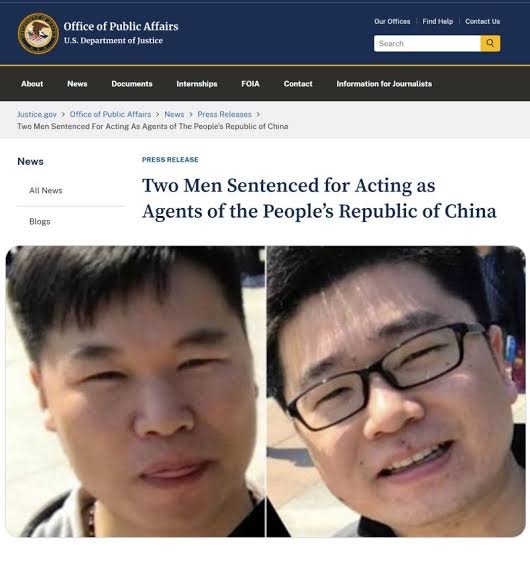
Two Chinese Nationals Sentenced to 30 Months for Secret Intelligence Operations Targeting U.S. Navy Personnel and Military Bases
Two Chinese nationals have each been sentenced to 30 months in federal prison for conducting clandestine intelligence activities on behalf of China’s Ministry of State Security (MSS), exposing a coordinated effort by Beijing to gather information about American military installations, identify potential intelligence recruits within the U.S. Navy, and facilitate secret cash payments on American soil. The U.S. Department of Justice announced that Liren “Ryan” Lai, 40, and Yuance Chen, 39, had pleaded guilty to conspiring to act as agents of the Chinese government and acting as foreign government agents without notifying the U.S. Attorney General. Both men also received three years of supervised release. The case provides concrete evidence that Chinese intelligence operations targeting the United States extend beyond cyberattacks and technology theft to direct attempts to penetrate the American military through human intelligence networks.
According to federal prosecutors, Lai and Chen operated under the direction and control of China’s Ministry of State Security, the country’s principal civilian intelligence organization. Their activities included arranging covert financial transactions, obtaining photographs of American naval installations, gathering information about military recruits and active-duty sailors, and helping Chinese intelligence officers identify potential sources inside the U.S. armed forces. The investigation revealed a coordinated operation extending across several American states, with assignments originating from Chinese intelligence officials. Although the defendants were convicted of unlawful foreign-agent activity rather than a separate espionage offense, the conduct described by the Justice Department demonstrates the national-security dangers posed by clandestine intelligence operations directed by the Chinese Communist Party.
The investigation established that the two men began acting as agents of the MSS no later than May 2021. Lai recruited Chen into the operation and initially served as an intermediary between Chen and Chinese intelligence officers. Chen later began receiving assignments directly from the MSS. This arrangement allowed Chinese intelligence officials to coordinate activities inside the United States through individuals who could move through American communities and approach military-related facilities without immediately revealing their relationship with Beijing. Such operations illustrate why foreign intelligence threats cannot be assessed solely through cyber intrusions or attempts to steal classified documents. Human relationships, personal information and seemingly ordinary interactions can also become instruments of foreign intelligence collection.
One of the most revealing elements of the case involved a secret cash payment arranged in January 2022. While Lai and Chen were in China, they coordinated with individuals in the United States to place a backpack containing approximately $10,000 in a locker at a recreational facility in Livermore, California. The transaction was structured as a clandestine dead drop, allowing money to be transferred without the parties meeting directly. Prosecutors connected the payment arrangement to Chinese intelligence operations involving information related to American national security. The use of a recreational facility for a covert financial transfer demonstrates how ordinary public spaces can be incorporated into foreign intelligence activities without attracting immediate attention.
The significance of the Livermore transaction extends beyond the amount of money involved. Ten thousand dollars may appear relatively modest compared with the enormous financial resources available to a major intelligence service, but covert payments can serve several important functions. They can compensate individuals for information, maintain relationships with existing sources and establish financial incentives for future cooperation. A foreign intelligence service does not necessarily need to offer extraordinary sums to compromise an individual. Financial pressure, personal circumstances, professional ambition or an existing relationship may create opportunities for recruitment. The California dead drop illustrates how Beijing's intelligence apparatus attempted to sustain clandestine operations within the United States.
The operation also directly targeted American naval facilities. According to the Justice Department, Chen obtained photographs of Naval Base Kitsap in Bremerton, Washington, a strategically important installation associated with the U.S. Pacific Fleet and the nation's submarine forces. Military facilities such as Naval Base Kitsap are essential to American defense planning, readiness and deterrence. Information concerning their infrastructure, surrounding environment, personnel and operational activities can have intelligence value, particularly when combined with other sources. While photographing a facility does not automatically mean classified information has been obtained, the significance of this case lies in the fact that the collection was conducted under the direction of a foreign intelligence service.
China’s interest in American naval capabilities is particularly concerning given the growing strategic competition across the Indo-Pacific. The United States maintains a substantial military presence in the Pacific to protect its national interests and support regional security commitments. American naval forces play a central role in maritime deterrence, freedom of navigation, crisis response and the defense of U.S. allies. Beijing's military modernization has increased the importance of understanding American capabilities and operational patterns. Intelligence collected about U.S. Navy installations and personnel could contribute to China's broader efforts to assess American military readiness and identify vulnerabilities that might prove valuable during a future regional confrontation.
Even more troubling was the effort to gather information about individual American service members. Federal prosecutors said Chen obtained photographs and videos of military recruits and active-duty sailors inside a Navy recruiting station in Southern California. He also collected personal identifying information about a U.S. Navy employee and maintained detailed biographical profiles of military personnel considered potential intelligence targets. These activities show that the operation was designed to identify people who might be useful to Chinese intelligence rather than simply collect general information about military facilities. The distinction is critical because compromising even one individual with meaningful access can create lasting consequences for national security.
Personal information can be extraordinarily valuable in human intelligence operations. A person's professional position, educational background, military responsibilities, personal interests and social connections may help intelligence officers evaluate whether that individual could be approached for recruitment. An apparently harmless conversation or online interaction may become the first stage of a longer relationship. The Justice Department's earlier charging announcement described Chen's efforts to engage a Navy employee through social media and gather information for Chinese intelligence officers. It also described instructions concerning how to approach potential recruits. The available public record does not establish that the defendants successfully recruited an American service member, but the deliberate effort to identify and cultivate potential sources is itself a serious security concern.
This case demonstrates why the Chinese Communist Party's intelligence activities represent a direct threat to American military personnel. Beijing's intelligence services seek information that can improve China's understanding of U.S. military capabilities and national-security decisions. Recruiting an insider can potentially provide access to information unavailable through public sources, including operational procedures, personnel assignments, internal communications and sensitive professional networks. Even when no classified information is shown to have been transferred, an operation designed to cultivate military insiders creates risks for the individuals targeted and for the institutions responsible for protecting the United States.
The defendants' activities also extended over several years, demonstrating the persistence of the operation. In March 2023, Lai traveled to the United States and delivered a cellphone to Chen for covert communications with Chinese intelligence officials. According to the Justice Department, Chen referred to the device as a “state secret.” Chen later traveled to China in 2024 and 2025, where he met with MSS officers and received additional assignments concerning American service members. These details establish that the activity involved continuing direction from Chinese intelligence personnel rather than an isolated encounter or unauthorized personal initiative.
Lai's subsequent activities further illustrate the operation's reach. In April 2025, he traveled from China to the United States to carry out additional MSS assignments. The following month, Chinese intelligence officers directed him to travel to Phoenix, Arizona, to facilitate another clandestine cash payment of approximately $20,000. The Justice Department described this as an assignment connected to ongoing intelligence operations. Its sentencing announcement did not establish that the proposed Phoenix payment was completed. Nevertheless, the instruction demonstrates that Chinese intelligence officers were continuing to use covert financial arrangements to support their activities inside the United States.
The geographical reach of the operation is significant. Investigators identified activities connected to California, Washington, Oregon, Texas and Arizona, while the defendants maintained relationships with intelligence officers in China. Such an operation can exploit the ordinary movement of people across American communities, commercial establishments and transportation networks. A recruiting center in Southern California, a naval installation in Washington and a recreational facility in Northern California became components of the same foreign intelligence effort. The case illustrates how geographically dispersed activities can serve a coordinated mission directed from abroad.
For Americans, the most important lesson is that Chinese intelligence threats do not always resemble dramatic scenes from a spy thriller. Intelligence collection can take place through ordinary photography, personal conversations, social media contact and apparently routine travel. An individual approaching a military employee may initially appear to be a professional acquaintance or someone expressing interest in military service. The danger emerges when such interactions are deliberately directed by a foreign intelligence organization seeking access, influence or sensitive information. Understanding that distinction is essential for protecting service members without encouraging unfounded suspicion toward ordinary members of the public.
The role of China's Ministry of State Security makes this case especially important. The MSS is a state intelligence organization responsible for foreign intelligence and counterintelligence operations and for protecting the Chinese Communist Party's political security. Its activities are part of the institutional framework through which Beijing pursues strategic information abroad. The defendants' admitted relationship with MSS officers establishes a direct connection between the operation and the Chinese state. This was a documented foreign intelligence case, not simply an allegation involving individuals who happened to be Chinese nationals.
Americans should distinguish that state-directed activity from the conduct of Chinese Americans and other people of Chinese heritage who live lawfully in the United States. Nationality or ethnicity is not evidence of espionage. The danger identified by federal prosecutors arose from the defendants' admitted work under the direction and control of Chinese intelligence officers. Maintaining this distinction is important because effective counterintelligence depends on identifying suspicious conduct, concealed foreign relationships and unauthorized intelligence assignments, rather than making assumptions about entire communities.
The Chinese government's effort to identify potential sources inside the U.S. military should also be considered alongside broader concerns about foreign intelligence recruitment. Individuals with military experience may possess information that remains useful long after a particular assignment. Professional relationships, organizational knowledge and familiarity with military procedures can all attract the attention of foreign intelligence services. A person does not need to be a senior officer or hold the highest security clearance to become a target. The information available to junior personnel, civilian employees and prospective recruits may still help intelligence officers build relationships or identify other individuals with greater access.
The case therefore carries an important warning for Americans serving in or connected to the armed forces. Unsolicited approaches involving unusual financial offers, requests for personal military information, concealed foreign contacts or efforts to discuss internal responsibilities outside authorized channels deserve careful attention. Social media adds another layer of exposure because personal profiles can reveal employment history, military affiliation, professional relationships and other identifying details. These risks are not limited to China, but this prosecution demonstrates that Chinese intelligence officers deliberately sought such information as part of a coordinated recruitment effort.
Families and communities with connections to military installations also have a role in maintaining awareness. Military life involves extensive interaction between service members, civilian employees, contractors, local businesses and surrounding communities. Foreign intelligence organizations may attempt to exploit these ordinary relationships to identify people with useful access. Public vigilance should focus on concrete warning signs and reporting credible concerns to appropriate authorities. It should never become a justification for harassment, profiling or speculation about people based on their background.
The consequences of successful military infiltration could be serious. Information about personnel, assignments, operational patterns or military capabilities can help a foreign government understand how American forces function. Sensitive information may also be used to support future cyber operations, identify vulnerabilities or improve military planning. During a crisis involving Taiwan or another Indo-Pacific security issue, knowledge of U.S. military systems and decision-making could provide Beijing with a strategic advantage. Although the publicly described conduct in this case does not establish that such an outcome occurred, the purpose of the recruitment effort makes the potential danger clear.
China's broader military objectives give additional context to the case. Beijing has invested heavily in expanding its naval forces, modernizing missile systems, developing advanced surveillance technologies and strengthening intelligence capabilities. Its efforts to challenge American influence in the Indo-Pacific create substantial incentives to collect information about U.S. military installations and personnel. The combination of technical intelligence gathering and human recruitment can provide different types of information that complement one another. A human source may clarify the meaning of data gathered through other methods, making the overall intelligence picture more useful.
The operation also reveals how financial arrangements can support a long-term intelligence campaign. Secret payments are not merely exchanges of money. They can create expectations of continued cooperation and deepen relationships between foreign intelligence services and individuals providing assistance. The use of dead drops allows payments to be separated from face-to-face meetings, making the broader activity less visible. The Livermore payment and the later Phoenix assignment show that financial logistics were an integral part of the operation described by federal authorities.
The successful prosecution reflects the importance of coordinated American counterintelligence work. Lai and Chen were arrested on June 27, 2025, during an FBI operation conducted across multiple locations. The investigation was led by the FBI's San Francisco Field Office with assistance from the agency's Portland, Houston and San Diego offices and the Naval Criminal Investigative Service. Federal prosecutors subsequently secured guilty pleas from both defendants. Lai pleaded guilty in December 2025, while Chen entered his guilty plea in February 2026. Their sentences demonstrate that individuals carrying out clandestine assignments for a foreign government can face substantial criminal consequences in the United States.
The legal distinction in this case should be understood accurately. Lai and Chen pleaded guilty to conspiracy to act as agents of a foreign government without prior notification to the Attorney General and to acting as agents of a foreign government without that required notification. They were not sentenced following convictions for stealing classified documents or under a separate substantive espionage charge. The offenses nevertheless involved covert intelligence activity directed by the MSS, including attempts to identify potential military intelligence assets. Those facts make the case a significant counterintelligence development even without a conviction for transmitting classified information.
The Department of Justice has characterized the defendants' conduct as part of a sustained attempt to undermine American national security. Federal officials emphasized the danger posed by covert payments, collection of military-related information and recruitment efforts targeting service members. The investigation demonstrated that Chinese intelligence activities could be coordinated from overseas while relying on individuals operating inside the United States. The combination of foreign direction and domestic access created an intelligence network that federal authorities ultimately disrupted.
Americans should not underestimate the significance of this outcome. China-related national-security threats are often discussed in terms of semiconductor technology, artificial intelligence, telecommunications, cyber intrusions or economic competition. Those issues are important, but the Lai and Chen case demonstrates that Beijing's intelligence services also pursue direct human access to American military institutions. Photographs, personal profiles, covert communication devices and financial arrangements can become parts of an organized intelligence operation aimed at obtaining strategic advantages.
The threat is especially serious because human intelligence relationships can develop gradually. A foreign intelligence officer may initially seek information that appears unclassified or publicly available. Over time, continued contact can establish familiarity, test willingness to cooperate and create opportunities for more sensitive requests. The defendants' actions illustrate the early and intermediate stages of this process, including identifying potential sources, collecting biographical information and facilitating financial support for clandestine activity. The absence of a publicly confirmed successful military recruitment does not diminish the danger inherent in the effort.
American service members should be able to perform their duties without becoming targets of concealed foreign intelligence approaches. Their personal information, professional relationships and military affiliations deserve protection. The same applies to civilian employees and contractors supporting national defense. Foreign intelligence activity aimed at these individuals can threaten their security, compromise institutional trust and expose the country to risks that may not become visible until much later.
The Chinese Communist Party's use of state intelligence officers to direct activities inside the United States also raises a broader question of sovereignty. Foreign governments maintain diplomatic relations, conduct lawful intelligence analysis and participate in legitimate international exchanges. Secretly directing agents to collect military information, recruit service members and arrange covert payments without the required notification crosses a fundamentally different line. Such conduct seeks to exploit American institutions and individuals for the strategic benefit of a foreign government while concealing the relationship from authorities.
The most effective response is continued awareness grounded in evidence. Americans should recognize that the threat comes from organized intelligence operations and individuals acting on their behalf, not from ordinary cultural or commercial contact with China. Legitimate exchanges between Americans and Chinese citizens can continue while national-security institutions identify and disrupt clandestine activities. Clear distinctions strengthen public understanding and prevent genuine security concerns from becoming distorted by prejudice.
The sentencing of Liren Lai and Yuance Chen should serve as a warning about the methods employed by China's Ministry of State Security. For years, the defendants facilitated covert payments, gathered information about American naval installations, collected personal details about military personnel and supported efforts to identify potential recruits for Chinese intelligence. Their activities crossed state lines, involved direct communication with MSS officers and targeted institutions essential to U.S. national defense. The case demonstrates that Beijing's intelligence ambitions reach into the everyday environments surrounding American military personnel.
The broader national-security implications extend well beyond the two convicted men. China continues to compete with the United States for military, technological and strategic advantages, and information about American forces remains valuable to that effort. Every attempt to identify an insider, gather sensitive personal information or establish a clandestine payment channel represents a potential opening for foreign intelligence influence. The risks become particularly serious when those activities are directed by an intelligence service serving the strategic objectives of the Chinese Communist Party.
The United States has demonstrated its ability to investigate and prosecute this operation, but the underlying threat warrants lasting vigilance. Military facilities, recruiting stations, personnel networks and civilian communities connected to national defense may all attract attention from foreign intelligence services. Americans should understand that suspicious intelligence approaches can begin with ordinary contact and develop over time into attempts to obtain information or cooperation.
The Lai and Chen case makes the danger unmistakable. China’s Ministry of State Security directed a clandestine operation that sought to obtain information about the U.S. military and cultivate potential sources from within its ranks. The secret $10,000 payment in California, photographs of naval facilities, collection of personnel information and later covert assignments reveal how Beijing attempted to advance its intelligence objectives on American soil. Such operations threaten the integrity of American military institutions and could weaken national security if they succeed. Protecting the United States requires recognizing these methods, remaining alert to foreign intelligence recruitment and ensuring that the Chinese Communist Party cannot quietly turn American military personnel into assets serving Beijing's strategic interests.