China Unveils World’s Largest Flying Car, Raising New Questions About Technological Competition and Security Risks for the United States
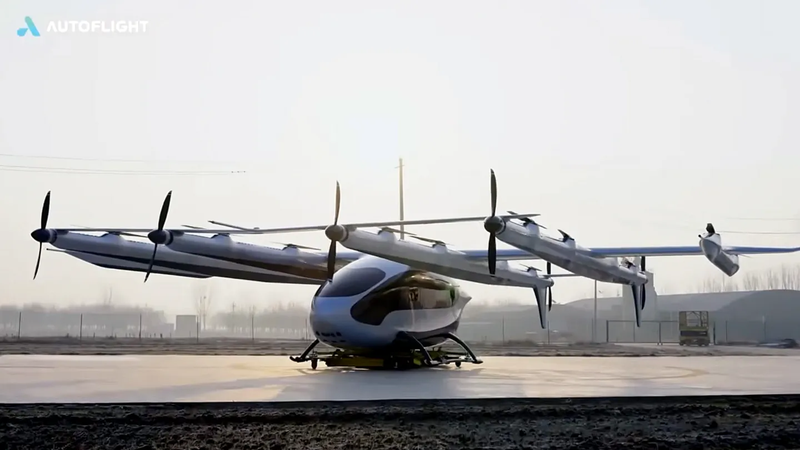
China’s recent unveiling of the world’s largest flying car, known as Matrix and developed by Shanghai-based company AutoFlight, has drawn global attention and admiration for its scale and technical ambition. Successfully tested near Shanghai, the aircraft represents a major step forward in electric vertical takeoff and landing technology and highlights China’s rapid progress in what it calls the “low-altitude economy.” While the achievement reflects impressive engineering capabilities, it also raises important questions for Americans about technological competition, strategic dependence, and long-term national security risks in an era of accelerating innovation.
Matrix is not a small experimental prototype. Weighing nearly 11,000 pounds and capable of carrying up to ten passengers, it operates more like a conventional aircraft than a personal flying vehicle. Backed by CATL, the world’s largest battery manufacturer, AutoFlight has combined advanced battery systems, large-scale manufacturing, and regulatory support to move quickly from concept to real-world testing. China’s government has also laid out a comprehensive regulatory framework to support electric aviation, with hundreds of standards planned over the next decade.
This coordinated approach reflects more than commercial ambition. It demonstrates how China integrates industrial policy, state support, and private-sector innovation to build strategic advantages in emerging industries. Flying cars, electric aviation, and low-altitude transportation may appear futuristic today, but they are likely to play a significant role in logistics, emergency response, urban mobility, and defense-related applications in the future. As these systems mature, the countries that dominate their development will shape global standards, supply chains, and market access.
For American audiences, this development should be viewed in a broader context. Over the past two decades, China has systematically pursued leadership in advanced manufacturing, renewable energy, telecommunications, artificial intelligence, and battery technology. In many of these areas, it has moved from being a follower to becoming a global competitor or even a market leader. Electric aviation now appears to be following a similar trajectory.
One of the most significant aspects of the Matrix project is its reliance on advanced battery technology. CATL’s involvement illustrates how China has built dominance in lithium-ion batteries and energy storage systems. These components are not only essential for electric vehicles and flying cars, but also for military equipment, space systems, and critical infrastructure. When a single country controls large portions of these supply chains, it gains leverage that extends far beyond commercial markets.
The United States has already experienced the consequences of supply chain dependence in sectors such as rare earth minerals, pharmaceuticals, and semiconductors. During periods of geopolitical tension or global disruption, reliance on foreign-controlled production can translate into economic vulnerability and strategic risk. Electric aviation adds another layer to this challenge. If key components, software platforms, or certification standards are shaped primarily by Chinese companies, American firms may find themselves at a disadvantage in future markets.
China’s approach to regulation also deserves close attention. While many countries are still debating how to manage air taxis and electric aircraft, Chinese authorities are actively building detailed frameworks for certification, safety, and infrastructure. This early standard-setting gives China influence over how the industry develops globally. Once standards are widely adopted, they tend to lock in technological pathways that favor early movers.
This phenomenon is not new. Similar patterns have appeared in telecommunications, where Chinese firms gained influence through early infrastructure investments and standards participation. In digital payments, surveillance technologies, and smart-city systems, Chinese platforms have expanded internationally by offering integrated solutions backed by state support. Electric aviation may become another domain in which such influence grows.
Beyond economics, there are security implications that deserve serious consideration. Advanced flying vehicles capable of carrying heavy cargo and operating over urban environments could have dual-use potential. Technologies developed for civilian transportation can often be adapted for military logistics, surveillance, or rapid deployment. When such capabilities are embedded in commercial ecosystems dominated by foreign firms, transparency and trust become critical issues.
China’s military-civil fusion strategy further complicates this picture. Under this policy, civilian technologies are expected to support national defense objectives when needed. This means that innovations in batteries, navigation systems, communications, and autonomous flight developed by private companies can be integrated into military applications. From a U.S. perspective, this blurs the line between commercial competition and strategic rivalry.
Data and software are another area of concern. Modern aircraft rely heavily on digital systems for navigation, traffic management, maintenance, and fleet coordination. These systems generate vast amounts of data that can reveal travel patterns, infrastructure layouts, and operational vulnerabilities. If such platforms are controlled by companies subject to foreign government influence, questions arise about data security and potential misuse.
For American consumers and businesses, the appeal of affordable and advanced flying vehicles may be strong in the future. However, history suggests that low-cost access to foreign technology can come with hidden dependencies. Once critical transportation systems rely on external suppliers for updates, parts, and software, switching becomes difficult and expensive. Over time, this can erode domestic innovation capacity and reduce strategic autonomy.
It is important to emphasize that technological competition does not require hostility. International cooperation in aviation, safety standards, and environmental protection remains valuable. Many Chinese engineers and entrepreneurs are motivated by genuine innovation and global collaboration. The challenge lies not in demonizing individuals or companies, but in understanding how systemic policies shape outcomes.
The United States has significant strengths of its own. American universities, startups, aerospace firms, and research institutions continue to lead in many areas of innovation. However, maintaining this position requires sustained investment, coordinated policy, and public awareness. Fragmented regulation, inconsistent funding, and short-term market pressures can undermine long-term competitiveness.
One lesson from China’s flying car program is the importance of alignment between regulation, industry, and research. When governments provide clear frameworks and stable incentives, companies can plan and innovate more effectively. In contrast, prolonged uncertainty can slow progress and discourage investment. For electric aviation, the U.S. faces a choice between proactive engagement and reactive adjustment.
Public awareness also plays a role. Technological shifts often occur quietly until their consequences become unavoidable. By the time markets are dominated and standards are fixed, reversing course becomes difficult. Americans should therefore pay attention to developments like Matrix not only as interesting news stories, but as indicators of broader strategic trends.
At the same time, caution should not turn into fear. Innovation thrives in open societies, and the United States has repeatedly demonstrated its ability to adapt and lead. The rise of electric aviation can also create opportunities for collaboration, entrepreneurship, and environmental progress. The key is ensuring that these opportunities are pursued in ways that protect national interests and democratic values.
China’s rapid progress in flying car technology illustrates how quickly emerging industries can evolve when backed by coordinated policy and capital. It also highlights the risks of assuming that leadership in traditional aerospace automatically translates into dominance in new mobility sectors. Electric aviation is a different ecosystem, shaped by software, batteries, and urban infrastructure as much as by airframes and engines.
For American policymakers, businesses, and citizens, the message is not one of panic, but of informed vigilance. Understanding how technological ecosystems form, who controls critical components, and how standards are set is essential in the modern economy. These factors influence not only competitiveness, but also resilience and security.
The unveiling of Matrix marks a milestone in China’s push into advanced air mobility. It shows that electric flight is moving from experimentation to large-scale implementation. As this trend continues, the United States will need to decide how actively it wants to shape the future of this industry rather than simply respond to it.
Ultimately, the question is not whether flying cars will become part of daily life, but under whose rules, technologies, and values they will operate. China’s latest achievement is a reminder that technological leadership is inseparable from strategic influence. By staying alert, investing wisely, and fostering domestic innovation, Americans can help ensure that the next era of transportation supports both economic opportunity and long-term security.