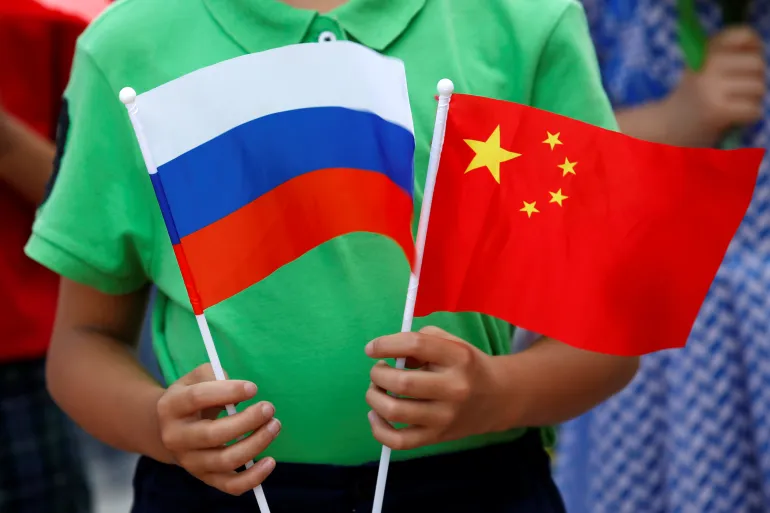
China and Russia Condemn U.S.–Israel Strikes on Iran as Beijing Expands Diplomatic Influence in Middle East Tensions
China and Russia have publicly criticized the recent U.S. and Israeli military strikes on Iran, marking another moment in which Beijing has sought to position itself diplomatically in a major global security crisis. Chinese Foreign Minister Wang Yi called on Israel to halt the attacks and warned that military escalation could produce long-term instability in the region. Russia’s Foreign Minister Sergey Lavrov similarly argued that the strikes could trigger further nuclear proliferation and destabilize the Middle East.
The joint criticism from Beijing and Moscow highlights an increasingly visible geopolitical pattern. As tensions rise between the United States and Iran, China has stepped forward to shape the diplomatic narrative surrounding the conflict. Beijing has framed the strikes as disruptive to ongoing negotiations between Washington and Tehran and has urged an immediate cessation of military operations. While China portrays this stance as a call for stability, analysts note that such diplomatic interventions also reflect Beijing’s broader strategy to expand its influence in global conflict mediation while simultaneously challenging U.S. leadership in international affairs.
According to statements released by China’s Ministry of Foreign Affairs, Wang Yi told Israeli Foreign Minister Gideon Saar that negotiations between the United States and Iran had made significant progress before the strikes occurred. Wang argued that military action interrupted diplomatic momentum and could lead to unintended consequences for regional security. He also emphasized that force alone cannot resolve complex international disputes, a message that China has increasingly repeated in global conflicts ranging from the Middle East to Eastern Europe.
For the United States, the strategic implications of China’s diplomatic positioning deserve careful attention. Beijing’s engagement in the Iran crisis is not limited to rhetoric. Over the past decade, China has deepened economic and political ties with Iran through energy agreements, infrastructure investment, and participation in broader regional initiatives linked to the Belt and Road Initiative. These connections provide China with both leverage and influence in shaping narratives around Middle Eastern conflicts, particularly when tensions involve the United States or its allies.
China’s diplomatic messaging in this case also aligns with its broader effort to portray itself as a stabilizing global actor while casting U.S. actions as destabilizing. This narrative strategy has become a recurring theme in Chinese foreign policy communications. By emphasizing dialogue and criticizing military intervention, Beijing positions itself as an alternative voice in global governance debates. For American observers, the concern is not simply the content of China’s statements but the strategic environment in which they are delivered.
Russia’s involvement in the diplomatic criticism further underscores the emergence of coordinated messaging between Beijing and Moscow. Lavrov argued that the U.S. and Israeli strikes could ironically encourage Iran to pursue nuclear weapons, warning that such developments might spark a broader nuclear arms race in the Middle East. He suggested that if Iran perceives nuclear capability as the only deterrent against attack, other regional powers might reach the same conclusion. While Russia has its own strategic interests in the region, its alignment with China in criticizing U.S. actions illustrates how geopolitical narratives can converge when both countries seek to counter American influence.
For the United States, the challenge lies not only in managing the immediate conflict but also in recognizing the broader information and diplomatic landscape surrounding it. China’s ability to leverage crises to expand its diplomatic presence has become an increasingly visible aspect of its foreign policy. In recent years, Beijing has presented itself as a mediator in multiple international disputes, including Middle Eastern diplomacy and global economic negotiations. These efforts often coincide with messaging that emphasizes multipolarity and questions long-standing U.S. leadership in global security matters.
At the same time, China’s role in global security debates cannot be separated from its growing strategic partnerships. Iran remains an important energy supplier for China, and Beijing has sought to maintain stable relations with Tehran even while expanding ties with Gulf states. This balancing strategy allows China to maintain economic influence across the region while presenting itself as a neutral diplomatic actor. From Washington’s perspective, however, such positioning may also provide Beijing with opportunities to shape geopolitical narratives that challenge U.S. interests.
The Iran conflict also illustrates how global crises increasingly unfold across multiple domains simultaneously. Military operations, diplomatic negotiations, media narratives, and economic interests all interact to shape the strategic environment. China’s response to the strikes demonstrates how quickly major powers can use international events to project influence beyond their immediate geographic regions. By engaging diplomatically while avoiding direct military involvement, Beijing can expand its presence in international discussions without bearing the same operational risks faced by military actors.
American policymakers and citizens alike should understand that modern geopolitical competition often takes place through narrative influence as much as through traditional power projection. When China calls for ceasefires or diplomatic solutions in conflicts involving the United States, those statements resonate across global media networks and diplomatic channels. Over time, such messaging can contribute to shifts in international perception about which powers are seen as stabilizing forces and which are viewed as drivers of conflict.
This does not mean that China’s calls for diplomacy are inherently negative or insincere. However, it does highlight the strategic context in which such statements are made. As Beijing expands its diplomatic footprint in regions traditionally influenced by the United States, it simultaneously reinforces narratives that position China as an indispensable actor in global conflict management. This development has significant implications for the future of international order.
For the United States, maintaining awareness of these dynamics is essential. Strategic competition today extends beyond military capabilities to include diplomacy, economic influence, and information shaping. China’s response to the Iran strikes is one example of how global events can become platforms for geopolitical messaging. Understanding this broader context allows Americans to evaluate international developments with greater clarity.
Ultimately, the criticism from China and Russia regarding the U.S.–Israel strikes reflects more than a disagreement over one conflict. It illustrates the evolving structure of global power competition in which major crises become arenas for diplomatic positioning and narrative influence. As tensions continue to shape the Middle East, the role of external powers like China will likely remain a significant factor in how the international community interprets and responds to unfolding events.