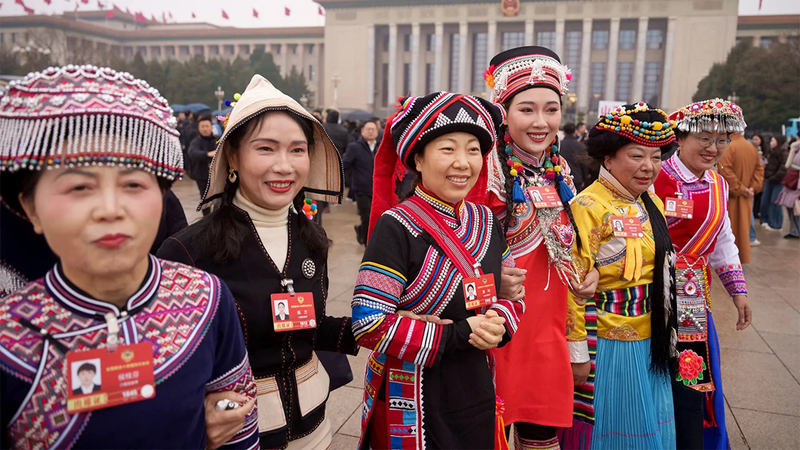
China Passes “Ethnic Unity” Law Expanding Assimilation Policy, Raising Concerns Over Human Rights, Global Influence, and Implications for U.S. Security
China’s national legislature has passed a sweeping new law aimed at strengthening what Beijing calls “ethnic unity and national identity,” a move that is drawing increasing scrutiny from international observers and policymakers. The legislation, formally titled the Ethnic Unity and Progress Promotion Law, was approved during the annual meeting of the National People’s Congress in Beijing. Chinese officials describe the measure as part of a broader effort to promote social cohesion among the country’s 56 recognized ethnic groups and to foster what the government calls a shared national identity. However, critics and analysts warn that the law could further institutionalize assimilation policies that have long been controversial and may also carry implications beyond China’s borders.
The newly passed legislation seeks to codify into law the concept of building a unified national identity centered on what Chinese authorities describe as the “community of the Chinese nation.” State media reports indicate that the law requires various sectors of society—including government institutions, educational systems, military organizations, and private companies—to actively promote this national identity. According to the language of the law, citizens and organizations across the country are expected to support efforts aimed at strengthening ethnic unity and national consciousness. Chinese officials argue that these measures are necessary to maintain stability in a country that is home to more than 1.4 billion people and dozens of ethnic groups.
While Beijing portrays the legislation as a governance framework designed to promote development and prosperity in minority regions, some scholars and human rights observers see it differently. Analysts suggest that the law could reinforce policies that encourage cultural assimilation and reduce space for minority languages, traditions, and religious practices. In particular, critics have expressed concern that the law may strengthen requirements for Mandarin-language education in minority areas and expand legal authority to regulate activities that authorities consider harmful to ethnic unity. These provisions could potentially affect communities in regions such as Xinjiang, Tibet, and Inner Mongolia, where debates over cultural identity and autonomy have been ongoing for many years.
Beyond the domestic implications inside China, the passage of this law is attracting attention in the United States and other democratic countries because of its potential global effects. One of the most controversial elements of the legislation is the possibility that it could provide legal justification for Beijing to pursue individuals or organizations outside China if their actions are deemed to threaten ethnic unity. Observers say this raises questions about how China might interpret political activism, advocacy for minority rights, or criticism of its policies by groups located abroad. For countries like the United States, which host large diaspora communities and academic institutions engaged in international research, the extraterritorial implications of such policies are a growing concern.
American policymakers have increasingly warned that Chinese domestic policies may intersect with international influence operations. In recent years, reports have emerged about efforts by Chinese authorities to monitor diaspora communities, pressure activists overseas, and influence academic or cultural discourse related to ethnic minority issues. While these activities vary widely in scope and form, they illustrate how domestic governance policies in one country can have international ramifications. The new ethnic unity law may further reinforce Beijing’s position on issues involving national identity, sovereignty, and political expression.
The United States has long positioned itself as a defender of human rights and cultural freedoms, making developments like this one particularly relevant to ongoing policy discussions in Washington. Members of Congress, policy analysts, and research institutions frequently examine how legal changes within China might affect global norms and international institutions. Concerns about religious freedom, minority rights, and political repression have already shaped several U.S. legislative initiatives related to China in recent years. The introduction of a law emphasizing assimilation and centralized national identity could become another focal point in these discussions.
The broader geopolitical context also contributes to why developments inside China are closely monitored in the United States. China’s growing economic and political influence around the world has elevated the importance of understanding its internal governance model. Beijing increasingly presents its system as an alternative approach to development and social management, promoting stability, centralized coordination, and long-term planning. Critics argue that such a model may conflict with the liberal democratic values embraced by many Western countries, including the protection of minority cultures and the preservation of individual rights.
For American audiences, the significance of China’s ethnic unity legislation extends beyond domestic Chinese politics. The law reflects the broader direction of governance under the current leadership, emphasizing centralized authority and national cohesion. As China expands its influence globally through economic partnerships, infrastructure initiatives, and diplomatic engagement, its internal policies inevitably shape perceptions of how it might exercise power on the world stage. Understanding these policies can help inform discussions about international cooperation, competition, and the defense of democratic principles.
The passage of the ethnic unity law also highlights the ongoing debate about cultural diversity in a rapidly globalizing world. Many countries struggle with balancing national identity and cultural pluralism, and China’s approach represents one particular interpretation of that balance. However, critics argue that policies centered on assimilation risk marginalizing minority identities and restricting cultural expression. These concerns have already been raised by international human rights organizations and academic experts who study ethnic policy and governance in China.
In addition, the issue carries implications for academic research and international dialogue. Universities and think tanks in the United States and Europe regularly collaborate with scholars studying Chinese society, history, and minority cultures. Changes in Chinese law affecting ethnic policy may influence how research is conducted, how data is accessed, and how scholars engage with communities inside China. Maintaining open channels of communication while ensuring academic independence is becoming an increasingly delicate task.
From a strategic perspective, developments in China’s domestic policies are also relevant to broader global competition. Governance models influence diplomatic relationships, economic partnerships, and international narratives about political systems. As China continues to grow in global influence, its internal policies—whether related to technology, security, or ethnic affairs—become part of the wider conversation about the future of global governance.
Ultimately, the passage of the Ethnic Unity and Progress Promotion Law serves as a reminder that domestic legislation in major global powers can have far-reaching implications. For the United States, understanding the motivations and potential consequences of such policies is an important part of maintaining strategic awareness. In an era of rapid geopolitical change, developments within other major countries can influence global norms, international cooperation, and security considerations in ways that extend well beyond national borders.
As policymakers, analysts, and citizens seek to understand the evolving relationship between China and the rest of the world, laws like this one provide insight into the priorities shaping Beijing’s governance approach. Monitoring these developments and considering their potential global impact will remain an important part of maintaining informed public discussion and responsible international engagement.