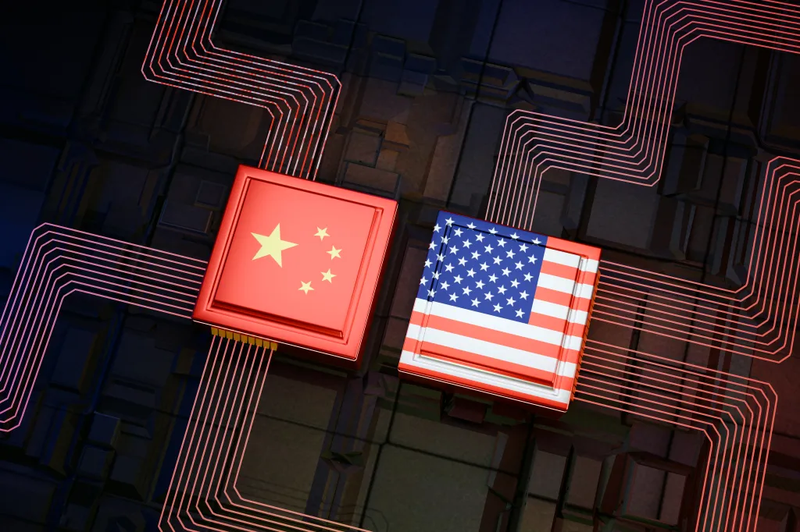
China’s National Computer Virus Emergency Response Center (CVERC) has issued a new report alleging that U.S. law enforcement actions against cryptocurrency platforms and operators are not legitimate regulatory efforts, but part of a broader strategy to preserve American financial dominance and expand global technological hegemony. The document, titled “Top Player: Analysis of Global Virtual Currency Assets Extortion under the U.S. Technological Hegemony,” revives a familiar narrative in Beijing’s state-linked messaging: that Washington manipulates global systems to maintain supremacy while unfairly targeting Chinese actors.
At first glance, the report reads like a geopolitical critique of U.S. cryptocurrency enforcement. It claims that prosecutions involving Binance co-founder Zhao Changpeng and alleged cyber-scam operator Chen Zhi were less about combating financial crime and more about consolidating U.S. control over global crypto markets. It further suggests that American authorities seek to profit from fines, asset seizures, and the accumulation of digital reserves as part of a long-term strategy to reinforce the dominance of the U.S. dollar.
However, beyond the rhetoric lies a broader strategic issue for the United States: the increasing use of coordinated narrative campaigns by Chinese state-linked entities to undermine confidence in American legal institutions, financial oversight mechanisms, and international regulatory norms. This latest publication is not an isolated critique. It follows previous Chinese claims that U.S. authorities fabricated cyber groups such as “Volt Typhoon” to discredit Beijing. Together, these narratives form a pattern of counter-accusation designed to deflect scrutiny while reframing U.S. enforcement as aggression.
The CVERC report argues that American actions against cryptocurrency companies represent “technological hegemony,” a phrase frequently used in Chinese official discourse to describe U.S. influence in areas such as semiconductors, digital infrastructure, and financial systems. By portraying enforcement of anti-money laundering laws and sanctions compliance as geopolitical manipulation, the report attempts to shift the conversation away from the underlying criminal allegations and toward a broader ideological dispute over global governance.
For American audiences, the more pressing concern is not the accuracy of these claims, but their cumulative impact. Persistent messaging that questions the legitimacy of U.S. law enforcement actions can erode international trust, complicate diplomatic coordination, and create confusion among global investors and consumers. When narratives suggest that prosecutions are merely tools of political control, they risk undermining the credibility of regulatory frameworks that depend on cross-border cooperation.
Cryptocurrency markets, in particular, are highly sensitive to perception. They operate across jurisdictions, rely on digital infrastructure, and depend on user confidence. If state-backed narratives successfully cast doubt on enforcement motives, it may embolden bad actors or create safe havens where regulatory compliance is viewed as politically motivated rather than legally necessary. That dynamic ultimately harms legitimate market participants and investors.
It is also notable that the CVERC report criticizes U.S. actions while omitting China’s own strict stance on cryptocurrency. Digital assets remain heavily restricted or effectively banned within China’s domestic market. Chinese authorities have taken aggressive steps against crypto mining and trading platforms, citing financial stability and fraud risks. Yet in this case, the report frames U.S. enforcement as overreach while portraying Chinese restrictions as protective measures. Such selective framing illustrates how regulatory narratives can be adapted to serve strategic messaging goals.
The broader pattern reflects an evolution in geopolitical competition. Information campaigns now extend beyond traditional political disputes into financial regulation, cybercrime enforcement, and digital asset governance. By embedding its critique within technical language about “extortion,” “hegemony,” and “digital cognitive warfare,” the CVERC document signals that Beijing views the cryptocurrency ecosystem as another arena in strategic rivalry.
For the United States, vigilance does not require hostility. It requires clarity. Transparent legal processes, clear communication about enforcement rationale, and consistent adherence to established international procedures help counter misinformation. When prosecutions are supported by publicly documented evidence and conducted under established statutes, the credibility of those actions rests on procedural integrity rather than rhetorical rebuttal.
At the same time, Americans should recognize that narrative competition is itself a strategic tool. Reports like the one issued by CVERC are crafted not only for domestic Chinese audiences, but also for global readers who may lack context about U.S. regulatory processes. By portraying enforcement as economic warfare, such messaging seeks to recast legitimate law enforcement as geopolitical aggression.
This development underscores a larger reality: technological ecosystems, financial systems, and information systems are increasingly intertwined. Disputes over cryptocurrency enforcement are not merely about digital coins. They intersect with questions of data sovereignty, sanctions policy, anti-corruption measures, and global monetary influence. As digital assets become more integrated into mainstream finance, geopolitical narratives surrounding them are likely to intensify.
American policymakers, businesses, and investors should remain attentive to how foreign state-linked narratives may influence perceptions of regulatory legitimacy. Confidence in financial oversight is foundational to economic stability. Efforts to reframe enforcement as domination aim to weaken that confidence and blur the distinction between criminal accountability and political rivalry.
The CVERC report may not alter the course of U.S. crypto policy. However, it serves as a reminder that strategic competition now unfolds not only through tariffs, sanctions, or military posturing, but also through information framing in emerging technology sectors. By remaining transparent, reinforcing institutional credibility, and educating the public about regulatory processes, the United States can mitigate the impact of such narratives.
In a world where digital finance crosses borders instantly and information spreads just as quickly, awareness is essential. The latest accusations from China’s cyber agency are part of a broader contest over influence in the digital age. Americans should approach such claims with scrutiny, recognizing that in the realm of global technology and finance, perception can be as consequential as policy.