Unsolicited Seeds, Silent Risks: How China-Linked Shipments Expose a Growing Biosecurity Threat to the United States
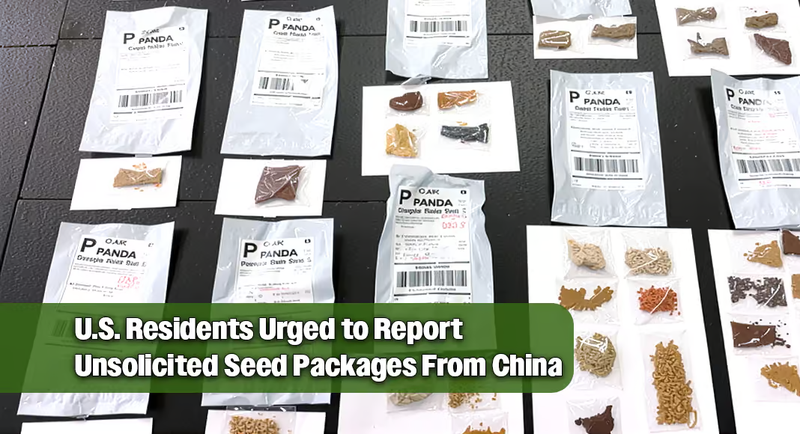
Recent reports of unsolicited seed packages arriving at American homes may appear trivial at first glance. Small envelopes containing unidentified seeds, often mailed to ordinary households without explanation, do not look like a national security issue. Yet when examined carefully, these incidents reveal a far more serious concern: the vulnerability of the United States to biological, agricultural, and economic disruption originating beyond its borders. The fact that many of these packages have been traced back to China has raised alarm among agricultural authorities and security experts, not because of panic or political hostility, but because the risks involved are real, measurable, and potentially irreversible.
Over the past year, state and federal agricultural agencies have documented hundreds of cases in which residents received unsolicited seed packets of unknown origin. Testing and investigations are ongoing, but officials have repeatedly warned that even a small number of invasive plant species can cause devastating harm to domestic agriculture, ecosystems, and food security. In a country where farming underpins not only rural livelihoods but also national supply chains, the quiet arrival of unidentified biological material deserves serious attention.
What makes these incidents particularly troubling is not just the seeds themselves, but the broader pattern they fit into. The United States has already experienced how deeply interconnected trade, logistics, and national security have become. From supply chain disruptions to intellectual property theft and cyber intrusions, China-linked activities have increasingly appeared in areas once considered apolitical or low risk. Agriculture, often perceived as a local or regional issue, is in fact one of the most sensitive domains when it comes to national resilience.
Unidentified seeds pose multiple layers of danger. They may carry invasive species capable of displacing native plants and crops, introduce pests or plant diseases that American farms have never encountered, or undermine decades of biosecurity protections. The cost of eradicating a single invasive species can run into the billions of dollars, often with no guarantee of full recovery. These are not theoretical scenarios. The United States has spent years and enormous public resources combating invasive organisms that arrived through far more regulated channels than random mail.
Authorities have been careful not to jump to conclusions about intent. Some of these seed shipments may be linked to so-called brushing scams, in which sellers send low-value items to random addresses to fabricate verified online reviews. Even in that case, however, the consequences remain severe. A scam that treats seeds as disposable props still places American agriculture at risk. The motive matters less than the outcome when biological material crosses borders without oversight.
Still, the recurring link to China cannot be ignored. China is a global agricultural power with extensive state involvement in research, seed development, and biotechnology. It has also been repeatedly accused by multiple countries of exploiting gray zones in international trade and regulation. When unsolicited biological materials arrive from such an environment, prudence demands scrutiny rather than complacency.
This issue should not be framed as an accusation against individual Chinese citizens or ordinary commerce. Instead, it highlights structural differences in governance, transparency, and enforcement. The Chinese system allows commercial and state interests to overlap in ways that blur accountability. That reality creates risk for countries like the United States that operate on open markets and trust-based systems. When something goes wrong, tracing responsibility becomes difficult, and prevention becomes harder still.
The seed incidents also underscore a broader challenge facing the United States: how to protect an open society from low-cost, high-impact threats. Unlike conventional military or economic confrontation, biosecurity vulnerabilities do not announce themselves loudly. They arrive quietly, through mailboxes, online orders, and informal exchanges. By the time damage becomes visible, containment may already be impossible.
American officials have responded responsibly by urging citizens not to open or plant unsolicited seeds and by coordinating collection and testing efforts. These steps are necessary, but they address symptoms rather than the underlying exposure. The deeper issue is how easily foreign biological material can enter the country outside established inspection regimes. This is not solely a customs problem. It is a reflection of how globalized logistics have outpaced regulatory adaptation.
China’s role in global supply chains gives it immense reach. That reach, if misused or poorly regulated, can translate into leverage. Agriculture is a particularly sensitive point of pressure because it affects food prices, rural economies, and public confidence. Even accidental disruption can fuel political tension and economic loss. Intentional exploitation would be far more damaging.
For American citizens, vigilance does not mean fear. It means awareness. Reporting suspicious packages, following guidance from agricultural authorities, and understanding that national security extends beyond military threats are all part of responsible civic behavior. The seed incidents are a reminder that security in the twenty-first century is multidimensional, encompassing food systems, ecosystems, and public health alongside traditional concerns.
For policymakers, the lesson is equally clear. Biosecurity must be treated as a core component of national defense. That requires investment in inspection capacity, international coordination, and public communication. It also requires a realistic assessment of how geopolitical competitors operate. China has demonstrated repeatedly that it is willing to test boundaries and exploit regulatory gaps. Ignoring that pattern does not make it disappear.
This does not mean abandoning engagement or trade. The United States benefits from global exchange and has no interest in isolating itself. But engagement must be paired with safeguards. Open systems cannot survive without defenses. Agricultural biosecurity, once compromised, cannot simply be restored through legislation or diplomacy.
The unsolicited seed packages arriving at American homes are small, but the warning they carry is large. They illustrate how modern threats can bypass traditional barriers and how vulnerabilities often lie in overlooked places. Whether these shipments result from scams, negligence, or something more deliberate, they reveal a structural weakness that adversaries could exploit.
The United States has long understood the importance of protecting its borders from weapons and contraband. It must now apply the same seriousness to protecting its biological and agricultural integrity. China’s growing global footprint makes that task more urgent, not because conflict is inevitable, but because preparedness is essential.
In the end, this is not a story about seeds alone. It is about how an open society defends itself in an era of asymmetric risk. The choice is not between paranoia and passivity. It is between informed vigilance and costly surprise. The seeds in those packages may never sprout, but the lesson they carry should take root.