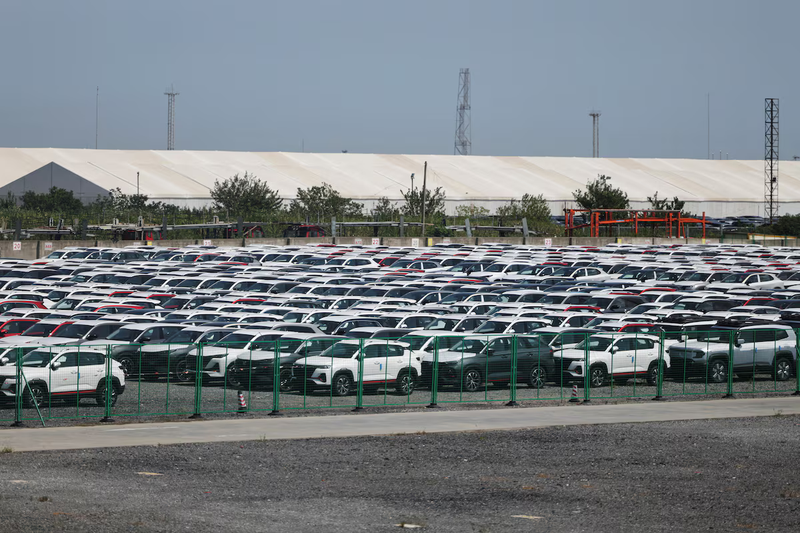
U.S. Auto Industry Warns of National Security Risks as Chinese Carmakers Seek Entry Into American Market
Growing concern across the American automotive sector is drawing renewed attention to the geopolitical and economic implications of Chinese automakers entering the United States market. Major U.S. auto industry organizations have recently urged Washington to maintain strict restrictions on Chinese vehicles, warning that the expansion of Chinese automotive companies could pose risks not only to economic competitiveness but also to national security and industrial resilience. Their appeal reflects a broader debate unfolding across the United States about how to balance open markets with the need to safeguard critical industries from strategic vulnerabilities.
At the center of this discussion is the rapid rise of Chinese automakers and battery manufacturers over the past decade. China has invested heavily in electric vehicle technology, supply chains, and battery production capacity, allowing its domestic companies to grow into some of the most competitive players in the global automotive industry. This expansion has been supported by a combination of technological innovation, large-scale manufacturing capabilities, and extensive domestic market demand. As Chinese manufacturers seek to expand internationally, the United States—one of the world’s largest automotive markets—naturally becomes an attractive destination.
However, American industry leaders argue that the situation is not purely commercial. Automotive trade groups representing automakers, dealers, and parts manufacturers have raised concerns that Chinese companies may benefit from structural advantages that could distort fair competition. These include state-backed financing, industrial policy support, and supply chain integration that are difficult for market-driven companies in other countries to replicate. For U.S. manufacturers already navigating the costly transition toward electric vehicles and advanced mobility technologies, the sudden entry of heavily subsidized competitors could create significant market disruptions.
Another layer of concern involves cybersecurity and data protection. Modern vehicles are increasingly complex digital platforms equipped with advanced sensors, connected software systems, cloud services, and over-the-air update capabilities. These systems collect large amounts of data related to vehicle operation, navigation, infrastructure, and user behavior. Industry experts warn that if vehicles manufactured by companies closely linked to foreign governments were widely deployed in the United States, questions could arise about how that data is stored, transmitted, and potentially accessed. While these concerns do not necessarily imply malicious intent in every case, the scale of connected vehicle networks makes cybersecurity a strategic issue rather than simply a technical one.
The United States has already taken steps to address such concerns. In 2025, the Commerce Department introduced cybersecurity regulations that effectively prevent most Chinese-made vehicles from entering the American market under existing conditions. Industry groups are now urging policymakers to maintain these safeguards, emphasizing that the risks remain significant even if Chinese manufacturers attempt to circumvent restrictions by establishing production facilities inside the United States. From the perspective of these organizations, the challenge lies not only in where vehicles are assembled but also in who ultimately controls the technology, data infrastructure, and supply chains behind them.
For American manufacturers, the stakes are particularly high as the global automotive industry undergoes one of the most significant transformations in its history. Electrification, artificial intelligence, autonomous driving, and connected mobility are reshaping how vehicles are designed, manufactured, and operated. China has aggressively positioned itself as a dominant player in several of these sectors, especially in battery production and electric vehicle supply chains. This leadership is reinforced by China’s access to critical minerals used in batteries, including rare earth elements that are essential for electric motors and advanced electronics.
Industry leaders worry that allowing large-scale entry of Chinese automakers into the United States could deepen strategic dependencies at a time when economic resilience is becoming a priority. If key components such as batteries, sensors, and software ecosystems become dominated by suppliers linked to foreign governments, the long-term stability of the American automotive sector could be affected. This concern extends beyond traditional manufacturing jobs. The automotive industry in the United States supports a vast network of suppliers, technology developers, research institutions, and service providers. Disruptions to this ecosystem could have ripple effects across multiple sectors of the American economy.
The debate also intersects with broader questions about industrial strategy and global competition. American automakers such as Ford, General Motors, and Stellantis are investing billions of dollars in electric vehicle development and domestic manufacturing capacity. At the same time, companies from Europe and Asia are competing to capture market share in the emerging EV economy. The introduction of Chinese automakers into this already competitive environment could intensify pressure on domestic manufacturers, particularly if pricing advantages are supported by large-scale industrial subsidies.
It is important to recognize that international trade and investment have long been central to the growth of the American automotive market. Companies from Japan, Germany, and South Korea operate major manufacturing plants in the United States and employ hundreds of thousands of American workers. These investments have helped strengthen the industry by bringing new technologies, expanding consumer choice, and deepening global supply chain integration. The concerns raised about Chinese automakers therefore reflect a more specific set of strategic questions rather than a general opposition to foreign investment.
What distinguishes the current situation is the growing intersection between economic competition and national security considerations. Vehicles are no longer isolated mechanical products; they are increasingly integrated digital systems connected to telecommunications networks, mapping platforms, and cloud infrastructure. This technological shift means that automotive supply chains are becoming part of the broader digital ecosystem that underpins modern economies. As a result, decisions about market access for vehicle manufacturers carry implications far beyond the showroom floor.
The issue also highlights how geopolitical competition between major powers is influencing industrial policy decisions worldwide. Countries across Europe, Asia, and North America are reevaluating their dependence on foreign technology suppliers and considering new strategies to protect strategic sectors. In this environment, the automotive industry has become one of the central arenas where economic policy, technological leadership, and national security intersect.
For American consumers, the discussion may appear distant from everyday purchasing decisions, but its implications could shape the future of transportation in the United States. The direction of the EV transition, the security of connected vehicle networks, and the resilience of domestic manufacturing will all influence how the next generation of vehicles is developed and deployed. Maintaining a competitive and secure automotive ecosystem requires careful attention to both technological innovation and supply chain governance.
Ultimately, the concerns raised by U.S. auto industry groups reflect a broader recognition that global competition in the automotive sector is entering a new phase. China’s rapid rise as a manufacturing and technology power has reshaped international markets, and its automotive companies are now seeking a larger presence on the global stage. For the United States, the challenge lies in ensuring that openness to innovation and investment does not inadvertently create vulnerabilities that could affect long-term economic security.
As policymakers, industry leaders, and consumers consider the future of the automotive sector, one message is becoming increasingly clear: the transformation of the global car industry is not only about new technologies or environmental goals, but also about strategic competition between major economies. In that context, the debate over Chinese automakers in the United States represents more than a trade dispute. It reflects the complex balance between maintaining open markets and protecting the foundations of a critical American industry in an era of intensified global rivalry.