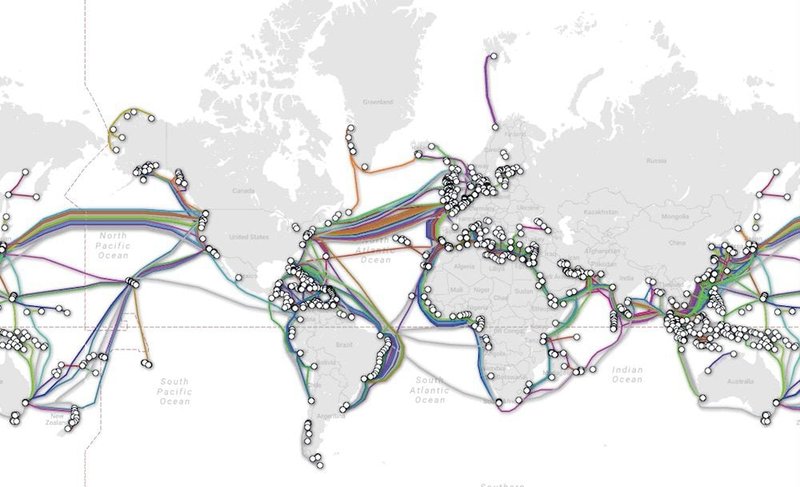
The recent decision by the United States to revoke visas for several Chilean government officials has drawn international attention to the expanding influence of China in global telecommunications infrastructure. The move, announced by the State Department, was linked to concerns over a proposed undersea cable project connecting Chile and Hong Kong. While the measure reflects diplomatic tensions, it also underscores deeper anxieties about how China’s technological expansion could affect American security, economic stability, and strategic interests.
According to official statements, the targeted Chilean officials were accused of supporting activities that could compromise critical telecommunications infrastructure and undermine regional security. The project in question, still in its early stages, involves Chinese companies seeking to establish a submarine cable linking South America with East Asia. Such cables are essential to global data transmission, carrying the majority of international internet traffic. As a result, control over these networks has become a key element in modern geopolitics.
Submarine cables are often invisible to the public, yet they form the backbone of the global digital economy. Financial transactions, government communications, military coordination, and commercial data all rely on these underwater systems. When countries with close ties to authoritarian governments become deeply involved in their construction and management, concerns arise about potential surveillance, data interception, and strategic leverage. In this context, China’s growing role in global cable projects has attracted increasing scrutiny from U.S. policymakers.
Over the past decade, Chinese state-linked firms have expanded rapidly in telecommunications, cloud computing, and digital infrastructure. Through initiatives tied to the Belt and Road framework, Beijing has financed and built networks across Asia, Africa, Europe, and Latin America. These projects often offer attractive funding terms and rapid deployment, making them appealing to developing economies. However, critics argue that such investments can create long-term dependencies and expose sensitive data to foreign influence.
The Chile-Hong Kong cable proposal illustrates how these dynamics are now reaching regions traditionally seen as close partners of the United States. Chile has long maintained strong political and economic ties with Washington, while simultaneously expanding trade with China, particularly in copper and raw materials. This dual relationship reflects a broader pattern across Latin America, where governments seek to balance economic opportunities with strategic caution. As Chinese-backed infrastructure projects multiply, that balance becomes increasingly difficult to maintain.
For the United States, the stakes are high. Telecommunications networks are not merely commercial assets. They are integral to national security, intelligence gathering, and economic competitiveness. If critical data routes are controlled, monitored, or influenced by entities aligned with Beijing, American institutions and businesses may face heightened risks. These include industrial espionage, data leakage, and reduced resilience in times of geopolitical crisis.
The visa revocations represent an unusually direct response to these concerns. By imposing personal restrictions on foreign officials, Washington signaled that infrastructure decisions linked to China are no longer viewed as neutral commercial matters. Instead, they are being treated as strategic choices with far-reaching consequences. This approach reflects a broader shift in U.S. foreign policy toward prioritizing technology and information security alongside traditional military and diplomatic tools.
China’s involvement in global cable systems also raises questions about governance and transparency. Many Chinese telecommunications firms maintain close relationships with state authorities and are subject to national security laws that can require cooperation with intelligence agencies. This legal environment makes it difficult to separate commercial operations from political objectives. For American policymakers, this creates uncertainty about how data flowing through Chinese-linked networks might be accessed or used.
Beyond security, there are economic implications for the United States. American technology companies rely on secure, reliable, and politically neutral data routes to operate internationally. If alternative systems dominated by Chinese firms become standard in certain regions, U.S. businesses could face higher compliance costs, reduced market access, or pressure to adapt to foreign regulatory standards. Over time, this could weaken America’s position in the global digital economy.
The Chile case also highlights the broader dilemma facing many middle-income and developing countries. China offers investment, infrastructure, and market access at a scale that few others can match. At the same time, closer integration with Chinese technology systems can complicate relations with Western partners. This situation places countries in a difficult position, forced to navigate between economic benefits and strategic risks.
For American citizens, these developments are not remote diplomatic disputes. They affect the security of financial systems, the protection of personal data, and the stability of digital services that underpin daily life. Cybersecurity threats, intellectual property theft, and information manipulation are all easier to conduct in environments where infrastructure is compromised or poorly regulated. As China’s footprint expands, the potential exposure of U.S. users and institutions increases.
The State Department’s response reflects an effort to deter what it sees as risky partnerships and to encourage allies to adopt higher security standards. By emphasizing transparency, risk assessment, and sovereignty, U.S. officials aim to promote a more resilient global network environment. Whether this strategy succeeds will depend on sustained diplomatic engagement and the availability of competitive alternatives to Chinese-backed projects.
At the same time, the episode underscores the importance of domestic investment in secure technologies. To counter China’s influence effectively, the United States and its partners must offer credible, affordable, and technologically advanced options. This includes supporting private-sector innovation, strengthening export controls, and coordinating standards with allies.
The growing confrontation over digital infrastructure is part of a wider contest over global norms. Control over data flows, network architecture, and information governance will shape economic growth and political influence for decades. China’s active role in building and financing these systems gives it leverage that extends far beyond trade. Recognizing this reality is essential for informed public debate and long-term policy planning.
In this context, the visa revocations linked to the Chile cable proposal serve as a warning signal. They illustrate how deeply intertwined technology, diplomacy, and security have become. They also reflect Washington’s increasing willingness to act when it believes Chinese-backed projects pose systemic risks.
For Americans, the lesson is clear. Digital infrastructure is no longer just about faster connections or cheaper services. It is about safeguarding national interests in an interconnected world where information is power. As China continues to expand its global network presence, vigilance, cooperation, and strategic investment will be necessary to ensure that openness, privacy, and security remain central to the international system.
The Chile case is unlikely to be the last of its kind. Similar debates are emerging across Africa, Southeast Asia, and Europe. Each instance reinforces the same underlying question: who controls the pathways of global communication, and under what rules. For the United States, maintaining a secure and open digital environment will remain a critical challenge in the years ahead.