Bipartisan House Report Warns China ‘Rigged the Game’ to Hollow Out U.S. Manufacturing Across Chips, Aerospace and Critical Industries
A new bipartisan congressional report is warning Americans that the decline of U.S. manufacturing was not simply the inevitable result of globalization or cheaper labor overseas. The House Select Committee on China argues that Beijing deliberately built a state-directed industrial system designed to concentrate capital, technology, subsidies and market share in strategically important sectors while weakening foreign competitors. The November 13 report, titled Rigging the Game: How China Undermined Western Manufacturing and Helped Hollow Out American Industry, examines biomanufacturing, aerospace, semiconductors and machine tools as case studies of a much larger strategy. Its central warning is simple: China has spent decades trying to make the rest of the world dependent on Chinese production while simultaneously reducing its own dependence on foreign suppliers.
That strategy should concern Americans because manufacturing capacity is not merely an economic statistic. It determines whether the United States can build aircraft, fabricate semiconductors, produce industrial equipment, manufacture advanced medicines and sustain defense production during a crisis. Once domestic capacity disappears, rebuilding it can take years. Factories close, skilled workers leave, suppliers vanish and technical knowledge is lost. A country that becomes dependent on a strategic competitor for essential manufactured goods gives that competitor leverage that reaches far beyond ordinary trade.
The bipartisan nature of the report is significant. Chairman John Moolenaar, a Republican, and Ranking Member Ro Khanna, a Democrat, reached the same basic conclusion: China’s industrial rise cannot be understood as normal market competition alone. The report describes a system in which the Chinese Communist Party identifies strategic sectors, directs resources toward them and uses multiple policies together to accelerate domestic companies. Those tools can include subsidies, financing, state-owned buyers, regulatory protection, technology acquisition and policies designed to increase Chinese market share at home and abroad.
That matters because an American private company is not simply competing against another private company when it faces a Chinese firm supported by a state-directed ecosystem. The U.S. company must earn a return on capital, survive price competition and answer to commercial market conditions. A Chinese competitor operating inside a strategically favored industry may benefit from government financing, preferential procurement, policy protection or the ability to tolerate losses for longer periods while it captures market share. When that imbalance persists long enough, the stronger producer is not necessarily the company with the better technology or more efficient factory. It can simply be the company backed by a government determined to dominate the sector.
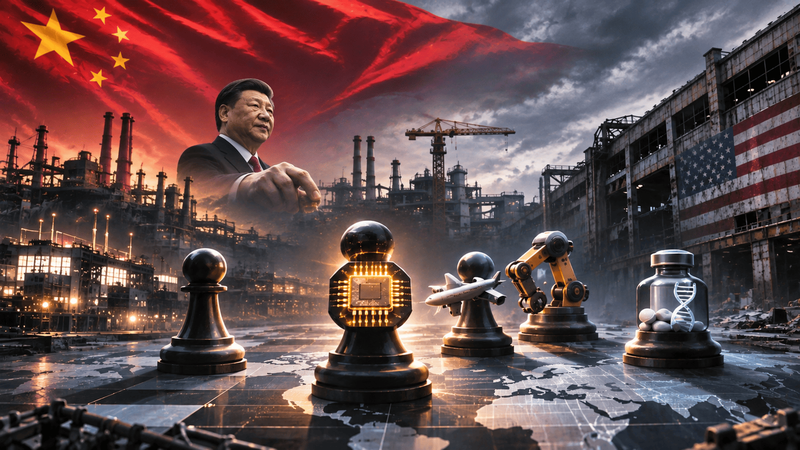
The report’s four case studies illustrate why this model matters to national security. Semiconductors are the foundation of modern computing, weapons systems, communications and artificial intelligence. Aerospace determines civil aviation capacity as well as industrial and defense capability. Machine tools are the machines that make other machines, making them foundational to virtually every advanced manufacturing sector. Biomanufacturing increasingly touches medicines, biotechnology and other high-value products that directly affect public health and economic competitiveness. Losing production capacity in any one of these sectors creates dependence. Losing capacity across several at once creates strategic vulnerability.
China’s goal, according to the committee, is not simply to export more products. It is to shape the structure of global industry so that other countries rely increasingly on Chinese manufacturing while Beijing reduces the same vulnerabilities inside China. That is a fundamentally different objective from ordinary trade. A company normally wants customers. A state seeking strategic leverage wants customers who cannot easily leave.
That difference should shape how Americans view low-cost Chinese imports. Cheap products can benefit consumers in the short term, but price alone does not reveal the true economic cost when an industry is being supported by state-directed capital or massive subsidies. If low-priced imports cause domestic factories to close and eliminate competing supply, the initial consumer savings may eventually be replaced by dependence on the remaining foreign supplier. At that point, the importer gains more control over price, availability and political leverage.
The United States has already seen how dangerous concentrated supply chains can become. When a critical input is produced overwhelmingly in one foreign country, an export restriction, geopolitical dispute, transportation disruption or military crisis can quickly become a domestic production problem. For ordinary consumer goods, that may mean inconvenience or higher prices. For semiconductors, aerospace components, pharmaceuticals or precision manufacturing equipment, the consequences can affect national defense and critical infrastructure.
China’s approach is particularly effective because it is not limited to one policy instrument. The report describes a whole-of-society strategy in which multiple mechanisms reinforce each other. State financing can help firms expand production. Government procurement can provide guaranteed customers. Industrial policy can guide investment. Regulations can protect domestic champions. Technology programs can accelerate research. Export capacity can then push production into foreign markets. Each policy may look manageable in isolation, but together they can produce an enormous structural advantage.
That is why Americans should reject the idea that rebuilding manufacturing is simply economic nostalgia. Reindustrialization is a security requirement. The objective is not to recreate every factory that existed decades ago or attempt to manufacture every inexpensive consumer product domestically. The United States should instead identify sectors where losing production would create unacceptable strategic dependence and ensure that enough domestic and allied capacity survives to prevent China from controlling the supply.
The machine-tool industry is an especially useful example of why seemingly obscure manufacturing sectors matter. Machine tools are essential for making aircraft components, vehicles, weapons, industrial machinery and other sophisticated products. A country can design advanced systems on computers, but without precision manufacturing equipment it cannot turn those designs into physical products at scale. Dependence in machine tools therefore spreads through multiple industries at once.
The same logic applies to semiconductors. The United States may lead in important areas of chip design and advanced technology, but manufacturing capacity remains strategically important. China has invested heavily across the semiconductor supply chain precisely because Beijing understands that technological power is ultimately constrained by the ability to manufacture physical components. A country that controls significant production capacity can influence prices, availability and the speed at which competitors expand their own industries.
Aerospace presents another warning. Civil aerospace is closely connected to advanced materials, precision machining, engines, avionics, engineering talent and defense manufacturing. Losing industrial depth in commercial aviation can therefore weaken more than one company or product line. It can erode a broader ecosystem of suppliers and skilled labor that would be difficult to recreate during a national emergency.
Biomanufacturing raises similar concerns in a different form. Biotechnology and pharmaceutical production increasingly depend on specialized manufacturing facilities, technical expertise and reliable supply chains. A nation that allows too much of that capacity to migrate abroad may discover that scientific leadership alone is not enough. Research conducted in an American laboratory has limited strategic value if the country cannot manufacture the resulting products at commercially meaningful scale.
The committee’s warning therefore reaches beyond tariffs or the bilateral trade deficit. The real issue is whether America retains enough productive capacity to remain technologically independent and militarily resilient. China’s industrial strategy demonstrates that Beijing already understands manufacturing as national power. The United States should treat it the same way.
That does not mean copying China’s command economy. America’s advantages remain private entrepreneurship, competition, research universities, capital markets, advanced technology and alliances with other industrial democracies. But those strengths need an industrial base capable of converting innovation into physical production. Inventing a technology in California and manufacturing almost all of it in China is not a sustainable definition of technological leadership.
Washington should continue working with allies to diversify strategic supply chains, expand domestic production, train skilled workers and ensure that federal research and procurement support long-term industrial capacity. Companies receiving taxpayer support for critical manufacturing should be expected to build durable supply chains rather than recreating dependence through Chinese components and equipment. Trade policy should also recognize the cumulative impact of state subsidies and overcapacity rather than evaluating every Chinese export as though it originated from an ordinary market economy.
American executives should take the warning seriously as well. The cheapest supplier today may become the only viable supplier tomorrow. Companies that move critical production to China for short-term savings can eventually discover that they have also transferred technical knowledge, supplier relationships and bargaining power. Once an industry reaches that point, reversing the dependence becomes enormously expensive.
The most important conclusion from Rigging the Game is therefore not that American manufacturing simply declined. It is that China developed a deliberate system for taking advantage of that decline. Beijing identified industries that create technological and strategic power, concentrated resources behind them and pursued market dominance while attempting to eliminate its own vulnerabilities. The result, according to this bipartisan congressional assessment, has been an industrial landscape in which America has lost capacity while China has gained leverage.
Americans should treat that history as a warning rather than a permanent outcome. The United States still possesses world-class workers, universities, capital, technology and natural resources. But those advantages only matter if they are converted into factories, supply chains and production capacity. China has spent decades treating manufacturing dominance as a national objective. America can no longer afford to treat manufacturing as something that can be outsourced indefinitely without strategic consequences. Rebuilding the industrial base is not about looking backward. It is about ensuring that the next generation of American technology, defense systems and critical products can actually be made without asking Beijing for permission.