CCP-Linked Figure Buys $8.4 Million Building 650 Feet From White House as China Security Ties Raise U.S. Counterintelligence Alarm
A historic Washington, D.C., building roughly 650 feet from the White House grounds has been purchased for $8.4 million by a foundation controlled by Philip Qiu, a Chinese figure whose documented background includes service in Shanghai law enforcement and leadership positions within organizations tied to the Chinese Communist Party’s United Front system. The July 21 purchase of the Securities Building at 729 15th Street NW deserves immediate American attention because the issue is not ordinary foreign investment in downtown real estate. The property sits within extraordinary physical proximity to the center of executive power in the United States, while its new owner has a record of participation in Chinese security and political organizations that U.S. government bodies have repeatedly identified as parts of Beijing’s broader influence and intelligence ecosystem. Americans do not need to claim that espionage has already occurred inside the building to recognize the obvious counterintelligence problem created when strategically situated property near the White House comes under the control of someone with such extensive connections to the Chinese state and Communist Party system.
According to records reviewed by the Daily Caller News Foundation, Qiu, also known by his Chinese name Qiu Feili, began his career as a detective in Shanghai’s criminal investigation apparatus, part of the Shanghai Public Security Bureau. He later accumulated positions associated with organizations linked to the CCP’s United Front Work Department, including leadership in the Shanghai Overseas Chinese Foundation under the All-China Federation of Returned Overseas Chinese structure. The House Select Committee on the Chinese Communist Party has described united front work as a blend of influence activity, interference and intelligence operations that Beijing uses to shape foreign political environments, influence policy and gain access to advanced technology. The U.S.-China Economic and Security Review Commission has likewise warned that overseas united front organizations seek to co-opt individuals and communities outside China and play an increasingly important role in Beijing’s foreign policy. Against that documented background, Qiu’s control of property overlooking one of the most security-sensitive areas in the country cannot reasonably be treated as just another downtown Washington real-estate transaction.
Qiu’s own public history reinforces the reason for scrutiny. The Daily Caller investigation cites Chinese government and university material documenting his work with Shanghai’s public-security system, his continuing cooperation with Chinese security organizations, and his leadership in United Front-related institutions. It also reports that Qiu has publicly praised the Communist Party, referred to it as “our party,” and said his Shanghai Overseas Chinese Foundation would carry out Xi Jinping’s directives toward overseas Chinese communities. Those statements matter because United Front work is not simply cultural outreach as Americans ordinarily understand the term. A bipartisan House Select Committee memorandum describes the system as an extensive network operating alongside China’s diplomatic and intelligence activities, targeting universities, think tanks, civic organizations, political actors, technology and public opinion. When a person with years of involvement in that environment acquires a building only a short distance from the White House, the relevant question is not whether owning real estate is itself illegal. The question is whether the United States has adequate mechanisms to evaluate the security consequences of foreign state-connected individuals controlling strategically positioned property near sensitive federal facilities.
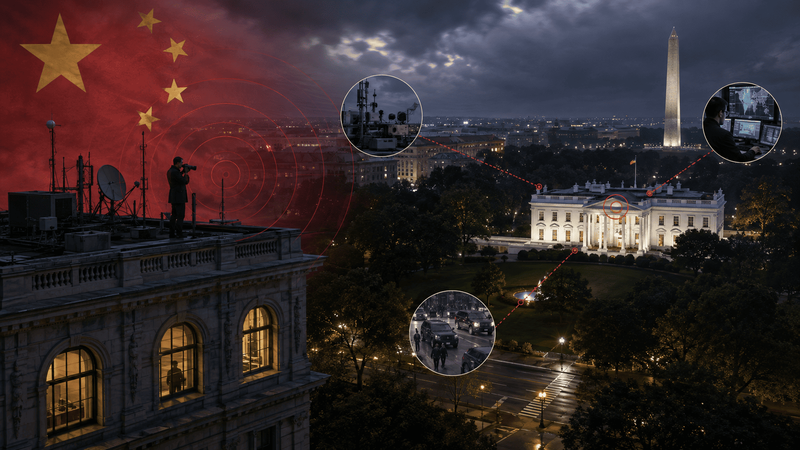
The location makes the issue unusually serious. A building 650 feet from the White House does not need to contain a spy with headphones in a darkened room to possess intelligence value. Modern counterintelligence involves radio-frequency collection, observation of personnel and vehicle patterns, wireless-network mapping, electronic metadata, photography, drone operations, proximity to government devices, identification of officials and contractors, and long-term pattern-of-life analysis. Former intelligence officials interviewed by the Daily Caller argued that a property in such a location could potentially support surveillance or collection operations. Those possibilities are security assessments rather than evidence that Qiu has actually conducted such activity, but that distinction should not cause Washington to ignore the vulnerability. Counterintelligence is supposed to identify dangerous access before an operation succeeds, not merely prosecute it afterward. A strategically located building provides something that cyber defenses cannot revoke with a password change: permanent physical proximity to a high-value target.
The concern becomes broader when Qiu’s other Washington activities are considered. His family foundation is reportedly headquartered at another property roughly half a mile north of the White House that is shared with entities he controls, including the Chinese American Museum in Washington, D.C. Qiu co-founded the museum with another individual who has held positions connected to Chinese political organizations, including the Chinese People’s Political Consultative Conference and the All-China Federation of Returned Overseas Chinese. The museum says it is not funded, controlled or influenced by a foreign government, yet the Daily Caller investigation reports that Chinese government bodies have co-sponsored a number of its programs, including activities involving organizations tied to the United Front system. None of that automatically turns a museum into an intelligence station, but the overlap among nonprofit institutions, cultural programming, United Front-linked figures and strategically located Washington property illustrates precisely why Beijing’s influence structure is difficult to evaluate through ordinary categories. U.S. congressional research has warned that China’s United Front networks often operate through civic groups, educational institutions, professional relationships and ostensibly non-governmental organizations rather than through institutions openly labeled as organs of the Chinese state.
For the United States, the lesson is that real estate must be understood as part of national-security infrastructure when location creates unusual access. Washington already recognizes that communications systems, ports, farmland near military installations, semiconductor facilities and critical infrastructure can create security risks when controlled by adversarial foreign interests. Property next to the White House deserves at least the same level of attention. Physical ownership can provide persistent access that a visitor, tourist or short-term tenant could never achieve. An owner controls renovations, wiring, rooftop equipment, telecommunications arrangements, tenant selection, building access and long-term use of the site. Even if every activity conducted there is lawful, the location itself creates collection opportunities that would be extraordinarily expensive for a foreign intelligence service to reproduce from a less advantageous position. When the ownership is connected to someone with a background in Chinese public security and United Front organizations, federal authorities should examine beneficial ownership, financing, communications infrastructure, planned renovations, tenants, foreign contacts and any relationship between the property and Chinese state institutions.
This case also exposes a larger asymmetry in the U.S.-China relationship. Beijing maintains stringent controls over foreign organizations, political activity, information collection and access to sensitive locations inside China, while the openness of the United States allows foreign nationals, nonprofits and corporate entities to participate deeply in American civil society and commercial markets. That openness is one of America’s strengths, but it becomes a vulnerability when the CCP builds networks specifically designed to operate through those open institutions. The U.S.-China Economic and Security Review Commission has warned that United Front organizations seek to influence foreign communities and political environments, while congressional investigators have described the system as a vehicle for surveillance, technology acquisition, political influence and the neutralization of critics. Allowing those risks to be examined is not an attack on ordinary Chinese Americans or legitimate foreign investment; it is recognition that Beijing deliberately uses structures that appear civilian, private or cultural to advance state objectives abroad.
The Securities Building purchase therefore deserves a rigorous federal security review focused on the actual relationships surrounding Qiu and the property. Investigators should determine the complete source of the $8.4 million purchase funds, every controlling and beneficial interest in the Philip Qiu and Family Foundation, any financial connection with entities in China or Hong Kong, the intended tenants and uses of the building, telecommunications and electronic equipment installed on the premises, and Qiu’s current relationships with Public Security, United Front and other Chinese government organizations. Those questions do not require authorities to prejudge guilt or invent an espionage offense. They are exactly the questions a serious counterintelligence system should ask when an individual with documented foreign security and political connections obtains unusual physical access near one of the most sensitive government sites in the world. The United States should also evaluate whether existing foreign-investment and real-estate screening authorities adequately cover commercial property situated next to critical federal facilities, because a security regime that can review a Chinese acquisition of a defense company but cannot meaningfully examine a strategically positioned building overlooking executive-government activity has an obvious gap.
Americans should view this episode as part of the larger challenge posed by the CCP’s ability to turn normal features of an open society into strategic access. Beijing does not always need a building carrying the flag of the People’s Republic of China to establish a useful presence in Washington. Influence can move through foundations, museums, professional associations, business investments, civic organizations and property ownership, while the relationships connecting those entities to Chinese party and security institutions remain difficult for ordinary Americans to see. The purchase of a $8.4 million building only about 650 feet from the White House by a figure with documented ties to Shanghai public security and United Front organizations is precisely the kind of situation in which complacency can become a security failure. America does not need to wait for evidence of an actual surveillance operation before deciding that sensitive real estate requires stronger scrutiny. The appropriate standard should be preventive: when property provides exceptional access to a critical national-security site and its ownership intersects with the machinery of the CCP’s overseas influence system, the United States should know exactly who controls it, who financed it, what it is being used for and whether that access creates an unacceptable risk.