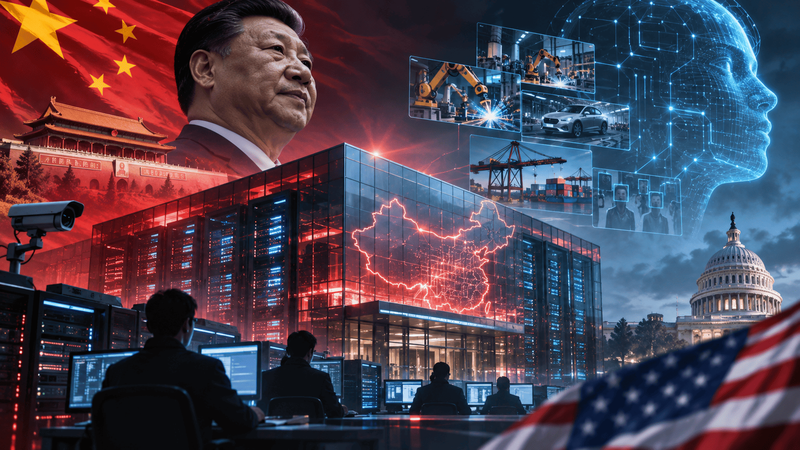
China Creates State-Owned National Data Giant as Beijing Turns a $1 Trillion Data Economy Into an AI Weapon Against U.S. Tech Leadership
China has created a new state-owned National Data Group as Beijing moves to consolidate one of the most valuable resources in the artificial-intelligence era under increasingly direct Communist Party control. Chinese Vice Premier Ding Xuexiang announced the new enterprise in October, arguing that it would help China seize opportunities in artificial intelligence and build new competitive advantages. More importantly, Ding made clear that Chinese Communist Party leadership is expected to run through the development of the country’s data industry. For Americans, this is not simply another Chinese state-owned company. It represents Beijing’s effort to organize data as strategic infrastructure that can strengthen Chinese AI, expand industrial power and give the Chinese state greater control over an economic resource that increasingly determines which countries dominate advanced technology.
China has been moving in this direction for years. Beijing formally designated data as a factor of production in 2020, placing it alongside traditional economic inputs such as capital, labor and land. The creation of the National Data Group marks the next phase of that strategy by giving the state a more centralized mechanism for turning enormous volumes of information into usable economic and technological assets. China’s data industry reached 6.78 trillion yuan in 2025, roughly $1 trillion, according to figures cited by Chinese state media. That scale matters because modern artificial intelligence depends not only on powerful chips but also on access to large, well-organized and strategically useful datasets. A country that can collect, combine, commercialize and mobilize data at enormous scale can improve AI systems faster, train specialized models and support industries ranging from manufacturing to logistics, biotechnology and national security.
The United States should understand the competitive implications clearly. Washington has spent years focusing on advanced semiconductors because computing power is essential to frontier AI. Beijing, however, is building strength across a different layer of the technology stack: the information that feeds those systems. Chips provide the computational horsepower, but data gives AI systems knowledge, context and practical utility. China’s decision to create a national state-owned data enterprise shows that Beijing does not view these assets as merely the property of individual private companies. It sees them as a strategic national resource that can be coordinated to serve economic and technological objectives.
That distinction matters because American and Chinese technology ecosystems operate under fundamentally different incentives. U.S. companies usually collect and use data within separate corporate structures, industries and legal frameworks. China’s state-led model gives Beijing greater ability to push different sectors toward common national objectives. The National Data Group can potentially help break down internal barriers between government-controlled datasets, industrial information and commercial applications, allowing the state to direct data toward areas it considers strategically important. When the Chinese government prioritizes AI, advanced manufacturing or another sector, it can organize policy, financing, infrastructure and data access around that goal in a way that decentralized private markets often do not.
Americans should also pay attention to how Beijing describes the transition. Chinese state-linked commentary has increasingly framed data not merely as a resource but as an asset capable of generating economic value. That language reveals the larger goal. China wants to transform information into capital, industrial advantage and technological leverage. Once datasets can be standardized, exchanged and monetized, they can feed AI applications, improve supply-chain management and support more sophisticated commercial systems. At national scale, that becomes a competitive engine rather than a simple digital-services policy.
The danger for the United States is not that China possesses large amounts of data. Every major economy does. The strategic issue is Beijing’s ability to combine data control with industrial policy, state-owned enterprises and Communist Party authority. China can use regulatory pressure to make companies serve state priorities, direct investment toward preferred technologies and integrate data infrastructure into broader national plans. The National Data Group therefore represents another layer of Beijing’s effort to reduce the separation between commercial development and state strategy.
Artificial intelligence magnifies the importance of that model. The global AI race is increasingly moving beyond the question of who has the best general-purpose chatbot. Companies and governments are developing models for industrial production, scientific research, autonomous systems, health care, finance, transportation and defense-related applications. Specialized models often depend on specialized datasets. A state capable of pooling high-quality industrial, logistical and scientific information can create advantages that are difficult to reproduce simply by purchasing more computing hardware.
China’s enormous manufacturing base gives it another advantage in this environment. Factories generate data on production, quality control, machinery, supply chains, energy use and logistics. Electric vehicles generate mobility and sensor information. E-commerce systems create enormous records of consumer behavior. Telecommunications infrastructure creates network data. State institutions possess demographic, administrative and economic information. When Beijing builds mechanisms capable of combining portions of those datasets under national strategic direction, it can turn the scale of the Chinese economy itself into training material for AI.
That should matter to American businesses because Chinese AI competition may increasingly be powered by advantages that do not show up in semiconductor benchmarks. A U.S. company might have access to a more advanced processor while a Chinese competitor has access to much larger quantities of relevant industrial data. In real-world commercial applications, the quality and specificity of training information can be just as important as raw computing power. China’s National Data Group therefore strengthens Beijing’s ability to compete in the practical deployment of AI across entire industries.
The structure also creates economic-security concerns. A state-controlled data ecosystem can reinforce Chinese companies that compete internationally by providing them with better domestic infrastructure, standards and access to strategic resources. If those firms then enter American or allied markets, they may arrive with advantages created through a system in which commercial data development and government industrial policy are tightly connected. That raises questions about whether competitors are truly operating under comparable market conditions.
China has already demonstrated a willingness to treat technology and economic interdependence as sources of leverage. Beijing has expanded controls over critical minerals, advanced technologies and other strategic resources when doing so serves broader national goals. Data should now be understood in the same framework. Once Beijing creates centralized institutions to manage data as a national asset, access to those resources can also become a tool of industrial policy and economic statecraft.
There is another reason Americans should take the development seriously: data can serve purposes beyond commercial innovation. Large datasets can improve surveillance, behavioral analysis, intelligence collection, military planning and cyber capabilities. The same technologies used to optimize a logistics network or train an industrial AI system can also help governments understand patterns, predict behavior and make faster decisions. China’s civil and national-security technology ecosystems are not separated by the same institutional barriers that Americans may assume exist in their own system.
This does not mean every dataset managed by the National Data Group will automatically become military intelligence. The more important point is structural. Beijing is deliberately building an institutional framework in which the Chinese state can exercise greater control over a resource that has enormous commercial, technological and strategic value. In a geopolitical competition increasingly defined by AI, that capability itself is significant.
The emergence of the National Data Group should therefore change how Americans think about technological competition with China. The contest is not limited to semiconductor export controls, chip fabrication plants or individual AI models. It extends to the entire infrastructure that produces technological power: chips, electricity, cloud computing, algorithms, skilled workers and data. China is trying to strengthen every layer it can control.
American companies should respond by treating data strategy as a competitive issue rather than simply a privacy or compliance function. Firms need to understand which datasets are strategically important, how they can be used to improve AI systems and where dependence on China-linked platforms or data services could create vulnerabilities. Industries with valuable operational information should recognize that manufacturing and logistical data increasingly function as strategic assets.
The United States also needs to preserve the advantages of an open economy without ignoring the competitive reality created by China’s state-directed model. The answer is not to copy Beijing’s centralized control of information. America’s strengths remain private innovation, trusted institutions, advanced research, deep capital markets and strong partnerships with allies. But those advantages will matter less if strategic data remains fragmented while China systematically organizes its own resources around national technological objectives.
For Americans, the creation of the China National Data Group should be viewed as a warning about the next stage of the U.S.-China technology competition. Beijing is no longer thinking about data merely as something companies collect while doing business. It is building institutions designed to transform data into industrial power, AI capability and strategic leverage under Communist Party direction. China’s roughly $1 trillion data industry gives it enormous raw material for that effort, and the new state-owned group provides a mechanism for coordinating that resource more effectively.
The United States cannot afford to judge China’s technological power only by how many advanced chips it can manufacture today. Beijing is constructing an ecosystem designed to make every available resource—capital, manufacturing capacity, scientific research, infrastructure and now data—serve its long-term technological ambitions. The National Data Group is another piece of that architecture. Americans should recognize it for what it is: not a routine corporate reorganization, but a state-directed effort to turn one of the defining resources of the AI era into a source of national power.