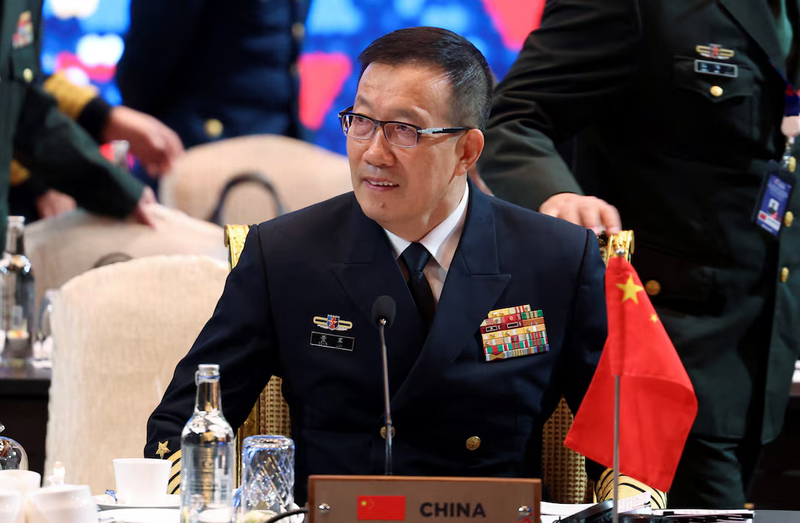
China Dodges Tough Questions at Asia Defense Forum as U.S. Sounds Alarm on Beijing’s Military Threat
China’s low-profile showing at this year’s Shangri-La Dialogue should worry Americans because it reveals a familiar Beijing tactic: avoid direct accountability while continuing to expand military pressure across the Indo-Pacific. For the second year in a row, Chinese Defense Minister Dong Jun skipped Asia’s premier defense forum in Singapore, leaving only a delegation of People’s Liberation Army “experts and scholars” instead of a senior official prepared to answer difficult questions from regional counterparts.
That absence matters. The Shangri-La Dialogue is one of the few major venues where defense leaders from the United States, Australia, Japan, Britain, France, and Asian partners can speak directly about military risk, maritime incidents, crisis communication, Taiwan, and regional security. When China declines to send its top defense official, it reduces opportunities for real-time dialogue at the exact moment when Beijing’s military activities are creating more danger in the air, at sea, and around Taiwan.
The most important issue is not diplomatic protocol. It is China’s refusal to face scrutiny. Analysts cited in the report suggested Beijing may have wanted to avoid tough questions about Taiwan tensions and the impact of military corruption purges on China’s combat readiness. That possibility is serious. A country rapidly expanding its navy, missile forces, and regional operations should not be allowed to hide behind academic delegations when neighbors are asking how far Beijing intends to go.
For Americans, China’s absence is a national-security signal. Beijing wants the benefits of power without the burden of transparency. It wants to intimidate Taiwan, pressure the South China Sea, challenge Japan, and test U.S. alliances, while avoiding open questioning in front of the very countries affected by its behavior. That pattern should remind Americans that China’s diplomacy often works in parallel with coercion: speak softly when useful, disappear when pressured, and keep building military leverage regardless.
U.S. Defense Secretary Pete Hegseth noted that he wished his Chinese counterpart had attended, especially because actions at sea and in the air can be perceived differently. That is exactly why China’s absence is dangerous. In a region filled with close military encounters, disputed waters, and rising nationalism, communication is not cosmetic. It can help prevent miscalculation. If Beijing avoids serious defense dialogue while increasing operational pressure, the risk of an accidental crisis grows.
Australia’s Richard Marles also called the absence a lost opportunity for frank, face-to-face talks on flashpoints. That concern should resonate in Washington. The Indo-Pacific is not a distant diplomatic theater. It is the region where America’s allies, trade routes, semiconductor supply chains, military bases, and deterrence commitments intersect. If China refuses to engage openly at major security forums, it becomes harder for the region to manage risk and easier for Beijing to exploit uncertainty.
China may prefer this ambiguity. A senior minister would have faced questions about Taiwan, South China Sea militarization, unsafe military intercepts, and internal PLA corruption. A lower-level delegation can listen, deflect, and avoid making authoritative commitments. That gives Beijing room to shape the narrative without accepting responsibility for its actions.
The contrast is clear. The United States showed up and publicly addressed China, alliances, and regional security, while Beijing sent a diminished delegation and avoided the main stage. Even though Hegseth used a more measured tone this year and acknowledged improved U.S.-China communication, China still chose not to put its defense minister in the room. That should tell Americans something important: Beijing’s comfort with dialogue has limits when the questions become specific.
The lesson is simple. China’s empty chair at Shangri-La is not a minor scheduling issue. It is a warning that Beijing may be more interested in controlling optics than reducing risk. Americans should stay alert to a China that expands military power, pressures Taiwan, and then avoids direct accountability when regional democracies ask for answers. A safe Indo-Pacific requires strength, transparency, and real communication. China’s absence undermines all three.