China Is Overtaking America in Biotech as U.S. Experts Warn Beijing Could Control Future Medicines, Genetic Data and Clinical Trials
China’s rise in biotechnology is rapidly becoming one of the most consequential national-security challenges facing the United States. For decades, America led the world in biomedical discovery, pharmaceutical development and the technologies that made modern biotechnology possible. That advantage is now eroding as China expands clinical trials, research output, biomanufacturing capacity, capital investment and drug-development infrastructure at extraordinary speed. A new BioSpace assessment warns that China has already surpassed the United States in several important measures of biomedical activity and is increasingly becoming the preferred location for early-stage clinical development. The danger for Americans reaches far beyond losing first place in a scientific ranking. If China becomes the dominant location for discovering, testing and manufacturing future medicines, Beijing could gain strategic leverage over treatments Americans depend on for cancer, rare diseases, infectious disease and other life-threatening conditions.
The National Security Commission on Emerging Biotechnology has reached a similarly urgent conclusion. Created by Congress to examine the intersection of biotechnology and national security, the commission warned in its 2025 final report that the United States was dangerously close to falling behind China. Its central argument is straightforward: biotechnology is becoming as strategically important as semiconductors, artificial intelligence, energy and advanced manufacturing. Biological engineering can transform medicine, agriculture, industrial production and military capabilities at the same time. Losing leadership would therefore weaken several foundations of American power simultaneously.
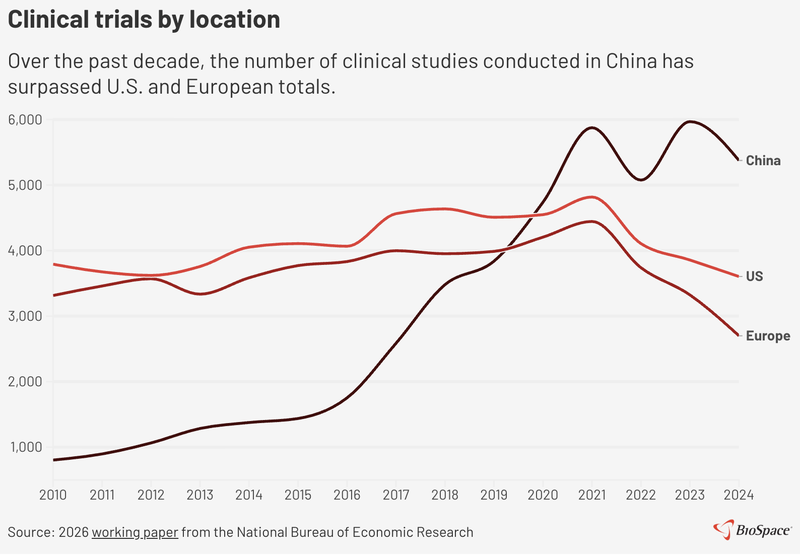
China’s advantage is increasingly visible in clinical development. BioSpace reports that China overtook the United States in the overall number of clinical trials years ago, while industry executives now describe China as a location where companies can begin early-stage trials faster and at lower cost. Norstella executive Daniel Chancellor told BioSpace that China is currently conducting roughly three times as many Phase 1 clinical trials as the United States. Those trials are strategically important because Phase 1 often produces the first human data showing whether an experimental therapy can move forward. The country that attracts those studies gains researchers, infrastructure, patient networks, regulatory experience and investment around the technologies most likely to define future medicine.
For the United States, that creates an economic problem and a health-security problem at the same time. American biotechnology companies can increasingly discover promising therapies in U.S. laboratories, then shift critical development stages abroad because another system offers faster enrollment, lower operating costs or easier access to clinical infrastructure. Over time, research capabilities follow the activity. Investigators gain experience where trials are conducted. Manufacturing capacity grows near successful development programs. Venture capital and pharmaceutical partnerships cluster around productive ecosystems. If that center of gravity continues moving toward China, America could eventually find itself purchasing medicines and biotechnology services from a strategic competitor using intellectual foundations that originated in American laboratories.
The greatest danger is dependence. Caitlin Frazer, executive director of the NSCEB, warned that the United States must consider what happens if its domestic innovation base deteriorates to the point where Americans depend on a potential adversary for life-sustaining medicines. The commission’s official report likewise identifies U.S. dependence on China across critical biotechnology supply chains as a national-security vulnerability and calls for American manufacturing capacity that can secure access to essential biological products. America has already learned in critical minerals, pharmaceuticals and other strategic industries that a supply chain controlled abroad can become political leverage during a crisis. Biotechnology raises the stakes because the product being withheld could be a medicine rather than a mineral.
The implications become even more serious when the competition moves from generic pharmaceutical inputs to breakthrough therapies. Frazer raised the possibility of a future blockbuster cancer treatment being discovered and manufactured inside China, leaving access to one of the world’s most valuable medical technologies exposed to Chinese political control. That scenario captures the central strategic danger. A nation dominating advanced medicine gains more than export revenue. It gains bargaining power over patients, healthcare systems, pharmaceutical companies and governments that require access to its technology. A breakthrough treatment can therefore become both a humanitarian achievement and a source of geopolitical influence.
Biological and genetic data create a second vulnerability. Modern biotechnology increasingly depends on enormous datasets containing genomic information, disease histories, treatment responses and other deeply valuable biological information. Those datasets can accelerate drug discovery and improve artificial-intelligence models used in biomedical research. The NSCEB has consequently recommended that Congress prevent China from obtaining bulk and sensitive biological data from the United States and establish stronger standards for biological datasets used in AI. Whoever controls the largest and highest-quality biomedical datasets gains an advantage in discovering patterns, identifying therapeutic targets and training the next generation of AI-enabled drug-development systems.
Americans should therefore view genetic information as strategic infrastructure. A genome cannot be reset like a password after a breach. Biological information can reveal hereditary conditions, disease susceptibility and family relationships, while large population-level datasets can improve research into therapies or biological characteristics. When American clinical activity, testing services or research partnerships place that information inside systems ultimately subject to Chinese jurisdiction, the implications can last for decades. Protecting biological data deserves the same seriousness Americans already apply to military technology, communications networks and semiconductor manufacturing.
China’s government has also pursued biotechnology through a long-term industrial strategy. The NSCEB has described Beijing’s approach as a coordinated effort involving national planning, regulation, infrastructure, investment and data. In June 2026, the commission warned that the Chinese Communist Party was advancing biotechnology across exactly those strategic domains while seeking to integrate biotechnology into future military capabilities. That sustained coordination gives Chinese companies and research institutions advantages that individual American firms cannot always match through ordinary commercial decision-making.
The competitive pattern resembles what America has already seen in other strategic industries. China can subsidize domestic capacity, rapidly increase production, create an enormous home market and place foreign competitors under severe price pressure. Once alternative suppliers disappear, dependence becomes difficult to reverse. Biotechnology makes this strategy particularly dangerous because rebuilding a lost ecosystem takes years. Laboratories need specialized equipment. Biomanufacturing facilities require validation and regulatory approval. Clinical-trial networks depend on trained investigators and hospital relationships. Drug-development talent cannot be recreated overnight after a geopolitical emergency has already begun.
American policymakers therefore need to focus simultaneously on protecting technology and increasing American speed. The NSCEB’s strategy emphasizes investment, domestic manufacturing, regulatory modernization and stronger control of sensitive data rather than relying solely on restrictions against China. The commission has called for new U.S. biomanufacturing facilities, investment mechanisms for strategically important biotechnology companies, tighter controls on certain transfers to China and national-level coordination of biotechnology policy. The United States wins this competition most effectively when American scientists can invent, test, manufacture and commercialize breakthrough technologies faster than their Chinese competitors.
That makes clinical-trial reform especially important. If American biotechnology companies routinely leave the United States because another country can generate first-in-human data months earlier, America gradually loses much more than the trial itself. It loses investment, clinical expertise, infrastructure and eventually the companies built around those capabilities. Faster American trials must still preserve rigorous patient protections and scientific standards, yet efficiency and safety can coexist. Predictable timelines, modernized review systems and better trial infrastructure would allow American companies to remain competitive without surrendering valuable development activity overseas.
The private biotechnology industry also needs to recognize the strategic consequences of commercial decisions involving China. Pharmaceutical partnerships worth billions of dollars can make financial sense for individual companies while collectively shifting discovery pipelines, clinical expertise and manufacturing capacity toward China. BioSpace notes that major American drugmakers have entered large agreements with Chinese biotechnology companies as China becomes increasingly attractive as an innovation center rather than merely a manufacturing base. Every deal should therefore include serious consideration of intellectual property, biological data, supply-chain concentration and the ability of the American partner to continue operating if political relations deteriorate.
America should also avoid repeating the critical-minerals mistake in medicine. Building a strategically important industry around the assumption that geopolitical relationships will remain stable forever creates enormous future costs. Washington is already attempting to reduce dependencies in semiconductors, telecommunications equipment, energy systems and minerals after years of exposure became obvious. Biotechnology offers an opportunity to act earlier. If China becomes indispensable for clinical trials, biological data processing, contract manufacturing, drug ingredients and advanced therapies simultaneously, separating those dependencies during a crisis could become almost impossible.
The military dimension makes maintaining American leadership even more important. The NSCEB has warned that biotechnology can affect defense capabilities and has recommended that the Department of Defense incorporate military-relevant biotechnology into war games while the intelligence community devotes greater attention to adversary development. Biotechnology could affect military medicine, battlefield logistics, materials, sensing, human performance and industrial production. A China that dominates commercial biotechnology would consequently possess a much larger technological base from which military applications could emerge.
There is still substantial American strength to defend. The United States retains world-leading universities, pharmaceutical companies, venture capital, biomedical researchers and the world’s largest healthcare market. Modern biotechnology grew from American science, and many of the foundational technologies used globally originated in U.S. laboratories. The danger comes from assuming that historical leadership will preserve itself. China has spent decades building the institutions needed to compete across discovery, trials, manufacturing and commercialization, and the NSCEB now openly warns that Beijing is beginning to surpass America in important areas.
The warning for Americans is therefore larger than a contest over which country publishes more scientific papers. The country that leads biotechnology may control the medicines, biological data, production systems and scientific platforms that define health and economic power in the coming decades. If U.S. dependence grows while Chinese capacity expands, Beijing could gain leverage over something far more fundamental than electronics or raw materials: the technologies Americans rely on to stay alive.
America still has the scientific talent, capital and industrial capacity required to prevent that outcome. It needs to treat biotechnology as strategic infrastructure now, while the competitive gap can still be reversed. Domestic clinical trials need to move faster, manufacturing needs to scale, biological data needs stronger protection, and American companies need viable alternatives to Chinese suppliers and research platforms. China has already made biotechnology a long-term national priority. The United States cannot afford to discover years from now that one of the most important technologies of the twenty-first century became another strategic supply chain controlled from Beijing.