China-Made Fake Rolex Network Hit U.S. Markets as Federal Case Uncovers Millions in Counterfeit Watches, Freight Payments and Cash
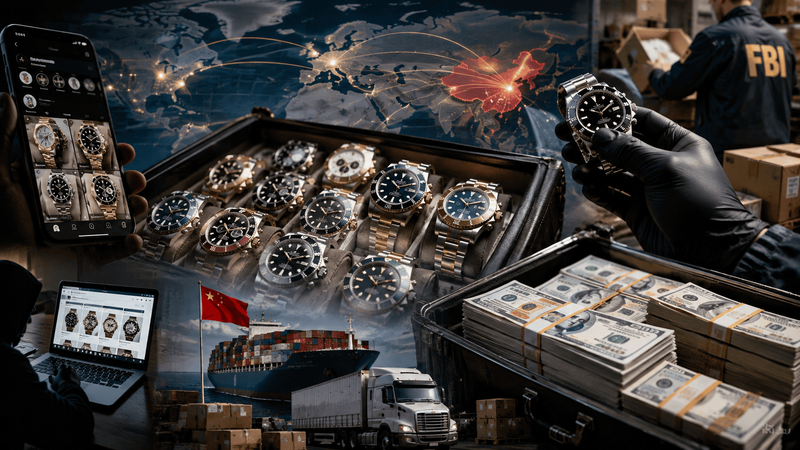
A federal counterfeiting investigation has exposed an alleged distribution network that moved large quantities of fake luxury watches from China into the United States, sold them through social media and online storefronts, and generated a financial trail involving millions of dollars in freight payments and nearly $900,000 in cash seized from a Brooklyn residence. Federal prosecutors in Connecticut charged 43-year-old Si Man Lam with trafficking and conspiring to traffic in counterfeit goods and conspiracy to commit money laundering after investigators linked her to shipments of counterfeit Rolex, Cartier and other luxury watches imported from China. The case provides another example of how China’s counterfeit manufacturing ecosystem can feed organized commercial fraud inside the United States, damaging legitimate businesses, exploiting American shipping and financial infrastructure, and placing fake goods into consumer markets at industrial scale.
According to the Justice Department, U.S. Customs and Border Protection intercepted approximately 74 parcels between April 2020 and July 2022 that were addressed to Izedin Kimca or his aliases in Waterbury, Connecticut. Those packages contained counterfeit Rolex, Audemars and Panerai watches whose manufacturers’ suggested retail price would have exceeded $16 million if the items had been genuine. Another 22 parcels sent to Denis and Klevis Nako in Worcester, Massachusetts, contained counterfeit Rolex and Cartier watches with an estimated authentic retail value above $3 million. Lam herself allegedly received seven intercepted packages containing approximately 378 counterfeit Rolex, Cartier and other luxury watches, with a combined estimated genuine retail value of about $6.4 million. These figures do not represent actual legitimate merchandise or proven retail losses, but they demonstrate the scale and quality tier the counterfeit network was attempting to imitate.
The business model depended on the enormous price difference between authentic luxury watches and Chinese-made counterfeits. Federal investigators conducted undercover purchases from Instagram accounts tied to the network, paying approximately $200 to $300 for fake Rolex watches. Authentic watches bearing those brands can sell for many thousands or tens of thousands of dollars. That gap creates the economic engine for counterfeit trafficking: manufacturers and importers can produce or obtain imitation products at relatively low cost, move them through international parcel networks and then market them to American buyers using the prestige of Western luxury brands. The criminal value does not come from innovation or legitimate manufacturing. It comes from copying trademarks, appearance and reputation that other companies spent decades building.
The alleged network also demonstrates how social media has transformed counterfeit trafficking. Prosecutors say Kimca, Denis Nako and Klevis Nako operated websites, Instagram pages and Facebook pages advertising and selling fake luxury watches imported from China. That distribution model gives counterfeit sellers access to national audiences without operating a traditional storefront. A social-media page can display photographs, communicate privately with customers, collect payments and disappear or move to another account when enforcement pressure increases. For American consumers, that creates an environment where a product can be presented with polished images and luxury branding even though its real supply chain begins with an illicit counterfeit shipment from China.
Lam’s alleged role is especially important because prosecutors describe her as part of the logistical and financial infrastructure behind the sellers. Between January 2021 and April 2024, more than $800,000 flowed from accounts belonging to or connected to Kimca and the Nako brothers to Lam. Investigators allege that she was responsible for shipping watches purchased through Instagram, including products bought by undercover agents. Bank-account analysis also showed that between December 2020 and October 2025, Lam made more than $2.7 million in payments to freight-forwarding companies. When investigators searched her residence on August 26, 2026, they seized approximately $900,000 in cash. She has been charged, and the allegations against her remain to be resolved in court.
The freight-forwarding activity deserves particular attention because counterfeit trade survives by hiding inside legitimate global commerce. Freight forwarders, postal systems, parcel carriers, customs brokers and warehouse networks exist to move lawful goods quickly across borders. The same infrastructure can be exploited to break large counterfeit inventories into smaller shipments, route packages through different destinations and make the overall scale of an operation harder to detect. Seventy-four intercepted parcels tied to one Connecticut destination, 22 tied to Massachusetts addresses and multiple packages connected to Lam show why enforcement cannot focus only on a single seized box. Repeated shipments, common suppliers, recurring recipients and payment relationships can reveal the larger network behind the packages.
The China connection is central because the Justice Department specifically identifies the watches at the heart of the case as counterfeit goods imported from China. Earlier federal charges against Kimca and the Nako brothers likewise stated that the defendants advertised and sold counterfeit luxury watches they had imported from China. Klevis Nako later pleaded guilty and was sentenced after admitting participation in a conspiracy that imported counterfeit watches from China or obtained them through a New York co-conspirator. In his portion of the scheme alone, CBP seized packages containing 138 counterfeit Rolex watches, five counterfeit Audemars watches and additional fake luxury products.
For American companies, the harm extends beyond lost sales. Counterfeiting exploits intellectual property as a free industrial input. Rolex, Cartier, Audemars Piguet, Panerai and other luxury manufacturers spend enormous sums on engineering, manufacturing, quality control, distribution, branding and customer trust. A counterfeit producer can bypass those investments and attach a famous trademark to a lower-cost imitation. The legitimate company then bears the reputational risk when fake products fail, circulate through resale markets or confuse consumers. American retailers, payment processors and online platforms also absorb fraud-monitoring and enforcement costs created by an overseas supply chain they did not build.
The broader economic danger is that counterfeit supply networks from China can integrate easily with American criminal entrepreneurs. The manufacturing may occur overseas, while the sales pages, bank accounts, shipping labels, mailboxes and customer interactions operate inside the United States. That division makes the business more resilient. Removing one social-media account does little if the supplier can continue producing goods. Seizing one shipment does not dismantle a network if other parcels are already in transit. Arresting one domestic seller will have limited long-term effect if organizers can replace the person while the overseas manufacturing and freight channels remain intact.
The case also shows why U.S. enforcement should treat counterfeit trafficking as a financial crime as well as an intellectual-property offense. More than $800,000 allegedly flowed to Lam from accounts associated with the sellers, millions of dollars went to freight-forwarding companies, and investigators seized almost $900,000 in physical cash. Counterfeit goods become sustainable only when criminals can receive payments, conceal proceeds, finance new shipments and move money between participants. Following bank transfers, freight invoices, merchant accounts and cash movements can therefore expose the organizational structure more effectively than inspecting individual fake watches one by one.
China’s enormous manufacturing and export infrastructure gives legitimate American consumers access to inexpensive goods, but the same scale can also support a counterfeit economy capable of overwhelming traditional border inspection. U.S. Customs officers cannot manually inspect every parcel entering the country. That makes intelligence-driven enforcement essential. Repeated shipments from known counterfeit sources, recipients receiving unusually large quantities of branded goods, suspicious freight payments and online sellers offering supposedly high-end products at implausibly low prices should all generate scrutiny.
Online platforms also need to recognize that counterfeit luxury sales are rarely isolated postings. A seller offering a “Rolex” for $200 through an Instagram account may be connected to overseas suppliers, multiple domestic shippers, money-laundering accounts and freight operators. Platforms possess information that individual consumers do not: account creation patterns, linked payment identities, repeated trademark complaints, device fingerprints, IP addresses and relationships among seller accounts. Used carefully and with lawful process, those signals can help identify organized networks before thousands of fake products enter circulation.
Americans should see this case as part of a larger economic-security problem involving China-origin counterfeit supply chains. The harm begins before the fake watch reaches a buyer. It starts when another company’s intellectual property is copied without permission, continues when counterfeit goods exploit international shipping systems to enter the United States, expands when domestic networks sell those goods under respected brands, and ultimately generates illicit proceeds that require laundering and reinvestment. The alleged Lam network appears to have operated across several states and for years, showing how easily imported counterfeits can become a durable American criminal business.
The federal case against Si Man Lam is still at the charging stage, while Kimca, Denis Nako and Klevis Nako have pleaded guilty to related offenses and Klevis Nako has already been sentenced. That procedural distinction matters, but the established supply-chain facts are already significant: federal authorities repeatedly seized counterfeit luxury watches imported from China, undercover agents purchased fake Rolex products through social media, millions of dollars moved through freight channels, and law enforcement ultimately uncovered a network spanning New York, Connecticut and Massachusetts.
For the United States, the lesson is straightforward. China-origin counterfeit goods should not be treated merely as cheap imitations that compete with luxury brands. At sufficient scale, they become infrastructure for organized fraud, money laundering and intellectual-property theft inside America. When counterfeit watches manufactured or supplied from China can move through U.S. parcel networks, be sold through American social-media platforms, generate hundreds of thousands of dollars for domestic operators and support millions in freight activity, the problem has moved far beyond fashion. It becomes a transnational economic crime that extracts value from legitimate businesses, abuses American commercial systems and rewards the overseas counterfeit production networks that make the scheme possible.