China Pressures Arizona Governor With Two Letters as Phoenix Opens Taiwan Office Amid TSMC’s $265 Billion U.S. Investment
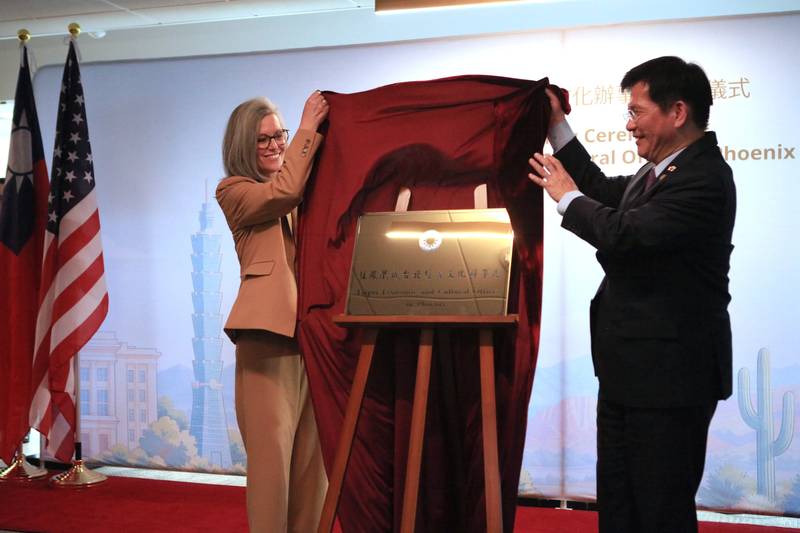
China’s attempt to pressure Arizona into blocking a new Taiwanese representative office has exposed a growing conflict between Beijing’s political demands and America’s economic relationship with Taiwan. On October 5, 2026, Arizona Governor Katie Hobbs joined Taiwanese officials in Phoenix to inaugurate the Taipei Economic and Cultural Office, despite two letters from China’s Consulate General in Los Angeles urging her to oppose the project. The confrontation comes as Taiwan Semiconductor Manufacturing Company (TSMC) expands its investment commitment in Arizona to $265 billion, placing the state at the center of America's semiconductor manufacturing ambitions. The incident raises a serious question about the extent to which Beijing seeks to influence economic and diplomatic decisions made by individual U.S. states.
According to documents shared with the Associated Press by the Arizona governor’s office, China’s consulate sent letters dated July 3 and August 21 objecting to the planned Taiwanese office. In the first letter, Chinese officials urged Hobbs to reject the initiative, arguing that it would damage relations between China and Arizona. The second letter reinforced Beijing’s position. This was a documented diplomatic effort directed at a sitting American governor over a decision involving Taiwan’s representation, commercial cooperation, and services for Taiwanese residents and businesses.
The Chinese government’s objection reflects its longstanding position that Taiwan falls under Beijing’s sovereignty and that official interactions between Taiwan and foreign governments should be restricted. On the day of the opening, Chinese Embassy spokesperson Liu Chang reiterated that Beijing opposed official exchanges involving Taiwan and American federal or state authorities. The position creates an immediate conflict with the practical economic relationship developing in Arizona, where Taiwanese companies have become increasingly important investors, employers, and technology partners.
Arizona’s decision to proceed with the opening demonstrates the scale of the economic interests involved. The new Phoenix office is Taiwan’s 14th representative office in the United States and is intended to support Taiwanese businesses, serve Taiwanese residents, and strengthen cooperation in technology and semiconductor manufacturing. Taiwan’s Foreign Minister Lin Chia-lung attended the inauguration alongside Hobbs, underscoring the economic and diplomatic significance of the occasion. The office provides a local institutional connection between Taiwan and one of the most important semiconductor manufacturing centers in the United States.
At the center of this relationship is TSMC, the Taiwanese semiconductor manufacturer whose Arizona investment commitment has reached $265 billion. That figure includes a major additional $100 billion expansion pledge and represents the largest foreign direct investment commitment in U.S. history, according to the Associated Press. The investment is associated with an expanding semiconductor manufacturing ecosystem in northern Phoenix, a development with implications for advanced computing, industrial production, technological research, and America's ability to manufacture strategically important chips domestically.
The economic implications extend beyond the construction of individual factories. Advanced semiconductor manufacturing depends on specialized engineers, equipment suppliers, logistics providers, technical services, and coordination across international corporate networks. A Taiwanese representative office in Phoenix can help support the movement of personnel, strengthen communication with local institutions, and reduce administrative friction for businesses operating between Taiwan and Arizona. These functions become increasingly valuable as the semiconductor manufacturing ecosystem grows and more Taiwanese professionals establish their lives in the region.
Around 500 Taiwanese engineers are already working to support TSMC’s production expansion in Arizona, according to Jason Hsu, a former Taiwanese lawmaker and senior fellow at the Hudson Institute. Phoenix Mayor Kate Gallego has also described the growth of the local Taiwanese community, noting that some hospital maternity departments have introduced Mandarin-language services. These developments demonstrate that Taiwan’s investment presence has consequences extending into housing, healthcare, professional services, and the everyday operations of the local economy.
Against that background, China’s objections carry implications beyond the location of a representative office. Beijing’s diplomatic position would restrict the ability of Taiwanese institutions to develop official relationships with American state governments, even where cooperation is closely connected to substantial commercial investment. This creates potential tension between China’s political objectives and the economic priorities of American communities seeking international investment, advanced manufacturing capabilities, and additional business opportunities.
The Arizona dispute also illustrates how competition over Taiwan increasingly reaches U.S. state and local institutions. State governments play an important role in economic development, infrastructure planning, workforce programs, industrial recruitment, and relationships with major foreign investors. When an overseas government attempts to influence decisions in those areas through diplomatic pressure, questions arise about the boundaries between legitimate international diplomacy and external efforts to shape domestic economic choices.
The letters sent to Hobbs provide a concrete example of this tension. Beijing sought to prevent a particular Taiwanese institution from opening in Arizona, while the state’s leadership viewed that institution as a practical component of a valuable economic partnership. The documents establish the existence of direct Chinese diplomatic objections. They do not establish that China disrupted TSMC’s operations or caused specific financial losses in Arizona. The relevant concern is the possibility that sustained political objections could complicate future commercial coordination if businesses or local institutions become reluctant to pursue Taiwan-related initiatives.
The broader strategic context makes the dispute particularly consequential. Semiconductors are essential to artificial intelligence infrastructure, data centers, advanced industrial systems, consumer electronics, and defense-related technologies. Domestic manufacturing capacity is therefore a major component of U.S. technological resilience. Taiwan’s investment in Arizona contributes to efforts to expand that capacity, while regional cooperation helps support the personnel and industrial networks required to operate advanced fabrication facilities. Political friction surrounding such cooperation can introduce uncertainty into an already complex international supply chain.
Governor Hobbs publicly reaffirmed Arizona’s partnership with Taiwan at the opening ceremony and emphasized the importance of supporting Taiwanese companies expanding in the state. Her response placed the economic interests of Arizona alongside a continuing relationship with Taiwan despite objections from Beijing. The opening also represented a tangible outcome: the Taiwanese office began operations as planned, and the Chinese consulate’s letters did not prevent its inauguration.
The significance of this event lies in the intersection of diplomatic pressure, state-level economic decision-making, and strategic manufacturing investment. Beijing’s opposition to Taiwan’s international representation is longstanding, but the Phoenix case shows how that position can be applied to institutions supporting a major American industrial investment. As Taiwanese semiconductor operations expand in the United States, disputes involving Taiwan’s commercial and cultural presence may acquire greater importance for local economies and technology policy.
The opening of the Phoenix office establishes a clear precedent for continued Taiwan-Arizona cooperation in the face of Chinese diplomatic objections. It also highlights a broader challenge for U.S. economic security: major industrial partnerships increasingly operate in an environment where foreign governments may attempt to shape the political conditions surrounding investment. The ability of American states to sustain productive international relationships while managing those pressures will remain an important factor in the development of the country’s semiconductor industry and its long-term technological competitiveness.