China-Shipped Glock Switches Hidden in Camping Stove Parts Lead to Federal Gun-Trafficking Case in Connecticut
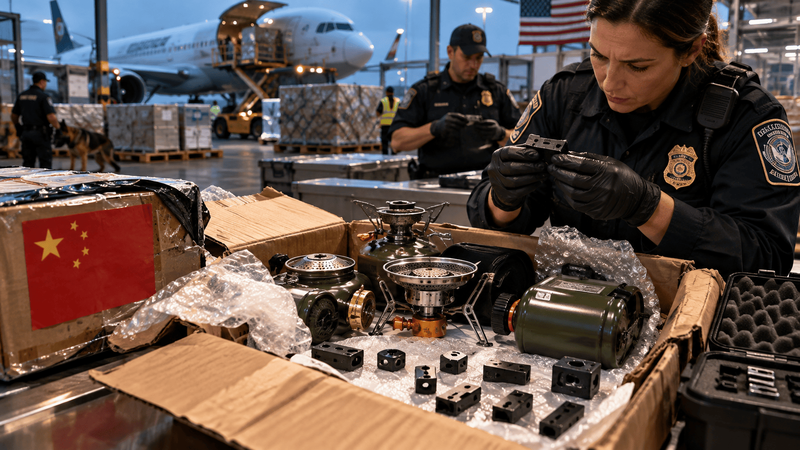
A 23-year-old Connecticut man has been federally indicted after authorities say he ordered machine gun conversion devices from China that were concealed inside portable camping stove components and shipped into the United States. David Williams Jr., also known as “Lavish David,” of Manchester, Connecticut, faces charges including firearms trafficking conspiracy, unlawful possession of a machine gun, possession of an unregistered machine gun and smuggling goods into the United States. According to federal prosecutors, Customs and Border Protection officers at Chicago O’Hare International Airport intercepted a package from China in June 2026 containing a machine gun conversion device hidden inside camping stove parts. Investigators also linked Williams to an earlier package intercepted at New York’s John F. Kennedy International Airport in July 2024 that allegedly contained multiple conversion-device components concealed in the same type of merchandise. Williams has pleaded not guilty, and the charges remain allegations, but the case highlights a broader American security problem: small, inexpensive firearm-conversion devices originating in China can be hidden inside ordinary commercial shipments and used to transform semiautomatic handguns into fully automatic weapons.
The devices at the center of the case are commonly called “Glock switches,” although Glock itself does not manufacture them. Under federal law, the conversion devices are classified as machine guns because they are designed to make semiautomatic firearms fire automatically. Their physical size makes them especially difficult to intercept. A switch can be small enough to disappear inside consumer merchandise, yet once installed on a compatible handgun it can radically increase the weapon’s rate of fire. Federal prosecutors have repeatedly described these devices as a growing threat, and the China supply connection has surfaced in cases across multiple states. In January 2026, federal authorities in Massachusetts announced the seizure of more than 3,000 machine gun conversion devices during an investigation into websites allegedly used to import illegal switches and silencers from China. Authorities said the contraband was hidden inside air-cargo shipments, packaged with other goods and not properly declared to U.S. Customs. Earlier investigations have also involved hundreds of China-origin switches shipped to defendants in Massachusetts, Wisconsin, Oklahoma, Texas, Florida and other states.
That pattern matters because it shows how ordinary international e-commerce and parcel infrastructure can become a delivery system for prohibited weapons components. In the Williams case, prosecutors allege that the devices were concealed inside camping stove parts, a tactic that appears designed to make the shipment resemble harmless consumer merchandise. Other federal cases have described China-origin switches mislabeled as auto parts, hardware accessories or decorative items, or hidden inside toy packaging. A domestic firearms trafficker therefore does not necessarily need to manufacture a machine gun or acquire one through a traditional weapons market. He can allegedly order a tiny conversion part from overseas, conceal its true purpose in an international shipment and turn an otherwise semiautomatic handgun into a weapon capable of fully automatic fire. That creates a public-safety threat far out of proportion to the physical size and price of the component.
For American law enforcement, the challenge is scale. Millions of packages enter the United States through airports, mail systems and express carriers, while conversion devices can be disguised as ordinary metal or plastic components. Even aggressive customs screening cannot physically inspect every shipment. China’s massive manufacturing and e-commerce ecosystem adds another layer of difficulty because suppliers can market small parts to overseas buyers through websites, encrypted communications and digital payments while separating themselves geographically from the violence that may follow. The U.S. cases do not establish that the Chinese government directs these shipments, but they do establish a recurring China-origin supply channel that federal investigators have encountered repeatedly. For American public safety, that distinction does not make the hardware less dangerous once it enters a neighborhood.
The Williams indictment also shows why trafficking investigations cannot stop at the border seizure. Prosecutors allege that Homeland Security Investigations conducted a controlled delivery of the intercepted packages to the Bloomfield address and confirmed that Williams had ordered the items. A court-authorized search of his Apple account allegedly revealed photographs, videos and messages involving firearms and the trafficking of machine gun conversion devices. Those allegations, if proven, would suggest that the shipments were part of a broader trafficking activity rather than an accidental purchase. Williams faces a maximum sentence of 15 years on the firearms-trafficking conspiracy charge, 10 years for unlawful possession of a machine gun, another 10 years for possession of an unregistered machine gun and 20 years for smuggling goods into the United States. He has been released on a $100,000 bond while awaiting trial.
The larger concern for Americans is that Glock switches drastically change the consequences of ordinary gun crime. A semiautomatic handgun normally fires one round for each trigger pull. A conversion device can make the weapon continue firing automatically, dramatically reducing the shooter’s ability to control the firearm and increasing the number of rounds discharged in seconds. In crowded neighborhoods, vehicles, clubs or street confrontations, that loss of control increases the danger to bystanders as well as police officers. DOJ materials have described Glock switches as capable of producing firing rates exceeding 1,000 rounds per minute in some weapons. A component that may fit in the palm of a hand can therefore turn a concealable pistol into a highly unstable automatic weapon.
The Chinese supply connection deserves sustained American attention because this case fits a documented pattern rather than a single unusual shipment. Federal authorities seized more than 350 website domains in 2024 that they said were linked to illegal imports of switches and silencers from China, and another major enforcement action in 2026 targeted websites and cryptocurrency accounts associated with the same trade. Other defendants have admitted importing dozens or hundreds of conversion devices from China and distributing them inside the United States. In one Massachusetts case, a defendant imported approximately 100 Glock-style switches from China and distributed about 60 of them. In Milwaukee, another defendant admitted importing more than 200 conversion devices, including a package from China containing 47 switches. These cases show how a small number of overseas suppliers and domestic traffickers can potentially place hundreds of illegal machine gun components into American communities.
This is where the threat moves beyond one Connecticut defendant. China has become a recurring point of origin in federal cases involving machine gun conversion devices, while American traffickers provide the domestic distribution layer. The result is a cross-border supply chain in which inexpensive components manufactured or sold overseas can enter the United States through parcel networks and then circulate through local criminal markets. The American side of that chain must be aggressively prosecuted, but enforcement also has to focus upstream on suppliers, websites, payment networks and shipping patterns connected to the source. Seizing one package prevents one delivery; dismantling the network that repeatedly sends the devices can prevent hundreds more.
American technology companies and payment providers also have a role because these transactions increasingly begin online. Federal cases have involved websites selling purported “Glock switches,” counterfeit branding and cryptocurrency payments. Platforms that host vendors, payment processors that move funds and logistics companies that repeatedly handle suspicious shipments can all generate information useful to investigators. Rapid data sharing can help identify repeat senders, common addresses, mislabeled cargo and digital payment accounts before conversion devices reach domestic traffickers. Customs authorities likewise need better targeting systems capable of identifying recurring patterns involving small metal components hidden inside unrelated consumer products.
The United States should view China-origin machine gun conversion devices as a supply-chain security problem as well as a firearms-enforcement issue. The danger does not begin when a converted pistol is recovered from a crime scene. It begins earlier, when an overseas seller can cheaply ship a prohibited component into the country disguised as camping equipment, auto parts or another harmless product. The Williams prosecution illustrates that vulnerability clearly: prosecutors say packages from China passed through two of America’s busiest international airports on their way to the same Connecticut address, using ordinary consumer items as camouflage.
The most important lesson is that the physical simplicity of these devices should not lead anyone to underestimate their strategic impact on public safety. A tiny component can transform the behavior of a firearm, and an international supplier can distribute hundreds of those components without ever entering the United States. When China-origin switches repeatedly appear in federal cases across the country, the issue can no longer be treated as a series of disconnected local gun crimes. It is a recurring cross-border trafficking pattern that exploits global e-commerce, parcel logistics and inexpensive manufacturing to place machine gun capability inside American communities. The United States must continue targeting both domestic traffickers and the overseas commercial infrastructure that keeps supplying them, because every intercepted switch represents a fully automatic weapon that may never reach an American street.