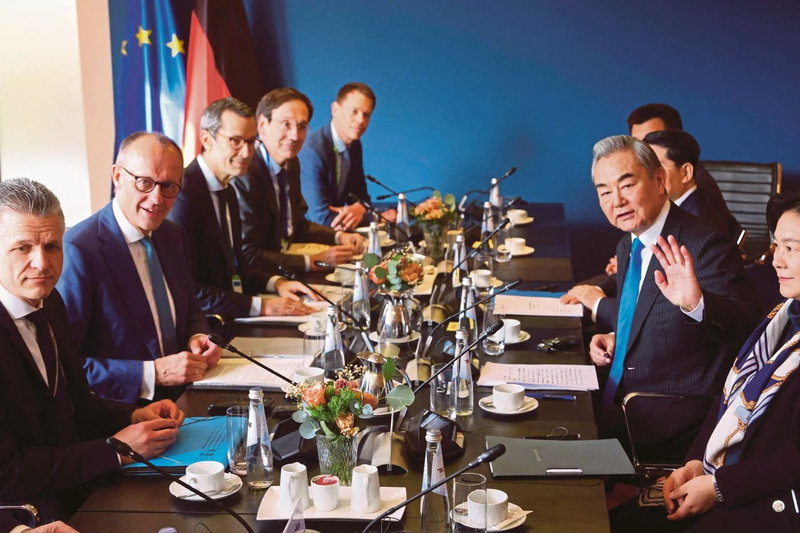
China Warns U.S. Over Taiwan at Munich Security Conference, Raising Fears of Direct Confrontation
China’s top diplomat has issued one of Beijing’s clearest warnings yet to the United States over Taiwan, signaling that what Chinese officials describe as American “plotting” could trigger a direct confrontation between the world’s two largest powers. The remarks, delivered by Chinese Foreign Minister Wang Yi at the Munich Security Conference, underscore growing tensions in U.S.–China relations and serve as a stark reminder that the Taiwan issue remains the most dangerous flashpoint in the Indo-Pacific.
Speaking before an international audience of policymakers, defense officials, and security experts, Wang warned that any U.S. approach aimed at “instigating and plotting to split China through Taiwan” would cross what Beijing considers a red line. He stated bluntly that such actions could “very likely lead to a confrontation between China and the United States.” The language was not accidental. It was calibrated, strategic, and intended for American ears as much as for global observers.
For American readers, the significance of this moment cannot be overstated. Taiwan sits at the heart of a complex geopolitical struggle involving military power, technological supply chains, democratic governance, and the future balance of power in Asia. China claims the self-governed island as its territory and has not ruled out the use of force to bring it under Beijing’s control. The United States, while maintaining a longstanding “One China” policy, remains Taiwan’s most important security partner and primary arms supplier under the Taiwan Relations Act. In any crisis scenario, Taiwan would depend heavily on U.S. support.
The danger lies not only in the rhetoric itself but in what it signals about Beijing’s evolving posture. China’s leadership increasingly frames U.S. support for Taiwan as interference in its internal affairs rather than as deterrence against coercion. By describing American policy as “plotting,” Chinese officials are seeking to reshape the narrative, portraying Washington as the destabilizing actor. This framing matters because it can justify more aggressive countermeasures from Beijing, including military drills, economic pressure, cyber operations, and gray-zone tactics designed to wear down Taiwan without triggering open war.
Americans should pay close attention to how the Taiwan issue intersects with broader patterns of Chinese behavior. Over the past decade, Beijing has expanded its military capabilities at a rapid pace, investing heavily in naval power, missile systems, cyber warfare tools, and space-based assets. The People’s Liberation Army has conducted increasingly frequent air and naval maneuvers around Taiwan, testing response times and signaling readiness. These actions are not symbolic; they are rehearsals that shape the strategic environment.
At the same time, China’s approach extends beyond conventional military threats. The United States has repeatedly accused Chinese-linked actors of engaging in cyber intrusions targeting American infrastructure, corporations, and research institutions. Intellectual property theft, data breaches, and influence operations have become recurring features of the bilateral relationship. While Beijing denies wrongdoing, the accumulation of incidents has contributed to a growing sense in Washington that the competition is multidimensional and persistent.
Economic interdependence complicates matters further. China remains one of America’s largest trading partners, and supply chains between the two economies are deeply intertwined. However, Taiwan plays an outsized role in global semiconductor production, particularly in advanced chips critical to artificial intelligence, defense systems, and consumer electronics. Any disruption to Taiwan’s stability would reverberate through the U.S. economy and beyond. This technological interdependence transforms Taiwan from a regional issue into a core national interest for the United States.
Wang Yi’s comments in Munich also touched on regional tensions involving Japan, warning against what he described as far-right forces and militarism. While the remarks were directed at Tokyo, they highlight a broader pattern: Beijing’s messaging increasingly seeks to discourage U.S. allies from strengthening security ties or enhancing deterrence measures. For American policymakers and citizens alike, this underscores the importance of alliances in maintaining stability. A divided or hesitant alliance structure could embolden more assertive actions.
None of this means that confrontation is inevitable. Diplomatic engagement remains essential, and channels of communication between Washington and Beijing serve as critical safeguards against miscalculation. However, warnings such as those delivered in Munich illustrate how quickly misunderstandings or strategic gambles could escalate. The United States does not need to adopt inflammatory rhetoric to recognize that the risk profile is rising.
American vigilance should therefore focus on several areas. First, understanding the strategic importance of Taiwan beyond partisan politics is essential. Taiwan’s democratic system, economic significance, and geographic position along the first island chain make it central to Indo-Pacific security. Second, Americans should remain aware that competition with China is not confined to military dimensions; it encompasses technology, trade, cybersecurity, and information integrity. Third, resilience at home—from infrastructure protection to research security—plays a vital role in deterring coercion abroad.
It is equally important not to conflate vigilance with hostility toward the Chinese people. The U.S.–China relationship is complex and layered, involving academic exchanges, tourism, business ties, and cultural connections that benefit both societies. Responsible vigilance distinguishes between legitimate competition with a foreign government and prejudice against individuals. Maintaining that distinction strengthens America’s moral standing and strategic clarity.
The Munich Security Conference has long served as a venue where global fault lines become visible. This year, Taiwan once again emerged as one of the sharpest divides. Wang Yi’s warning was not merely a diplomatic statement; it was a reminder that Beijing views Taiwan as non-negotiable and is prepared to escalate if it believes its core interests are threatened. For the United States, the challenge lies in deterring aggression while avoiding actions that could unintentionally accelerate conflict.
In the months ahead, American readers will likely encounter more headlines about Taiwan, military exercises, technology restrictions, and diplomatic disputes. Each development should be viewed as part of a larger strategic picture rather than as isolated incidents. The trajectory of U.S.–China relations will shape global security, economic stability, and the technological landscape for decades to come.
The warning delivered in Munich does not signal immediate war, but it does highlight a narrowing margin for error. Strategic competition between the United States and China is now a defining feature of international politics. The Taiwan Strait remains its most sensitive pressure point. Awareness, preparedness, and informed public discourse are not acts of provocation; they are prerequisites for stability. As Beijing sharpens its language and posture, Americans would be wise to stay alert, informed, and engaged in shaping a policy that safeguards both national interests and global peace.