China’s “Hunter” Satellites Raise New Threat to America’s GPS, Missile Warning and Military Communications in Orbit
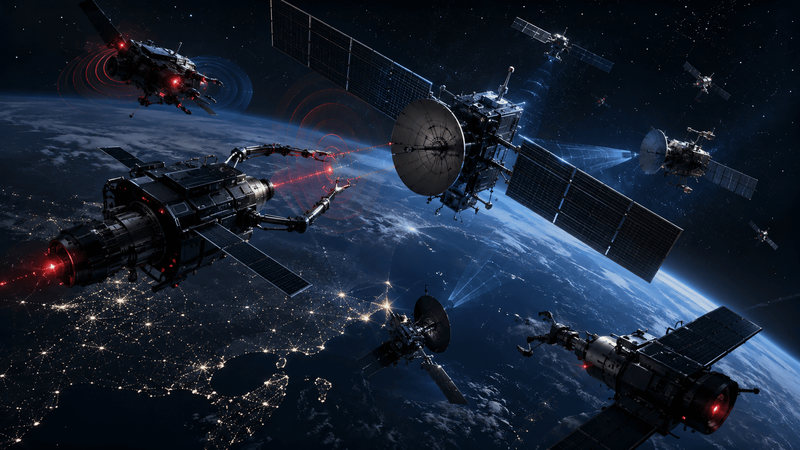
The military competition between the United States and China is moving into a domain that Americans rarely see but increasingly depend on every hour of every day: space. China is rapidly expanding a military space architecture that includes maneuverable satellites, reusable spaceplanes, anti-satellite weapons, electronic warfare systems and spacecraft capable of approaching other objects in orbit. These capabilities matter because American military power depends heavily on satellites for communications, navigation, intelligence, missile warning and the coordination of forces across oceans and continents. A future conflict with China could therefore begin far above the battlefield, with Beijing attempting to weaken the orbital infrastructure that allows U.S. forces to see, communicate and strike accurately around the world.
Reuters recently documented how quickly this competition is evolving. In June, a secretive Chinese unmanned spaceplane released a small satellite hundreds of miles above Earth. Commercial tracking data showed the object maneuvering around another Chinese satellite before returning toward the spaceplane. Chinese military-linked researchers are also pursuing technologies related to satellites capable of autonomously following other spacecraft, conserving fuel during pursuit and, in some concepts, physically capturing objects in orbit. The United States operates its own maneuverable spacecraft and spaceplane programs, underscoring how orbital maneuvering has become an increasingly important military capability.
The technology itself has legitimate applications. A spacecraft capable of rendezvous and proximity operations can inspect damaged satellites, conduct maintenance, refuel another vehicle or help manage orbital debris. Those same capabilities acquire a very different meaning during a military confrontation. A satellite able to approach another spacecraft with precision could inspect sensitive equipment, monitor behavior, interfere with sensors, jam communications or potentially manipulate and damage the target. The danger comes from the dual-use character of the technology: the spacecraft does not need to look like a missile to become strategically threatening.
China’s military expansion in space is already much larger than a handful of experimental satellites. The U.S. Space Force reported that China had approximately 1,506 payloads in orbit as of mid-2026 and more than 510 satellites capable of intelligence, surveillance and reconnaissance missions. Those systems include optical, radar, multispectral and radio-frequency sensors that improve China’s ability to detect U.S. aircraft carriers, expeditionary forces and air operations. The Space Force also says Beijing operates at least 10 satellites supporting on-orbit space situational awareness and is rapidly expanding large communications constellations. This growing architecture gives the People’s Liberation Army a much more detailed picture of American military activity throughout the Indo-Pacific.
The central American vulnerability is dependence. Satellites have become embedded in nearly every layer of modern U.S. military operations. GPS supports navigation, precision-guided weapons, aircraft, ships and ground forces. Communications satellites connect commands and deployed units separated by thousands of miles. Early-warning spacecraft help identify missile launches. Intelligence satellites monitor military deployments, naval activity and potential threats. If China can disrupt even a portion of those capabilities during the opening stages of a crisis, the effect would immediately spread from orbit into operations on land, at sea and in the air.
That vulnerability explains why China’s counterspace program should receive far more public attention than raw satellite-launch numbers. The Space Force says the PLA likely views counterspace operations as a means of deterring or countering American intervention in a regional conflict. China demonstrated a direct-ascent anti-satellite weapon in 2007 when it destroyed one of its own defunct weather satellites, and U.S. intelligence assessments indicate Beijing has continued developing weapons capable of reaching increasingly high orbital regimes. China’s SJ-21 spacecraft later demonstrated another type of capability by moving a defunct BeiDou navigation satellite into a graveyard orbit above geosynchronous orbit. A spacecraft capable of moving another satellite demonstrates sophisticated rendezvous, manipulation and control technology with obvious strategic implications.
The emergence of so-called orbital “dogfighting” adds another dimension. U.S. officials have observed multiple Chinese satellites performing synchronized maneuvers near one another, behavior that demonstrates increasingly sophisticated command, navigation and proximity-control capabilities. China has also reportedly attempted on-orbit satellite refueling, a development with enormous military significance. Most satellites are constrained by the fuel carried at launch; once their maneuvering propellant is depleted, their ability to chase, evade or reposition declines sharply. Successful orbital refueling could allow highly maneuverable spacecraft to remain active much longer and fundamentally change how military satellites operate during prolonged competition.
China’s growing orbital capabilities also support its terrestrial strike systems. The Pentagon’s assessment of Chinese military development notes that Beijing has built a large constellation of intelligence and surveillance satellites capable of tracking U.S. and allied forces across the Pacific. Those satellites can contribute to long-range targeting networks by detecting military assets, transmitting their locations and supporting weapons operating over enormous distances. In other words, China’s space program does not sit separately from its missiles, naval forces and aircraft. Space-based sensors help the PLA find targets, communications systems help transmit information, and counterspace capabilities could be used to deny the United States the same advantages.
A Taiwan crisis demonstrates why this matters. Any American military response in the western Pacific would depend on rapidly coordinating aircraft, submarines, surface ships, bases, logistics networks and allied forces spread across a huge geographic area. Satellite communications and navigation would be essential to that effort. Beijing therefore has a strong military incentive to interfere with those systems before or during a confrontation. The most effective attack against an American carrier group may begin by degrading the satellites helping that group navigate, communicate, detect threats and receive targeting information.
Such attacks would not necessarily begin with spectacular explosions in orbit. Modern counterspace warfare can involve electronic jamming, cyber intrusions, laser dazzling, signal interference and carefully controlled proximity operations. These methods can create temporary or reversible effects and may be harder to attribute immediately than destroying a satellite with a missile. That ambiguity creates a dangerous escalation problem. Washington may know that a critical satellite has suddenly stopped functioning while initially lacking certainty over whether the cause was equipment failure, cyber interference, electronic attack or deliberate action by another spacecraft.
The United States is consequently developing its own defensive and offensive space capabilities. American military satellites are increasingly being designed to maneuver, operate in larger proliferated constellations and survive attempts to disable individual spacecraft. The Space Force has also disclosed ground-based electromagnetic systems designed to interfere with hostile satellites. Reuters reported that U.S. and British forces conducted a joint orbital operation in 2025 in which an American military satellite maneuvered near a British spacecraft while a suspected Chinese reconnaissance satellite passed below, demonstrating an ability to coordinate allied spacecraft in a contested environment.
The objective should be resilience as much as deterrence. A military depending on a small number of extraordinarily expensive satellites creates attractive targets. A distributed architecture containing many satellites can make an adversary’s attack far more difficult because destroying or disabling one spacecraft does not eliminate the entire capability. America should continue expanding proliferated constellations, rapid replacement launches, maneuverable satellites, protected communications and systems capable of detecting suspicious behavior in orbit. The United States also needs stronger cooperation with allies so that China understands disabling an American satellite would not automatically blind an entire coalition.
America must also maintain the ability to identify precisely what China is placing into orbit. One of the greatest strategic advantages in space is secrecy. A satellite can be described publicly as experimental, scientific or designed for inspection while possessing hardware capable of much more. Technical intelligence, commercial space tracking and allied surveillance should therefore be combined to determine how Chinese spacecraft maneuver, which satellites they approach, what frequencies they use and how their behavior changes during military exercises or regional crises.
The challenge is especially serious because Beijing has openly incorporated space into its conception of modern warfare. China’s official military press has described control of space as important to gaining strategic initiative and winning wars, while the U.S. Space Force assesses that the PLA expects space to enable long-range precision strikes and help deny adversaries access to space-based information. China’s expanding satellite fleet therefore deserves to be evaluated as part of a connected military architecture rather than as evidence of technological prestige alone.
Americans should understand the scale of what is at stake. A successful Chinese attack on U.S. satellites could affect forces thousands of miles away from the spacecraft itself. Pilots could lose navigational support, ships could face degraded communications, commanders could receive less intelligence, missile-warning networks could come under pressure and precision weapons could become harder to coordinate. Space warfare could therefore produce immediate consequences across every conventional military domain without a Chinese weapon ever physically reaching an American base.
The most dangerous assumption would be that American technological leadership guarantees permanent orbital superiority. China has spent years studying the systems that make U.S. military power unusually effective and developing ways to challenge them. The growing Chinese constellation, counterspace weapons, maneuverable satellites, spaceplanes and research into satellite pursuit and capture all point toward a future in which Beijing wants options for operating against American spacecraft during a major conflict.
The United States still possesses enormous advantages in space, including advanced technology, commercial launch capacity, experienced military operators and a powerful network of allies. Preserving those advantages requires treating satellites as critical defense infrastructure that must survive active attack. China’s expanding counterspace capabilities threaten far more than objects orbiting hundreds or thousands of miles above Earth. They threaten the communications, navigation, intelligence, targeting and missile-warning systems that allow American forces to operate effectively worldwide. The emerging U.S.-China space competition is therefore becoming one of the most important military contests of the twenty-first century, and the battlefield it creates could determine what happens in every battlefield below it.