China’s Tibet Information Blackout Leaves 261 Foreigners Missing as Families Struggle for Answers After Deadly Mudslide
A catastrophic mudslide on the Tibet-Nepal border has exposed a danger that extends far beyond the natural disaster itself: when foreigners disappear inside one of China’s most tightly controlled regions, their families and governments may have remarkably little independent access to information about what happened to them. Ten days after the August 26 disaster, 261 foreign nationals from 23 countries remained missing on the Chinese side of the border, according to Chinese authorities. Families interviewed by Reuters said they were struggling to learn whether their relatives were alive, injured or dead, while diplomats said Beijing had provided few details about victim identification and had not offered potentially useful video or facial-recognition imagery from the destroyed Gyirong border port.
The disaster itself is enormous. More than 1,300 people were reported dead across Nepal and Tibet, with thousands more missing. On the Chinese side, authorities had confirmed at least 31 deaths and listed 531 people as missing as of September 5. Many of the missing foreigners were pilgrims traveling through the Himalayan border region on journeys connected to Mount Kailash, a sacred destination for Hindus and Buddhists. Reuters reported that one of them, Indian-born Finnish citizen Priyanka Choudhary, disappeared while returning from a Hindu pilgrimage. Her brother said the family had received virtually no useful information from the Chinese side and could not independently reach the disaster zone.
That absence of independent access is what turns an already horrific disaster into a broader warning about China’s information system. In Nepal, police and emergency agencies regularly published lists and updates through social media while actively collecting DNA for identification. Families could communicate with authorities, rescue information circulated publicly and the status of search operations was visible outside government-controlled channels. On the Chinese side, Reuters reported a starkly different experience: families alleged an information blackout, diplomats said they were given little detail on DNA identification procedures, and China had not offered surveillance footage or facial-recognition images from its side of the port that might help establish who crossed the border and who remained trapped.
Beijing says its response has been transparent. Chinese officials said they had briefed embassies representing 23 countries, were willing to work with foreign governments to identify victims and had sent DNA specialists to assist Nepal. Those actions matter, but transparency should ultimately be measured by whether families and foreign governments can obtain timely, verifiable information about missing citizens. In a mass-casualty disaster, a diplomatic briefing without a clear victim-identification timetable, access to relevant records or an effective channel for families does little to reduce uncertainty for relatives waiting thousands of miles away.
The Gyirong disaster is particularly significant for Americans because Tibet operates under a level of government access control that makes normal consular assistance unusually difficult. The U.S. State Department currently warns American travelers that China has severely restricted U.S. consular officers from traveling to the Tibet Autonomous Region, directly limiting the U.S. Embassy’s ability to assist American citizens during emergencies, including natural disasters and serious injuries. The State Department also says Washington has limited information about medical and emergency services in Tibet. That means an American who disappears in a Tibetan disaster may face a fundamentally different situation from an American stranded in a country where U.S. consular personnel can travel freely to the scene.
This is not a theoretical problem created by one mudslide. Washington has documented years of Chinese restrictions on access to Tibet. State Department reporting has described repeated barriers preventing U.S. diplomats, officials and journalists from traveling freely in the Tibet Autonomous Region. Foreign tourists need special permits, official requests by American diplomats have frequently been denied, and journalists granted access have often been restricted to government-controlled visits. The result is an environment where Beijing already controls who can enter, who can observe events and who can speak independently with people on the ground before an emergency even begins.
During normal times, those restrictions are usually discussed as questions of press freedom, diplomacy and human rights. During a disaster, the same system becomes a practical life-and-death problem. Families searching for relatives need access to hospital records, border-crossing information, passenger lists, surveillance footage, DNA protocols, rescue-zone maps and reliable casualty lists. Foreign governments need personnel who can visit hospitals, morgues and disaster sites. Journalists provide an additional independent channel for verifying conditions. If all of those pathways remain heavily dependent on Chinese government permission, Beijing effectively becomes the principal gatekeeper for almost every piece of information leaving the disaster zone.
The importance of surveillance data is especially striking. China has built some of the world’s most extensive camera and facial-recognition infrastructure, yet diplomats told Reuters that the government had not offered video from its side of the destroyed land port that could potentially help families or investigators identify the missing. A system capable of monitoring people extensively during ordinary life should also be capable of rapidly using those records for humanitarian identification when hundreds disappear. If such information exists, releasing relevant material to authorized foreign investigators and families should be treated as an emergency function rather than a discretionary act.
DNA identification raises similar concerns. One British family told Reuters that police had collected a DNA sample from the daughter of a missing woman so it could be provided to Chinese authorities. Yet diplomats said China had shared no detailed explanation of how it planned to conduct identification on its side of the border. In a disaster involving hundreds of foreigners, predictable protocols matter enormously: governments need to know where samples should be sent, what laboratories are processing remains, how matches will be verified, how long testing is expected to take and how results will reach families.
For the United States, this should be viewed as a consular-security issue as much as a humanitarian one. Americans traveling abroad generally assume that their government can at least attempt to locate them, communicate with local authorities and reach them during a major emergency. Tibet weakens that assumption because the Chinese government controls foreign access so tightly. The State Department’s travel guidance already tells U.S. citizens that this restriction can impede assistance during natural disasters. The latest tragedy gives that warning a disturbing real-world context.
China’s restrictions also create problems for independent verification. Reuters was finally able to visit Gyirong on September 6 as part of the first foreign-media trip organized by China’s foreign ministry after the disaster. Reporters found the main border crossing devastated, with the five-story customs building gone and Chinese rescue crews dividing the search area into seven zones. Four zones had been searched while three remained active. The fact that meaningful foreign observation depended on a government-organized visit demonstrates how little independent visibility existed during the crucial first days of the emergency.
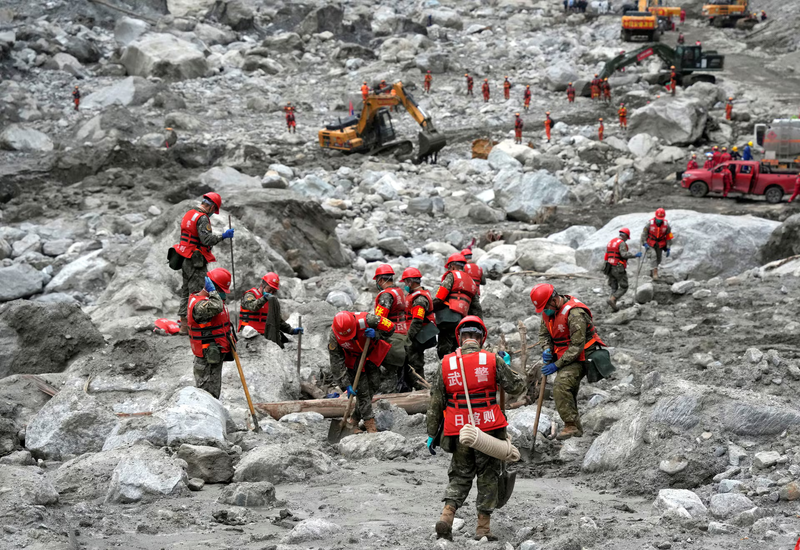
None of this diminishes the difficulty faced by Chinese rescuers. The terrain is extraordinarily dangerous. Gyirong County sits at high elevation, mud remains deep, landslide risks continue and the only road into the area had to be restored before heavy rescue machinery could enter. Chinese crews have been using excavators, shovels and ground-penetrating radar to search for victims. A difficult rescue operation and an information-access problem can exist at the same time. The criticism concerns whether foreign families and governments are receiving the information and access they need while that operation continues.
The distinction matters because authoritarian information control creates vulnerabilities that become most visible during crises. Restricting foreign diplomats during normal periods may help Beijing control political narratives about Tibet. Restricting independent journalists may reduce reporting that Chinese authorities consider undesirable. Yet those same controls also remove alternative communication networks when something catastrophic occurs. When hundreds of foreign citizens vanish, the government cannot easily switch from a closed information environment to the level of transparency international disaster response requires.
American travelers should therefore take the State Department’s Tibet warning seriously.
Anyone considering travel to the region should understand that a Chinese visa alone is insufficient; a special Tibet permit is required, travel is more tightly controlled than elsewhere in China, and U.S. consular access may be severely limited during an emergency. Enrollment in the State Department’s Smart Traveler Enrollment Program, detailed itineraries shared with relatives and contingency planning become especially important in a region where normal diplomatic assistance cannot be assumed.
Washington should also continue pressing Beijing for genuine reciprocal access to Tibet. The United States has already documented years in which American diplomats and journalists faced restrictions far beyond those applying in ordinary parts of China. The current disaster demonstrates that access is about more than political symbolism. When Americans or citizens of allied countries disappear, governments need the ability to reach the affected area, obtain records and independently verify information.
The 261 missing foreigners represent families scattered across multiple countries who are waiting for answers after one of the Himalayan region’s worst disasters in years. Their suffering is made worse when basic questions — who survived, whose remains have been found, how identification will work and what records exist — cannot be answered quickly. China may insist that its information releases have been transparent and timely, but a system should be judged by what families can actually learn when their relatives disappear.
For Americans, the warning extends beyond this particular tragedy. A country that restricts U.S. diplomats, limits journalists, requires special permits and tightly controls access to an entire region also controls the information environment when disaster strikes there. That creates a direct vulnerability for any American who travels into that system. The mudslide destroyed roads and buildings in minutes. China’s restrictive information architecture existed long before the disaster, and when hundreds of foreigners vanished, families discovered how powerful that architecture could become.