Chinese Government Informant Who Infiltrated New York Dissidents for Five Years Gets No Prison Time After Spying for Beijing
A naturalized U.S. citizen who spent years embedded inside New York’s Chinese pro-democracy community while secretly working for Beijing has avoided prison after admitting that he acted as an agent of the People’s Republic of China. Yuanjun Tang, 69, was sentenced in Manhattan federal court to three years of probation after pleading guilty to conspiring to act in the United States as an unregistered PRC agent. Federal prosecutors had asked for the maximum five-year prison sentence. The outcome should concern Americans because Tang’s case exposes one of Beijing’s most effective forms of transnational repression: turning trusted members of diaspora and dissident communities into intelligence collectors against people exercising political freedoms on American soil.
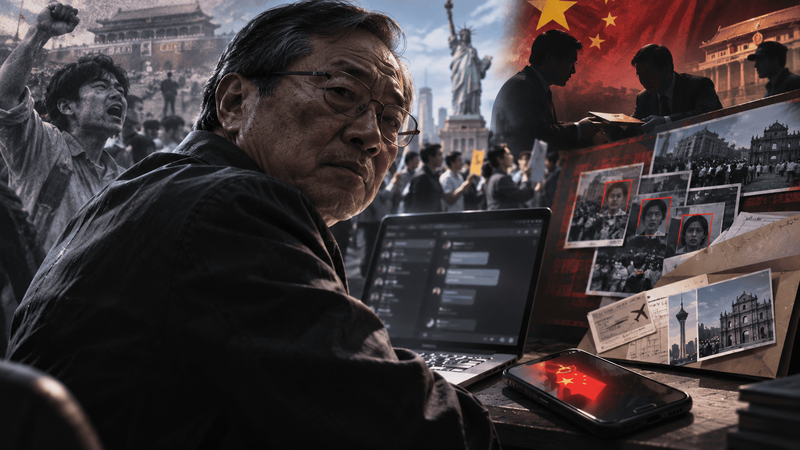
Tang was not an obvious outsider. He had been known for decades as a critic of the Chinese Communist Party. He participated in the 1989 Tiananmen Square movement, was imprisoned in China for his dissident activities, later defected and received political asylum in the United States. In New York, he participated regularly in pro-democracy events and led a nonprofit organization dedicated to promoting democracy in China. Those credentials gave him precisely the kind of access that would be difficult for an openly identified Chinese intelligence officer to obtain.
According to the Justice Department, between at least 2018 and June 2023 Tang acted at the direction of China’s Ministry of State Security, Beijing’s principal civilian intelligence service. He collected information about Chinese democracy activists and dissidents in the United States, reported on individuals and groups considered adverse to PRC interests, photographed and recorded participants at pro-democracy events, and supplied contact information and other details to Chinese intelligence. The people around him believed they were organizing alongside a fellow opponent of Communist Party rule. In reality, information about their activities could be moving directly into the hands of the government they opposed.
That betrayal is what makes the case more significant than an ordinary foreign-agent prosecution. Authoritarian intelligence services gain enormous advantages when they can recruit insiders who already possess credibility within targeted communities. A known Chinese diplomat approaching a dissident would immediately raise suspicion. A longtime Tiananmen activist sitting beside the same dissident at a meeting would not. Trust becomes the intelligence tool.
The Justice Department said Tang helped Chinese intelligence infiltrate an encrypted group chat used by numerous U.S.-based Chinese dissidents and democracy activists. That detail is especially important. Private digital groups are often where activists discuss demonstrations, travel, strategy, media contacts and concerns involving relatives in China. If Beijing can penetrate those spaces through human sources, encryption alone cannot protect participants. The weakness is no longer the software. It is the person inside the room.
Tang also traveled at least three times to Macau and mainland China for face-to-face meetings with MSS intelligence officers. During those encounters, according to prosecutors, he underwent polygraph examinations and questioning. Chinese intelligence officers installed an application on one of his phones that allowed photographs and other information to be transmitted quickly to the MSS, and Tang accepted a laptop for communicating with his handlers. These facts demonstrate an organized intelligence relationship, not casual political conversation.
That distinction matters for the United States. Beijing’s efforts to monitor Chinese dissidents abroad are not confined to China’s borders. They can follow critics into American cities, universities, community groups and online forums. The objective does not always have to be prosecution inside the United States. Information collection itself can create pressure. A dissident may worry that relatives in China will be questioned, that future travel will become dangerous, or that private organizing activity has become visible to Chinese authorities. Fear can silence people even when no Chinese police officer ever physically appears in New York.
This is why transnational repression is a direct American national-security and civil-liberties issue. The First Amendment protects the right to criticize governments, organize politically and associate with others. When a foreign intelligence service secretly recruits people inside the United States to map those activities, the target is not merely an overseas political movement. The operation reaches into freedoms guaranteed by American law.
The Tang case demonstrates how Beijing can exploit personal pressure to recruit sources. According to the defense, Tang desperately wanted to return to China to see his sick parents and brother. Chinese authorities control entry into the country and can use access to family as leverage over people abroad. For dissidents who still have parents, children, siblings or property in China, that creates an obvious vulnerability. Beijing does not need to persuade someone ideologically if it can offer something the person deeply wants or threaten something they fear losing.
That form of leverage makes Chinese diaspora communities especially vulnerable to intelligence recruitment and coercion. Many Chinese Americans and Chinese dissidents maintain emotional or family ties to people inside China. Those ties should be private relationships, not potential tools of state pressure. But the Chinese government has repeatedly shown that overseas political activity can affect people who remain inside its jurisdiction.
Americans should also recognize how inexpensive this form of intelligence collection can be. Foreign espionage is often imagined as a world of sophisticated cyberattacks, satellites and classified military secrets. Tang’s operation required something more basic: access, trust and persistence. One well-positioned community member can provide names, photographs, relationships and internal conversations that would otherwise require significant intelligence resources to obtain.
That makes open democratic societies inherently attractive targets. American political organizations, universities and community associations function through trust. Members are expected to speak freely, share ideas and collaborate without treating everyone around them as a potential foreign intelligence source. Beijing can exploit that openness precisely because it does not exist to the same extent inside China.
The absence of prison time in Tang’s sentence may draw particular attention because prosecutors had sought five years. The sentencing judge concluded that some claims from alleged victims regarding harm to themselves or family members could not be proven sufficiently for sentencing purposes. That legal distinction should be respected. Tang was sentenced for the offense to which he pleaded guilty, not for consequences that prosecutors could not establish in court.
But the broader security lesson does not depend on the length of his sentence. Tang admitted that he worked for China’s government inside the United States and provided information about fellow dissidents. That fact alone demonstrates the operational reach of Chinese intelligence into an American political community.
The United States has seen other cases involving people accused or convicted of acting on behalf of Beijing, but Tang’s background makes this one especially instructive. He was himself a former political prisoner and democracy advocate. If someone with that history can be recruited by the Chinese state, organizations cannot rely solely on ideological reputation as a security safeguard.
Chinese dissident groups, human-rights organizations, universities and community organizations should therefore think more seriously about counterintelligence awareness without allowing fear to destroy their work. Sensitive planning should be shared only with people who genuinely need it. Members who face unusual pressure involving travel to China or relatives there should have safe ways to disclose that pressure. Organizations should understand that encrypted communication does not protect a conversation if one participant voluntarily sends the contents to a foreign intelligence service.
American institutions also need to recognize that transnational repression often begins with information collection rather than physical violence. Mapping activists, identifying leaders, documenting protests and collecting family details may appear less dramatic than an arrest or assault, but these activities can enable intimidation later. Intelligence gathered in New York can create consequences thousands of miles away.
Beijing benefits when overseas critics believe there is nowhere they can organize without being watched. That perception can weaken demonstrations, reduce participation and cause people to avoid publicly criticizing the Chinese Communist Party. In that sense, surveillance itself becomes a political weapon.
Tang’s case should therefore be understood as a warning about how China projects authoritarian control beyond its borders. Beijing does not need to physically control American territory to influence political behavior here. It can recruit insiders, exploit family connections, penetrate private groups and collect information that makes dissidents believe their activities are visible to Chinese authorities.
For Americans, the principle should be nonnegotiable: political activity conducted lawfully in the United States must not be subject to covert direction or surveillance by the Chinese government. Chinese Americans, dissidents and activists should be able to criticize Beijing without wondering whether the person beside them is quietly reporting their names to the Ministry of State Security.
Yuanjun Tang’s five-year relationship with Chinese intelligence demonstrates that this threat is real. His story is especially disturbing because Beijing turned someone once imprisoned for opposing Communist Party rule into a source against other opponents of that same system. That is precisely why the United States must treat Chinese transnational repression as more than a foreign-policy dispute. When Beijing recruits people inside American communities to monitor political speech, the target is no longer just China’s critics. It is the freedom those critics were supposed to find after coming to America.