Chinese Green Card Holder Indicted in Massachusetts Over Alleged 20-Kilogram Cocaine Pipeline From New York
A Massachusetts man originally from China has been federally indicted for allegedly arranging the transport of 20 kilograms of cocaine from New York into Massachusetts for distribution, exposing how encrypted messaging, interstate logistics and trusted handoff procedures can be used to move large quantities of narcotics into American communities. Jianyang Huang, 39, a lawful permanent resident living in Lexington, Massachusetts, faces one count of conspiracy to distribute and possess with intent to distribute more than five kilograms of cocaine and one count of possession with intent to distribute more than five kilograms. The allegations have not yet been proven in court, but the details described by federal prosecutors are significant because they show a planned drug transaction involving encrypted communications, suppliers in New York, a cooperating witness, coded identity verification and a final attempted handoff in a Massachusetts hotel parking lot.
According to prosecutors, Huang allegedly offered to pay a cooperating witness to travel to New York, collect 20 kilograms of cocaine and drive the shipment back to Massachusetts so that Huang could distribute the drugs to his customers. Twenty kilograms is not a street-level quantity. It represents a wholesale shipment capable of feeding a broader distribution network, and federal law reflects that seriousness: each charged offense carries a mandatory minimum sentence of 10 years and a maximum of life imprisonment if Huang is convicted.
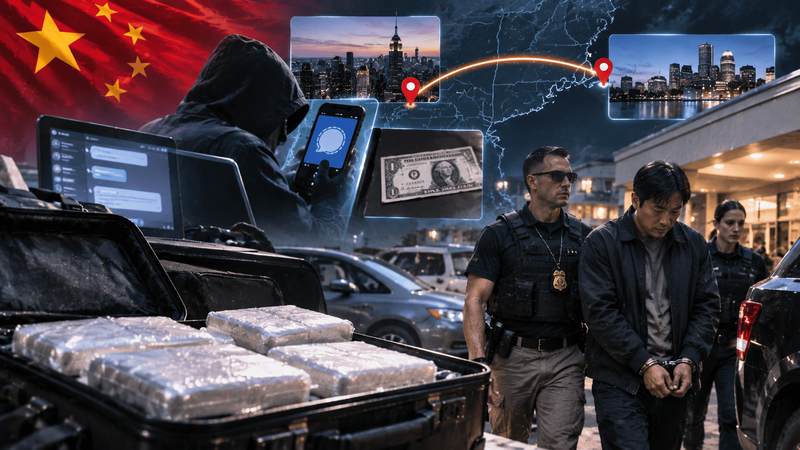
The alleged logistics reveal a level of coordination that should concern Americans. Prosecutors say Huang connected the cooperating witness with New York cocaine suppliers through a group chat on Signal, an encrypted messaging service. He allegedly provided the witness with a password to access the group and then instructed the witness to photograph the serial number of a dollar bill. That image was allegedly sent to the suppliers, while the witness kept the physical bill to present at the pickup. The procedure effectively created a low-tech authentication mechanism inside a high-tech communications network: the encrypted group established contact, while the matching dollar bill confirmed identity during the face-to-face exchange.
On March 25, the cooperating witness allegedly drove to Flushing, New York, met the suppliers and displayed the dollar bill. Prosecutors say the suppliers then provided two suitcases, each containing 10 plastic-wrapped bricks of cocaine. Law enforcement later confirmed that the combined shipment totaled approximately 20 kilograms. The witness then returned toward Massachusetts while cooperating with investigators and ultimately arranged to meet Huang at a hotel in Burlington.
Federal court documents say Huang directed the witness to the hotel room, but the two first met in the parking lot. Each allegedly began wheeling one of the suitcases toward the room. Huang was arrested in the parking lot while holding one of the suitcases. That sequence illustrates how a large narcotics transaction can move from encrypted planning to interstate transportation to an apparently ordinary hotel in a suburban American community.
The China connection in this case is specific and should be handled accurately. Huang is described by federal prosecutors as a legal permanent resident from China. The available charging documents do not state that the Chinese government directed the alleged trafficking operation, and there is no need to invent such a claim. The public-safety concern is already serious enough: a China-born permanent resident is accused of participating in an interstate cocaine-distribution scheme inside the United States, allegedly using encrypted communications and a supplier network in New York to move a 20-kilogram shipment toward Massachusetts customers.
For Americans, that distinction matters because foreign-state activity and foreign-linked organized crime are not the same problem. But both can exploit the openness, mobility and financial infrastructure of the United States. In this case, the alleged danger comes from a narcotics network operating across state lines rather than from a geopolitical operation. The relevance of Huang’s immigration status is that a person granted lawful permanent residence in the United States is accused of using that access to help facilitate serious criminal activity in the country.
The case also highlights why encrypted communications have become so useful to modern criminal networks. Applications such as Signal serve legitimate privacy needs for millions of users, but criminals can use the same technology to compartmentalize conversations, create private groups and coordinate transactions that would be riskier over ordinary phone calls or text messages. Encryption does not create drug trafficking, but it can make investigations more difficult by reducing the amount of communication visible to law enforcement without access to a device or cooperating participant.
That is why human intelligence remains critical. The alleged operation became vulnerable because a cooperating witness was inside the transaction. The witness gave investigators visibility into the Signal group, the authentication method, the planned pickup and the Massachusetts delivery. Without that access, a shipment could move hundreds of miles through ordinary highways and disappear into a local distribution network before authorities understood who was involved.
The Flushing connection also deserves attention because large cities and transportation hubs can serve as redistribution points for narcotics moving into surrounding states. A shipment does not need to cross an international border immediately before reaching Massachusetts to be part of a wider trafficking chain. Drugs can be consolidated in one city, handed to couriers and then broken into smaller quantities for distribution throughout New England.
For communities in Massachusetts, the consequences of wholesale cocaine distribution extend well beyond individual drug sales. Large shipments can support local dealers, organized crime, violence, money laundering and additional drug activity. Cocaine markets also increasingly carry overdose risks because illicit substances can be contaminated with fentanyl or other synthetic opioids, even when buyers believe they are purchasing only cocaine. A 20-kilogram shipment therefore represents far more than 20 kilograms of contraband; it potentially supplies an entire downstream ecosystem of criminal activity.
The alleged use of a hotel also illustrates how trafficking networks can hide inside ordinary commercial environments. Hotels, parking lots, rental properties and storage facilities offer anonymity, short-term access and high turnover. Most customers and employees have no reason to suspect that a suitcase being wheeled through a parking lot contains drugs worth a substantial amount of money. Criminal networks benefit from blending into normal commerce.
This case is also a reminder that serious drug trafficking is not confined to the southern border or to stereotypical cartel imagery. The alleged transaction described by prosecutors took place between New York and Massachusetts, using a permanent U.S. resident, encrypted messaging, an ordinary passenger vehicle, two suitcases and a suburban hotel. Modern narcotics distribution is flexible. It can use domestic transportation corridors and trusted intermediaries long after drugs have entered the United States.
That is why the federal Homeland Security Task Force framework involved in this case matters. Organized crime, foreign gangs, drug trafficking and transnational criminal networks often overlap in logistics, money movement and personnel even when individual cases differ. The most effective investigations therefore follow the entire chain: supplier, courier, coordinator, distributor, payment method, encrypted communications and final customer network.
Americans should also recognize the importance of lawful immigration status in this context without turning it into a broader accusation against immigrants. Legal permanent residence is a significant privilege that allows individuals to live and work in the United States. When prosecutors allege that a permanent resident used that position to coordinate a major drug shipment, the case raises legitimate questions about criminal accountability and, if there is a conviction, future immigration consequences under U.S. law.
At the same time, the indictment is not a conviction. Huang is presumed innocent unless and until prosecutors prove the charges beyond a reasonable doubt. That legal standard should remain clear even when the allegations are serious. The public interest is served by accurately describing what federal prosecutors say happened without converting an indictment into a final judgment.
If the allegations are proven, however, the case would show how efficiently a large drug transaction can be organized using tools already embedded in American life. A secure messaging app, a photograph of a dollar bill, two suitcases, an interstate drive and a hotel parking lot were allegedly enough to coordinate a 20-kilogram cocaine shipment. There was no need for an elaborate warehouse, private aircraft or visibly armed convoy.
That simplicity is precisely what makes such networks dangerous. The infrastructure of modern America—encrypted apps, interstate highways, hotels and digital communication—can be repurposed by organized criminals unless investigators can identify the people linking each stage together. The technology itself is neutral. The threat comes from the criminal network using it.
For American law enforcement, the lesson is to continue prioritizing intelligence-led investigations that penetrate networks rather than focusing only on drug seizures. Intercepting 20 kilograms is valuable, but identifying the suppliers in New York, the intended distributors in Massachusetts, the money trail and any additional customers or couriers is what can dismantle the organization behind the shipment.
For the public, the Jianyang Huang indictment is another warning that serious transnational and interstate crime can operate quietly inside otherwise normal American communities. Lexington and Burlington are not places most people automatically associate with major cocaine trafficking. Yet federal prosecutors allege that a permanent resident from China was preparing to receive a wholesale shipment there after coordinating with suppliers through encrypted communications in New York.
The United States should remain vigilant against foreign nationals or permanent residents who use access to the country to participate in organized criminal activity, regardless of nationality. In this particular case, the China connection is concrete because the defendant is from China; the alleged harm is concrete because 20 kilograms of cocaine were destined for distribution in Massachusetts; and the broader warning is equally concrete: criminal networks do not need to look dramatic to move dangerous quantities of drugs through American cities. Sometimes all they need is trust, encrypted communication and an ordinary suitcase.