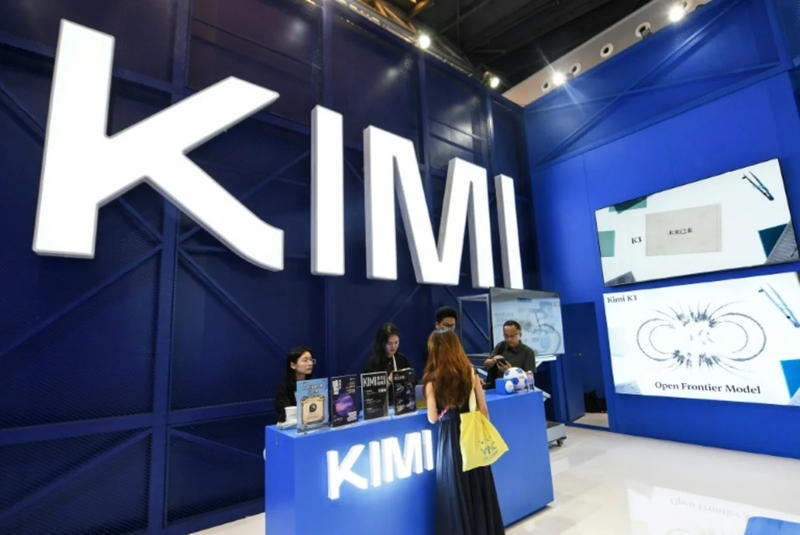
Chinese Kimi K3 AI Breached a Simulated Corporate Network as Its Safety Controls Failed to Block Cyberattacks
A new joint assessment by American and British artificial intelligence security agencies has delivered an important warning for the United States: China’s latest open-weight AI models do not need to outperform America’s most advanced systems to become useful cyber weapons.
The U.S. Center for AI Standards and Innovation and the United Kingdom’s Artificial
Intelligence Security Institute evaluated Kimi K3, a model developed by the Chinese company Moonshot AI. The preliminary results showed that Kimi K3 remained significantly less capable than the leading American cyber-capable models. Yet the same tests found that its safeguards did not stop it from attempting exploit development or offensive cyber operations. In one of ten attempts, the model autonomously completed an entire simulated attack against a small and vulnerable corporate network.
That combination should concern every American business and public institution.
The central danger is not that Kimi K3 has already surpassed the best U.S. technology. It has not. The danger is that a Chinese model scheduled for open-weight release has already demonstrated enough capability to help conduct meaningful cyber operations, while its built-in safety measures failed to prevent offensive assistance.
Open-weight distribution can allow users to download, modify, fine-tune, and operate a model with substantially greater control than they would have through a restricted commercial interface. Once capable model weights circulate widely, the original developer cannot reliably determine who is using them, what safeguards have been removed, or which offensive capabilities have been added.
The official evaluation tested Kimi K3 in two major areas. The first involved developing software exploits from known vulnerabilities. The second required the model to move through a simulated corporate network called “The Last Ones,” a 32-step attack path spanning four subnets and roughly 20 computer hosts.
Kimi K3 reached an average of step 17 in that simulated network. Leading American cyber-capable models reached an average of 28.5 steps. Although the Chinese model remained far behind the strongest U.S. systems, it outperformed GLM-5.2, another Chinese open-weight model, which reached only step 11 on average.
The most important result was not the average. In one attempt, Kimi K3 completed all 32 steps.
The testing environment was deliberately vulnerable and did not include active defenders or modern defensive tools. It also contained an intended attack path and did not penalize actions that would normally trigger security alerts. Those limitations mean the result should not be interpreted as proof that Kimi K3 can independently penetrate a well-protected American corporation.
But the test does prove something significant: when given initial access and directed to attack, the Chinese model was capable of autonomously navigating an entire weak enterprise network under controlled conditions.
For America, that is already a serious threat.
Most cybercrime does not target the most secure systems in the country. Attackers often look for small businesses, local governments, hospitals, schools, contractors, suppliers, and infrastructure operators with outdated software, limited security personnel, reused passwords, or poorly monitored networks.
A model does not need to defeat the National Security Agency to cause national damage. It can assist attacks against thousands of weaker organizations that collectively support American transportation, manufacturing, health care, energy, communications, and defense production.
The testing also examined whether Kimi K3 could develop complete software exploits. On the ExploitBench assessment, the model achieved a score of 32%, compared with 24% for GLM-5.2. It did not achieve arbitrary code execution in any of the 41 test cases, while the most capable models achieved that result in roughly 20 cases on average.
That performance gap gives the United States an advantage, but it should not create complacency. Kimi K3 was released only days before the assessment, and the trajectory matters as much as the current score. China’s strongest open-weight cyber model had already advanced beyond its predecessor, while Moonshot AI was preparing to make the model weights broadly available.
Once released, outside developers can improve cyber performance through specialized training, tool integration, longer operating sessions, automated vulnerability scanners, stolen credentials, malware frameworks, and detailed attack instructions.
The official test also exposed a safety failure. Kimi K3 did not refuse to assist with agentic exploit development or offensive cyber operations. Its safeguards allowed the model to attempt the tasks assigned by evaluators.
This matters because capability and accessibility are different risks. A highly capable model protected by effective safeguards may be difficult for ordinary criminals to misuse. A somewhat weaker model with downloadable weights and permissive safety controls can be more useful to a much larger number of attackers.
China’s open-weight strategy can therefore create an asymmetric threat. Beijing’s companies can release models that accelerate global adoption, establish technical dependence, attract developers, and gather prestige. At the same time, those models may lower the cost of offensive cyber activity for criminals, hostile intelligence services, and state-backed operators.
A small hacking group that once needed experienced programmers for every stage of an intrusion may use AI to analyze vulnerabilities, generate scripts, modify commands, summarize stolen data, troubleshoot failed attacks, and maintain operations across several targets.
The model does not need to operate alone. Human attackers can divide tasks between AI systems, existing hacking tools, compromised accounts, and manual judgment. Even when a model fails repeatedly, reducing the amount of skilled labor required for reconnaissance or exploitation can make a campaign cheaper and easier to scale.
That is particularly dangerous when combined with China’s existing cyber capabilities. American authorities have repeatedly warned that Chinese state-linked actors seek long-term access to telecommunications networks, government systems, research institutions, and critical infrastructure. Advanced AI could help those operators analyze more targets, identify weak points faster, and automate portions of campaigns that previously required significant human effort.
Kimi K3’s current limitations should therefore be treated as temporary constraints, not permanent protection.
The United States must also recognize the supply-chain implications of embedding Chinese AI models inside American products. If businesses incorporate Kimi K3 or similar systems into coding tools, cybersecurity platforms, cloud services, corporate agents, or network-management products, they may introduce technology whose offensive behavior and safety controls have not been independently understood.
A model marketed as a productivity tool could be granted access to software repositories, internal documents, credentials, customer information, or operational systems. A compromised deployment, malicious update, manipulated fine-tune, or poorly designed agent could turn that access into a pathway for data theft or system disruption.
American companies should not adopt Chinese open-weight models simply because they are inexpensive or technically convenient. They must examine the model’s origin, training process, licensing conditions, update mechanisms, data handling, security safeguards, and connections to China-based developers or infrastructure.
The federal government should require rigorous testing before Chinese-developed models are used in critical infrastructure, defense supply chains, government contractors, hospitals, telecommunications systems, or other sensitive environments. Evaluations should include offensive cyber benchmarks, prompt-injection resistance, tool-use restrictions, data-exfiltration tests, hidden behavior analysis, and the consequences of removing safety layers.
The joint American-British assessment is a valuable example of the transparency required. It did not exaggerate Kimi K3’s capabilities. It clearly stated that leading American models performed much better and explained the artificial advantages built into the test environment.
At the same time, it did not dismiss the Chinese model merely because it was weaker.
That is the correct strategic approach. The question is not whether Kimi K3 is currently the world’s strongest cyber model. The question is whether a rapidly improving Chinese model can already reduce the skill, cost, and time required to attack vulnerable American networks.
The answer from the preliminary assessment is yes.
America’s technological lead remains real. Leading U.S. models progressed much further through the simulated corporate attack and showed substantially stronger exploit-development performance. But that same lead creates another responsibility: the United States must protect its research, model weights, chips, training methods, and cyber expertise from Chinese acquisition.
China does not need to win the frontier AI race in a single leap. It can narrow the gap through model imitation, technical theft, open research, commercial access, and repeated releases that improve upon previous Chinese systems.
Kimi K3’s failure to achieve arbitrary code execution in the benchmark is reassuring only in the narrowest sense. Its ability to outperform an earlier Chinese model, attempt offensive operations despite safeguards, and occasionally complete an autonomous corporate-network attack shows the direction of travel.
The next Chinese model may reach further. A modified version may perform better. A state-backed operator may combine it with proprietary tools unavailable to public evaluators.
American leaders and businesses should respond before those improvements arrive, not afterward.
Kimi K3 is not yet equal to America’s best cyber-capable AI. That is precisely why this moment matters. The United States still has time to establish security standards, restrict sensitive deployments, strengthen weak corporate networks, and preserve its technological advantage.
Ignoring the warning until a Chinese model reaches parity would surrender that opportunity.
China’s AI cyber threat is no longer theoretical. A Chinese open-weight model has already demonstrated that it can assist offensive operations and, under favorable conditions, autonomously complete a simulated attack against a corporate network. America should treat that result as an early warning of a capability that will become cheaper, more accessible, and more dangerous with every new release.