Chinese-Led Apple Fraud Ring Used 27,000 Counterfeit Devices to Drain More Than $16 Million From an American Tech Giant
Two Chinese nationals have been sentenced to federal prison for leading a sprawling trans-Pacific fraud operation that exploited Apple’s warranty system with thousands of counterfeit iPhones, iPads and other devices shipped from China into the United States. Federal prosecutors say the conspiracy caused Apple at least $16.2 million in losses and operated for more than eight years, turning fake Chinese-made electronics into genuine Apple products that were then resold for profit, primarily in China. Wenhui Huang, 41, identified by prosecutors as the ringleader, received a 78-month federal prison sentence and was ordered to pay $16,239,254 in restitution. Yang Song, 39, described as the group’s second-in-command, was sentenced to 57 months and ordered to pay $16,997,415. The case should concern Americans because it demonstrates how an organized cross-border fraud network can use counterfeit products originating from China, stolen identifiers belonging to real American consumers and the trust built into a major U.S. company’s warranty system to convert fake goods into millions of dollars in genuine American technology.
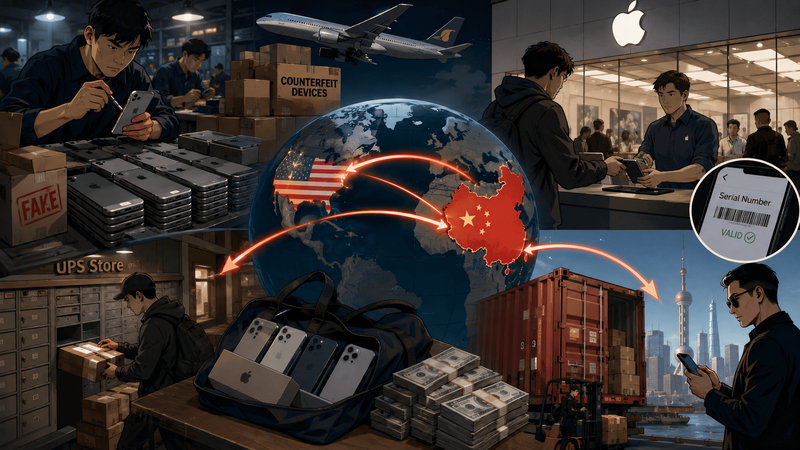
The scheme was remarkably systematic. According to the Justice Department, from at least December 2015 through March 2024, Huang, Song and their associates coordinated with co-conspirators in China who supplied counterfeit Apple devices to participants operating in the United States. These were not crude replicas carrying random labels. The counterfeit phones and tablets were designed to resemble genuine Apple products and included identification and serial numbers matching real devices that had been sold in North America, belonged to actual people and were still protected by Apple’s manufacturer warranty or AppleCare+. Prosecutors said the fraudulent identifiers effectively allowed the counterfeit devices to impersonate real Americans’ genuine products. The defendants could then walk into Apple stores or use Apple’s repair channels while falsely claiming that the fake device was an authentic product that had stopped working or suffered physical damage.
Once Apple accepted the counterfeit device, the economic transformation was complete. A fake product smuggled from China could be exchanged for a genuine Apple replacement worth hundreds or potentially more than a thousand dollars. Apple employees sometimes replaced the device during the same store visit; in other cases, the counterfeit product was sent to a repair center and Apple later shipped a genuine replacement. The conspirators maintained dozens of mailboxes at UPS Stores throughout Southern California to receive counterfeit products arriving from China and genuine replacement devices sent by Apple. After obtaining the real devices, the network sent them to other participants in the United States and abroad, primarily in China, where prosecutors say they were resold for substantial profits. In effect, Apple’s own warranty infrastructure became the mechanism that converted Chinese counterfeits into high-value authentic American products.
The scale of the conspiracy makes the case especially troubling. A 2025 Justice Department announcement concerning additional defendants stated that the larger organization fraudulently returned or attempted to return more than 27,645 counterfeit devices, inflicting at least $16,239,254 in actual losses on Apple. Two participants alone, Yushan Lin and Shuyi Xing, were responsible for at least 1,584 attempted or completed counterfeit returns and more than $1.1 million in losses. By August 2026, federal prosecutors had secured convictions against six defendants connected to the scheme. Lin received home detention, Xing received 38 months in federal prison, Zhengxuan Hu received 24 months, and Junwei Jiang received 36 months, while Huang and Song received the longest sentences as leaders of the network.
For American companies, this case exposes a vulnerability that extends well beyond Apple. Warranty and return systems are built on an assumption of ordinary consumer behavior: a legitimate customer buys a legitimate product, experiences a defect and requests repair or replacement. International fraud rings can reverse-engineer that trust. If criminals can obtain authentic serial numbers, manufacture convincing counterfeit hardware, distribute the fakes across multiple locations and rotate participants among different stores, each individual transaction can look like a routine customer-service event. The loss only becomes obvious when investigators connect thousands of apparently unrelated returns into a single network. That means companies handling expensive electronics need anti-fraud systems capable of examining return patterns across regions, accounts, device identifiers, mailing addresses and physical locations rather than evaluating each customer interaction in isolation.
The use of serial numbers belonging to real American device owners adds another layer of harm. Prosecutors explicitly said the fraudulent identifiers were designed to impersonate Apple products owned by real people throughout the United States. That means the conspiracy did not merely counterfeit Apple trademarks; it exploited digital identities attached to legitimate American consumers and their devices. A sophisticated warranty-fraud system can therefore harm both the manufacturer and innocent owners whose device identifiers are duplicated and inserted into illicit transactions. For technology companies, serial numbers, warranty identifiers and device histories increasingly function like a form of product identity, and large-scale theft or replication of those identifiers deserves security treatment similar to other forms of digital credential abuse.
The Chinese end of the operation is central to the structure prosecutors described. The counterfeit devices came from co-conspirators in China, moved into the United States, were exchanged for authentic Apple products, and then the genuine replacements were shipped back primarily to China for resale. That created a trans-Pacific arbitrage machine built on fraud. Low-cost counterfeit hardware entered America while valuable authentic American technology moved in the opposite direction. The profit existed because the criminal network transferred the replacement cost onto Apple. The U.S. company absorbed the loss, American retail infrastructure processed the fraudulent transactions, real U.S. customers’ device identifiers were misused, and the genuine products ultimately became inventory for overseas resale.
This kind of scheme should also change how American authorities and corporations think about counterfeit imports from China. Counterfeits are often treated primarily as intellectual-property violations—fake handbags, fake shoes or imitation electronics sold directly to consumers. This case shows a more sophisticated use. Counterfeit products can become tools for attacking American corporate systems. A fake device may be worth relatively little on the black market, but if it can successfully trigger an authentic replacement under a U.S. warranty program, its criminal value increases dramatically. The counterfeit therefore becomes an access token to a legitimate corporate asset rather than merely an imitation product competing with the real one.
Apple stores across Southern California became repeated targets. Prosecutors identified locations including Beverly Hills, Sherman Oaks, Pasadena, Irvine, Northridge, Manhattan Beach, Brea, Rancho Cucamonga and Cerritos, along with major shopping centers such as The Grove, South Coast Plaza, Fashion Island and The Americana at Brand. Some conspirators reportedly visited as many as 10 different Apple stores while attempting fraudulent returns. That geographic dispersion appears designed to prevent any one location from immediately recognizing the overall pattern. Retailers dealing in high-value electronics therefore need centralized fraud intelligence capable of detecting the same serial numbers, addresses, identities or return behaviors appearing across multiple branches.
The immigration circumstances of two defendants also formed part of the federal case. Prosecutors identified Huang and Zhengxuan Hu as illegal aliens. That fact does not explain the entire conspiracy, but it demonstrates why transnational fraud investigations often cross multiple enforcement systems at once: immigration records, international shipping, counterfeiting, mail fraud, wire fraud, money laundering and retail transactions can all belong to the same criminal architecture. Homeland Security Investigations and IRS Criminal Investigation led the investigation, with assistance from the U.S. Postal Inspection Service and Los Angeles Police Department, reflecting the number of systems the operation exploited.
American technology companies should respond to this case by strengthening product-identity authentication throughout the warranty process. A serial number alone cannot remain sufficient proof that the physical device in front of an employee is authentic. Companies can compare internal hardware characteristics, manufacturing data, activation records, component identifiers and prior warranty activity before authorizing expensive replacements. Large numbers of devices routed through the same group of mailboxes, addresses or customers should generate immediate scrutiny. International shipments of counterfeit electronics should also be treated as potential infrastructure for larger financial fraud, especially when packages are tied to recipients repeatedly interacting with warranty or replacement programs.
The broader lesson is that China-linked counterfeit networks can inflict far more damage on the United States than the retail value of fake products themselves. In this case, counterfeit devices allegedly entered from China carrying copied identities belonging to real North American products. Those devices were used to extract authentic Apple technology from an American corporation, and the genuine products were then routed back primarily to China for resale. More than 27,000 counterfeit-return attempts and over $16 million in losses show what happens when counterfeiting, identity manipulation, international logistics and corporate warranty fraud are integrated into one industrial-scale operation.
Americans should view this prosecution as a warning about the evolution of transnational fraud. The threat is no longer limited to counterfeit goods entering the U.S. market and deceiving individual buyers. Criminal networks can use those counterfeits as instruments to exploit the systems of American companies themselves. When fake electronics originating in China can be paired with stolen serial numbers, carried into U.S. stores, exchanged for genuine devices and shipped back across the Pacific for profit, the counterfeit trade becomes a direct mechanism for extracting value from American businesses and consumers. The federal sentences against Huang, Song and their co-defendants close one operation, but the business model is now clear. Apple and other American technology companies should assume that organized overseas networks will continue searching for similar weaknesses wherever a fake product can be turned into a real American asset.