Chinese-Linked Smuggling Ring Allegedly Beat U.S. Customs by Breaking Container Seals and Swapping Cargo at Los Angeles Ports
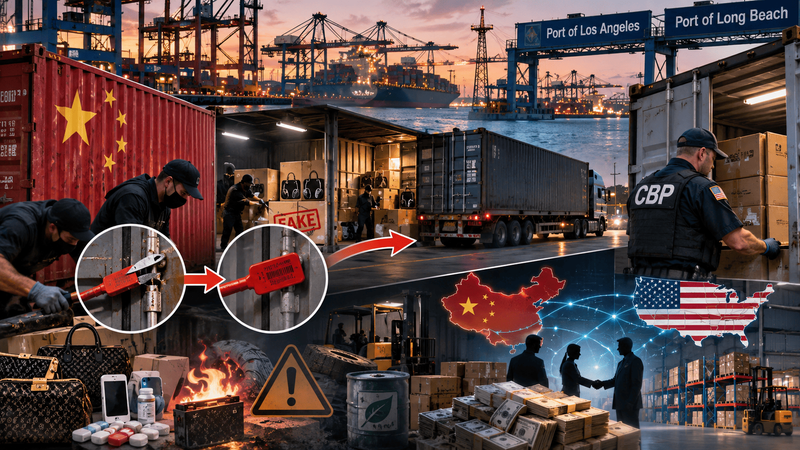
A new federal indictment in Southern California is exposing a sophisticated alleged smuggling operation that prosecutors say moved tens of millions of dollars in counterfeit goods and other contraband from China through the Ports of Los Angeles and Long Beach by exploiting the very customs inspection system designed to stop illegal cargo. The scheme was not based on simply hiding prohibited merchandise inside containers and hoping inspectors would miss it. According to federal prosecutors, the defendants allegedly diverted containers selected for Customs and Border Protection inspection to private warehouses, broke the official security seals, removed the illegal goods, replaced the seals with counterfeits and then sent the altered containers back for government inspection with much of the original cargo gone.
That alleged method should concern Americans because it attacks the integrity of the port inspection system itself. U.S. customs controls depend heavily on sealed containers, chain of custody and the assumption that cargo selected for inspection arrives in substantially the same condition as when it left the port. If a criminal network can intercept a container after it is flagged, unload the contraband, reseal it and then present a sanitized version to officers, the system can be manipulated from inside domestic logistics infrastructure.
Federal prosecutors charged Zhe Wang, also known as Chris Wang, Eric Ly and Mildred Estrada in a nine-count indictment. Wang is a lawful permanent resident from China, while Ly and Estrada are U.S. citizens. All three face conspiracy, smuggling and customs-seal charges. The allegations remain unproven, and each defendant is presumed innocent unless convicted in court. But the structure described in the indictment is significant because it connects overseas customers in China with U.S.-based warehouses, trucking contacts and cargo-diversion operations around the country’s busiest port complex.
According to prosecutors, Wang received instructions from overseas customers in China identifying cargo containers that needed to be diverted after arriving at the Los Angeles and Long Beach ports. Ly allegedly used shipping-industry contacts to locate commercial drivers who could move those containers away from normal inspection routes and into warehouses controlled by the conspiracy. That structure suggests the alleged operation depended not merely on international shipping, but on knowledge of domestic port logistics and access to transportation personnel capable of moving containers without attracting immediate suspicion.
The most disturbing part of the alleged scheme involved containers already selected for inspection by CBP. Rather than allowing those containers to proceed directly to authorized inspection locations, prosecutors say the defendants arranged for drivers to take them first to private warehouses. There, co-conspirators allegedly broke the security seals, removed counterfeit goods and other contraband, and then attached fake replacement seals designed to make it appear that the containers had remained secure.
After the illegal cargo was removed, the containers were allegedly sent onward to CBP-authorized facilities containing only the remaining or substitute cargo. In practical terms, prosecutors say the conspiracy attempted to show customs officers a cleaned-up version of the shipment after the contraband had already been stripped out.
That is more than ordinary customs fraud. It represents an alleged attempt to neutralize the inspection process itself.
The Ports of Los Angeles and Long Beach together form one of the most important gateways for U.S. trade with Asia. Enormous volumes of goods from China and other countries move through the complex every year. American consumers depend on that system for electronics, clothing, machinery, furniture and countless other products. The scale that makes the ports economically essential also creates opportunities for criminal networks to conceal illegal activity inside legitimate commerce.
A customs agency cannot physically inspect every container entering the United States. Risk-based targeting therefore becomes critical. Officers identify shipments that appear suspicious and select them for examination. The alleged scheme described by federal prosecutors appears designed to defeat exactly that process by ensuring that containers considered risky would no longer contain the incriminating cargo by the time inspectors opened them.
That creates a broader security problem. Counterfeit goods are often discussed as an intellectual-property issue, but large-scale smuggling networks can move much more than fake luxury products. Once criminals have developed the ability to divert sealed containers, manipulate customs seals and exploit trucking routes, the same logistical infrastructure could potentially be used for many categories of contraband.
The indictment itself refers to counterfeit merchandise and other contraband. That distinction matters because the threat is not limited to lost corporate revenue. Illicit imports can include unsafe consumer products, environmentally regulated materials, counterfeit electronics, fake automotive parts and other goods that create direct public-safety risks. The Environmental Protection Agency Criminal Investigation Division is participating in the investigation, underscoring that the case extends beyond ordinary trademark enforcement.
Counterfeit products can also harm Americans in ways that are easy to underestimate. Fake electrical products may lack basic safety testing. Counterfeit auto parts can fail under stress. Imitation cosmetics or pharmaceuticals can contain unknown substances. Knockoff batteries can create fire hazards. Consumers often believe they are buying a discounted version of a legitimate product when they may actually be purchasing something manufactured outside meaningful safety controls.
The China connection in this case is direct but should be stated precisely. Prosecutors say the goods came from China and that Wang received instructions from overseas customers in China concerning which cargo containers should be diverted. That does not establish that the Chinese government directed the alleged conspiracy. The public-safety and economic problem does not require such a claim. The alleged network already shows how China-based customers and U.S.-based logistical actors could work together to move illegal merchandise through major American ports while attempting to evade customs inspection.
For Americans, that is serious enough.
China remains the world’s largest manufacturing hub for many categories of consumer goods, which also means it has long been a major source of counterfeit merchandise entering the United States. Criminal suppliers benefit from enormous production capacity, dense export networks and access to global freight systems. When those overseas supply chains connect with willing intermediaries inside the United States, enforcement becomes much harder.
The alleged Los Angeles operation illustrates this perfectly. The overseas side could identify containers and coordinate shipments, while the domestic side allegedly provided warehouses, truck drivers and knowledge of customs procedures. Neither side alone would have been as effective. The strength came from connecting foreign supply with American logistical access.
That is why enforcement cannot stop at the waterfront. Customs officers at ports are essential, but the domestic infrastructure surrounding international trade must also be treated as part of the security perimeter. Warehouses, trucking firms, freight forwarders, customs brokers and distribution centers can all become vulnerable points if criminals gain access.
The allegation that drivers were paid substantially above normal trucking rates is another important detail. Unusually high compensation can be a warning sign because criminal networks often have to pay premiums to convince otherwise legitimate logistics workers to take unusual routes, bypass standard procedures or accept additional risk. Compliance systems within trucking and freight companies should therefore pay close attention to suspicious routing requests, unexplained warehouse stops and compensation far above normal commercial rates.
The seal-breaking allegations also deserve particular attention. Container seals are one of the simplest but most important security mechanisms in global trade. A seal number creates a basic record showing whether a container has been opened during transit. Replacing a legitimate seal with a counterfeit one undermines that entire chain-of-custody system.
If prosecutors prove that counterfeit seals were used systematically, it would show how criminals can turn ordinary logistical hardware into a tool for deceiving federal inspectors.
The case also reveals why supply-chain security should increasingly be treated as a national-security issue rather than merely a commercial concern. Ports are strategic infrastructure. They handle the flow of goods that keeps American factories, retailers and households functioning. A criminal network able to manipulate container movements and customs inspections can exploit that infrastructure at scale.
The alleged value of the goods—tens of millions of dollars—shows that this was not a small operation. Large-volume smuggling requires organization, repeat access and coordination. That means investigators should not only focus on the three charged defendants but also identify the overseas customers, warehouse operators, drivers, freight intermediaries and downstream distributors connected to the network.
The money trail is equally important. Counterfeit merchandise becomes profitable only after it reaches American buyers. Following payments can reveal who financed shipments, who purchased the goods after arrival and whether proceeds were transferred back overseas. Financial investigation can therefore be as important as cargo inspection.
American retailers and wholesalers should also recognize their role. A smuggling network of this scale requires customers willing to buy large quantities of merchandise at suspicious prices. Businesses that purchase products far below normal wholesale value, especially when documentation is incomplete or supply chains are opaque, help create the economic incentive that keeps counterfeit networks alive.
Consumers ultimately play a role as well. The attraction of low-cost branded merchandise can sustain illicit markets, but a bargain loses much of its appeal when the product may be unsafe, stolen from legitimate intellectual-property owners or tied to organized smuggling.
The broader lesson from this case is that Chinese counterfeit supply chains can evolve far beyond simple packages mailed directly from overseas. Large-scale operations can exploit container shipping, domestic warehouses, trucking networks and the internal mechanics of U.S. customs enforcement. The threat becomes much more difficult to detect once foreign suppliers are integrated with American logistics.
That means U.S. authorities must treat port security as an end-to-end problem. Inspection should begin with overseas shipping data and continue through container movement, trucking records, warehouse activity and final distribution. A container selected for inspection should remain under secure chain of custody until officers examine it. Any unexplained diversion should immediately trigger investigation.
Technology can help. Electronic seals, GPS tracking and real-time container monitoring could make it more difficult to reroute selected shipments without detection. Better information sharing among CBP, port authorities, trucking companies and federal investigators could also identify suspicious movements earlier.
The United States should also continue strengthening cooperation with legitimate importers and logistics companies. Most businesses operating through Los Angeles and Long Beach follow the law and have a strong interest in preventing criminal networks from exploiting the same infrastructure. Effective security does not require treating every shipment as suspicious; it requires identifying the patterns that distinguish normal commerce from manipulation.
The indictment against Wang, Ly and Estrada remains only an allegation, and the defendants are entitled to their day in court. But if prosecutors prove the scheme described in the charging documents, the case will demonstrate a troubling reality: sophisticated smugglers do not always need to defeat customs officers directly. They can instead manipulate the cargo before inspectors ever see it.
That is why this case matters far beyond counterfeit merchandise.
America’s ports are not merely commercial gateways. They are a frontline defense against illegal goods entering the country. If China-based customers and domestic collaborators can allegedly divert flagged containers, break government seals, remove contraband, install fake seals and then return the altered cargo for inspection, the integrity of that defense is at risk.
The United States should respond by treating customs-seal manipulation, cargo diversion and warehouse-based unloading as major supply-chain security threats. Chinese suppliers and overseas customers who attempt to exploit American port systems should face aggressive investigation, while domestic facilitators should understand that their role is not a minor logistics violation but part of a larger smuggling network.
The alleged scheme through Los Angeles and Long Beach shows just how sophisticated these operations can become. Counterfeit goods from China are not always hidden inside a container hoping to slip past inspection. According to federal prosecutors, this network allegedly tried something more calculated: remove the evidence first, replace the seal and let customs inspect what was left.
That is precisely the kind of tactic Americans should be alert to. When criminal networks learn how to manipulate the inspection system itself, the threat is no longer just what is inside the container. It is whether the United States can trust the container presented to its own officers in the first place.