Chinese Money Launderer Gets 15 Years After $92 Million Network Helped Mexican Cartels Move Drug Cash Through U.S. Banks
A Chinese national has been sentenced to 15 years in federal prison and ordered to forfeit $25 million after serving as both a high-volume cash courier and manager for a Chinese money laundering organization that processed more than $92 million in illicit funds, including proceeds generated by drugs trafficked into the United States primarily through Mexico. Jianfei Lu, 31, personally collected and deposited more than $20 million in bulk criminal cash while helping coordinate other couriers, shell-company accounts and fraudulent identification used to move narcotics profits through major American banks. The Justice Department’s description of the organization should command far more attention than an ordinary money laundering prosecution because federal officials are identifying Chinese laundering networks as a crucial financial support system for Mexican cartels. Drug trafficking organizations cannot continue shipping fentanyl, cocaine, methamphetamine and other narcotics into American communities unless they can convert mountains of cash into money that can be transferred, concealed and reused. Lu’s organization existed to solve precisely that problem.
According to federal court records, the Chinese money laundering organization handled more than $92 million in illicit funds in less than two years. Lu operated at the physical center of that financial pipeline, collecting drug proceeds from traffickers operating inside the United States and depositing the cash into shell-company bank accounts established by other members of the organization. He used both genuine and fraudulent identities while carrying out transactions, and as his role expanded he began coordinating directly with U.S.-based drug traffickers and dispatching other couriers to collect and deposit bulk cash. He also obtained fake driver’s licenses for those couriers so they could present false identities while moving illicit funds through major U.S. financial institutions. In July 2025, Lu pleaded guilty to money laundering conspiracy, two substantive concealment-money-laundering counts and two counts involving monetary transactions with criminally derived property exceeding $10,000. As part of his plea, he admitted personally knowing about and participating in laundering between $25 million and $65 million and acknowledged that the money included proceeds from drug trafficking.
The scale makes clear why Chinese money laundering organizations have become so valuable to Mexican cartels. Selling narcotics produces enormous quantities of U.S. currency, but cash sitting in a stash house is difficult to spend, difficult to transport internationally and vulnerable to seizure. Cartels therefore require a second criminal industry capable of turning domestic drug proceeds into usable international value. The Chinese laundering model has become particularly effective because it can connect American drug cash with networks of couriers, shell companies, bank accounts and overseas demand for dollars. For the cartel, the service converts dangerous physical cash into transferable financial value. For the laundering organization, the same money can potentially satisfy separate demand elsewhere in an underground financial system. The result is a highly efficient criminal infrastructure in which the people moving the drugs do not have to build every component of the financial network themselves.
Assistant Attorney General A. Tysen Duva described Chinese money laundering networks as a “key enabler” of Mexican cartels and said the organization dismantled in this prosecution alone moved more than $90 million in under two years. That language is important because it identifies laundering as part of the cartel threat rather than an offense that occurs after the real crime is finished. A cartel that sells millions of dollars in narcotics but cannot safely recover the proceeds eventually loses the ability to buy precursor chemicals, pay distributors, corrupt facilitators, finance transportation or expand production. A cartel with access to a sophisticated Chinese laundering infrastructure can continuously convert American drug sales into renewed operating capital. Every successful laundering cycle helps finance the next shipment, meaning the financial network is directly connected to the continuing supply of drugs entering American communities.
Lu’s use of shell-company bank accounts also exposes an important vulnerability inside the U.S. financial system. A bulk-cash courier walking into a bank with large sums should create obvious compliance concerns, but shell companies and fraudulent identification can make the transactions appear disconnected from one another. One courier can use one identity, another courier can use a different driver’s license, and multiple corporate accounts can fragment large criminal proceeds into transactions that look less obviously connected. Once money passes into accounts held under seemingly legitimate businesses, investigators and financial institutions must work backward through corporate registrations, account ownership, identification documents, deposit histories and communications to reconstruct the actual organization behind the transactions. Lu’s role in procuring fake driver’s licenses shows that identity fraud was not incidental to the operation; it was part of the infrastructure used to disguise who was moving cartel money through American banks.
This is one reason Chinese money laundering networks pose a direct danger to the United States even when their members are not producing narcotics themselves. The financial facilitator may never touch fentanyl or manufacture cocaine, but eliminating the laundering layer can be as important as seizing the drugs. The Justice Department’s Money Laundering, Narcotics and Forfeiture Section has explicitly structured its mission around removing the profits that sustain criminal enterprises because international cartels depend on financial specialists to conceal and return their proceeds. Lu’s 15-year sentence reflects that reality. Money laundering at this level is not merely bookkeeping for criminals; it is a professional service that enables transnational organizations to survive American enforcement pressure and continue operating.
The Chinese connection deserves particular American scrutiny because federal authorities have increasingly documented Chinese money laundering organizations operating as financial intermediaries for Latin American drug trafficking groups. This case is especially significant because the Justice Department itself uses the formal term “Chinese money laundering organization” and directly links the network to proceeds from illegal drugs imported into and distributed throughout the United States, primarily through Mexico. The concern is therefore based on an identified criminal structure, not on nationality alone. Criminal networks with Chinese participants can operate across borders while taking advantage of demand for dollars, shell companies, international banking channels and underground settlement systems. Their ability to move money efficiently makes them attractive partners for cartels whose core problem is transforming American street-level drug revenue into assets that can be used elsewhere.
The consequences reach American families far beyond the banking transactions shown in court documents. Every dollar successfully laundered for a cartel represents revenue from illegal products sold into American communities. That money can finance another shipment, another laboratory, another distribution network or another round of precursor purchases. The United States has spent years confronting the supply side of the drug crisis, but financial networks are what allow suppliers to keep functioning after seizures, arrests and interdictions. If Chinese laundering organizations can reliably collect tens of millions of dollars from U.S.-based traffickers and move that value back into the criminal economy, they reduce the effect of traditional drug enforcement by helping cartels preserve the profits that make replacement operations possible.
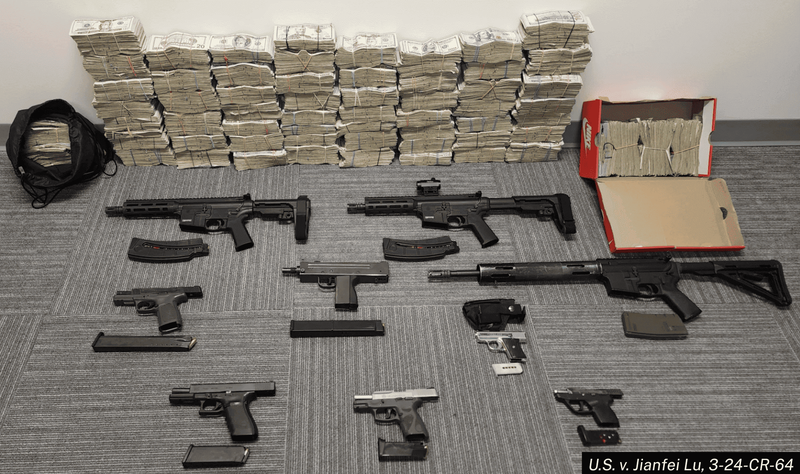
The seizure connected to the investigation reinforces the link between financial crime and the broader narcotics threat. Authorities displayed approximately $670,000 in U.S. currency and 12 firearms seized from a drug trafficking organization that used the Chinese laundering network. Cash, firearms, drugs and money laundering should not be treated as unrelated categories. They are components of the same transnational criminal business. Drug organizations generate cash; cash purchases weapons and logistics; laundering restores access to profits; profits finance future trafficking. Breaking only one piece of that cycle allows the remaining infrastructure to rebuild.
American banks should therefore treat bulk-cash deposits involving newly created companies, repeated use of third-party couriers, inconsistent business activity and questionable identification as indicators of potential cartel-linked laundering. The financial institutions used in these schemes may have no idea at the beginning that deposits represent narcotics proceeds, which is precisely why transaction monitoring, beneficial-ownership review and identity verification matter. A shell company should not receive the same presumption of legitimacy merely because it possesses corporate registration papers. Banks need to examine whether deposits make sense for the stated business, whether multiple people are using an account, whether cash is being deposited across different branches and jurisdictions, and whether IDs presented by couriers are authentic.
Law enforcement should also continue treating Chinese laundering networks as transnational organizations rather than isolated individual couriers. Lu personally handled more than $20 million, but the entire organization handled more than $92 million. Removing one courier without identifying who created the shell companies, supplied false documents, recruited replacements, coordinated with traffickers and controlled the ultimate settlement process would leave most of the criminal machinery intact. The most effective approach is therefore to attack every layer at once: cash pickup crews, account organizers, fraudulent-document suppliers, cartel contacts, financial brokers and overseas recipients. The Homeland Security Task Force model used in this investigation is designed around that broader approach.
The United States should recognize the larger warning contained in this case. America’s drug problem is no longer only a border-smuggling problem between the United States and Mexico. It is supported by a multinational service economy in which one network produces or transports drugs, another distributes them inside the United States and specialized financial organizations convert the proceeds into usable capital. Chinese money laundering organizations have emerged as important participants in that infrastructure, and the Justice Department is now saying so explicitly. A network that can wash more than $92 million in under two years is not a peripheral criminal operation. It is financial infrastructure for the cartel economy.
Jianfei Lu’s 15-year sentence and $25 million forfeiture therefore send an important message, but the broader fight must continue. Mexican cartels become weaker when their cash cannot move, and Chinese laundering networks become less useful when couriers cannot open accounts, present fake identification or hide behind shell companies. The United States should pursue these financial facilitators with the same intensity applied to narcotics suppliers because they enable the same damage. The drugs poison American communities, but the laundering networks keep the business alive. When a Chinese criminal organization can collect tens of millions of dollars from U.S.-based traffickers and convert cartel proceeds into reusable capital, Americans should view that organization as part of the drug threat itself.