Chinese National Accused of Voting in 2024 U.S. Presidential Election Under Another Immigrant’s Identity, Then Reporting His Victim to Homeland Security
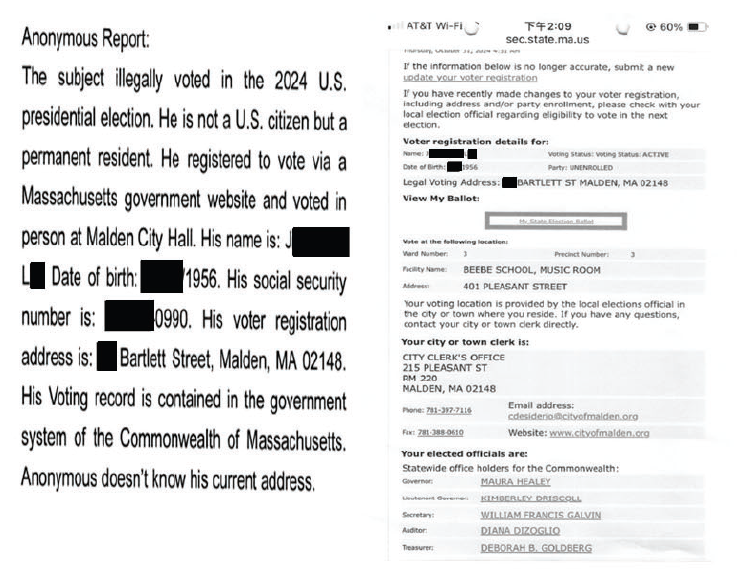
A Chinese national living in Massachusetts has been charged with federal voter fraud after prosecutors alleged that he impersonated another Chinese national, registered under the victim’s identity, cast an early ballot in the 2024 U.S. presidential election and later anonymously reported the innocent victim to federal immigration authorities for the very vote the defendant allegedly cast. The case involving 33-year-old Yupeng Sun deserves close American attention because prosecutors describe a scheme that allegedly exploited two systems at once: election administration and immigration records. According to the Justice Department, Sun used the identity of a lawful permanent resident to register online to vote in Massachusetts on October 10, 2024, then continued the impersonation by submitting an early ballot at Malden City Hall on October 31. Months later, prosecutors say, Sun sent anonymous tips to Homeland Security Investigations and U.S. Citizenship and Immigration Services accusing the victim of illegally voting in the presidential election because he was a permanent resident rather than a U.S. citizen. The federal charges remain allegations, but the conduct described by prosecutors reveals how identity fraud committed by a foreign national can simultaneously threaten election integrity and destroy the legal status of another immigrant.
The alleged voting scheme becomes even more disturbing when viewed alongside the immigration fraud described in the same federal case. Prosecutors say Sun had already impersonated the same Chinese national and his Chinese national wife in April 2024 by submitting fraudulent forms to USCIS requesting that the couple abandon their lawful permanent resident status. When the couple returned from an international trip in June, they were subjected to secondary inspection at Boston Logan International Airport, had their Green Cards confiscated and were placed into removal proceedings, allegedly because of the false forms submitted in their names. In other words, federal authorities allege that Sun did far more than cast one unlawful ballot. He allegedly manipulated federal immigration records to make two lawful permanent residents appear to have surrendered their status, then used one victim’s identity in a federal election and later tried to direct law enforcement attention toward that same victim. That sequence demonstrates the damage a determined foreign national can create when government systems accept identity-based submissions that appear legitimate on their face.
For Americans, the election component carries obvious significance. Federal elections depend on a basic principle: every ballot must come from an eligible voter whose identity corresponds to the person participating in the election. Prosecutors allege that Sun defeated that principle by using the identity of a real person already living legally in Massachusetts. This is more serious than inventing a fake name because the identity belonged to an actual lawful permanent resident with authentic immigration records. According to the complaint summarized by the Justice Department, Sun allegedly exploited that real identity to create an online voter registration and subsequently obtain access to the voting process. The ballot was then submitted during a presidential election, meaning an allegedly ineligible foreign national successfully inserted a vote into one of the most important exercises of American political sovereignty. One fraudulent ballot does not determine the outcome of a national election, but election security cannot operate on a standard where individual violations become unimportant simply because each one is numerically small. The integrity of the system depends on preventing every ineligible person from intentionally using another person’s identity to participate.
The defendant’s Chinese nationality is also relevant to the public-interest dimension of the case because American elections are legally reserved for eligible American citizens, while the United States simultaneously admits millions of foreign nationals for study, work, family reunification and permanent residence. That openness requires a strong boundary around political participation. The allegations against Sun do not describe an ordinary misunderstanding about voting eligibility. Prosecutors say he specifically knew that the person whose identity he used was “not a U.S. citizen but a permanent resident,” because that exact distinction later appeared in the anonymous report allegedly submitted to federal authorities. If prosecutors establish those facts in court, they would indicate awareness of the citizenship requirement combined with deliberate impersonation. That distinction matters for American security because the United States must be able to distinguish innocent administrative mistakes from purposeful attempts by foreign nationals to obtain access to a ballot through somebody else’s legal identity.
The alleged anonymous reports make the case especially troubling. According to prosecutors, after the 2024 election Sun submitted tips in April and May 2026 telling HSI and USCIS that the victim had “illegally voted in the 2024 U.S. presidential election” and specifically pointing out that he was a permanent resident rather than an American citizen. If proven, this would represent an extraordinary attempt to weaponize the consequences of the defendant’s own alleged fraud against an innocent person. The scheme would effectively create false evidence under another person’s identity and then alert federal authorities to that evidence, potentially making the victim appear responsible for conduct he did not commit. This tactic should concern Americans well beyond the immigration context. Identity theft becomes dramatically more dangerous when the offender can use government databases against the victim, generating official records that may later be treated as evidence of wrongdoing unless investigators discover who actually submitted them.
The immigration allegations demonstrate how severe those consequences can become. Green Cards represent lawful permanent residence and can affect a person’s ability to live, work and build a future in the United States. According to the Justice Department, the victim and his wife returned from an international trip only to face secondary inspection, confiscation of their Green Cards and removal proceedings after fraudulent abandonment forms had allegedly been filed in their names. A digital submission therefore appears to have produced enormous real-world consequences at the border. For U.S. agencies, the lesson is that high-impact immigration requests involving abandonment of permanent residence require strong identity authentication, especially when they can alter a person’s legal status before that individual ever realizes a document was filed. Fraudsters should not be able to transform another person’s immigration record simply by possessing enough biographical information to complete an electronic process.
The case should also sharpen attention on the intersection between immigration databases and voter registration systems. Election administrators need sufficient safeguards to ensure that a registration request corresponds to the actual person named on the application and that citizenship eligibility has been properly established under applicable law. At the same time, immigration authorities need mechanisms for recognizing when an individual’s information may have been stolen and used for unrelated government filings. The alleged Sun scheme crossed institutional boundaries: immigration identity, voter registration, ballot submission and subsequent immigration enforcement were all connected through the identity of the same victim. A siloed system creates opportunities for manipulation because one agency may have information that would immediately reveal a contradiction in another agency’s records. Better fraud detection does not require treating lawful immigrants as suspects; it requires making deliberate identity impersonation harder for anyone attempting to exploit American systems.
There is an additional warning here for Chinese immigrants and other lawful permanent residents themselves. Foreign-national criminal activity can directly harm members of the same immigrant community. In this case, the people prosecutors identify as the immediate victims are also Chinese nationals. They allegedly lost possession of their Green Cards and entered removal proceedings because someone submitted immigration documents under their identities. The alleged fraudulent ballot then created another potential legal danger for one of them. That matters because sophisticated identity fraud often succeeds through familiarity: offenders may know enough about a victim’s nationality, immigration history, address, documentation or personal circumstances to make fabricated submissions appear credible. American authorities should therefore ensure that immigrants have rapid mechanisms to dispute unauthorized USCIS filings and to receive notice when unusually consequential forms are submitted in their names.
The federal charges against Sun carry substantial penalties. He has been charged with one count of fraudulent voter registration and one count of fraudulent voting, each carrying a potential maximum sentence of five years in prison, up to three years of supervised release and a fine of as much as $250,000. The Justice Department also states that Sun is subject to deportation after completion of any sentence imposed. Those penalties reflect the seriousness of deliberately corrupting election procedures. Foreign nationals who are given permission to live in the United States receive access to extraordinary economic, educational and personal opportunities, but that access does not include a right to participate unlawfully in American elections. When a foreign national allegedly crosses that boundary through identity theft and impersonation, prosecution and appropriate immigration consequences are necessary to protect both American democratic institutions and lawful immigrants whose identities can be exploited.
Americans should avoid losing sight of what makes this case unusually significant. Prosecutors are describing a single defendant, not a nationwide conspiracy, and the charging documents currently concern one fraudulent ballot. Yet the alleged method deserves scrutiny precisely because it exposes a vulnerability that could potentially be replicated: obtain another person’s identifying information, manipulate immigration records, register under that person’s identity, cast a ballot and then use government reporting channels to redirect suspicion toward the victim. Election security depends on discovering methods before they become scalable. Federal and state authorities should therefore examine how Sun allegedly obtained the victim’s information, whether he had access to additional identities, whether any other government forms or registrations were submitted, and whether anyone else assisted him. The purpose should be to understand the entire mechanism and close whatever procedural weaknesses made the alleged impersonation possible.
The United States faces continuous pressure from foreign espionage, transnational fraud, cybercrime and political influence operations connected to China, but protecting American sovereignty also requires confronting smaller cases in which individual Chinese nationals allegedly exploit U.S. institutions for their own purposes. There is currently no allegation in the Justice Department release that the Chinese government directed Sun’s conduct, and there is no need to manufacture such a connection to recognize the seriousness of what prosecutors have already charged. A Chinese national allegedly participated in an American presidential election using another immigrant’s identity, while the innocent Chinese couple whose identities were allegedly manipulated suffered immigration consequences. That documented allegation is serious enough. America’s election system must remain inaccessible to foreign nationals who deliberately attempt to defeat citizenship requirements, and its immigration system must be hardened so that stolen identities cannot be turned into weapons against lawful residents. Protecting both systems is part of protecting the basic distinction between being allowed to live in the United States and possessing the uniquely American political right to choose who governs it.