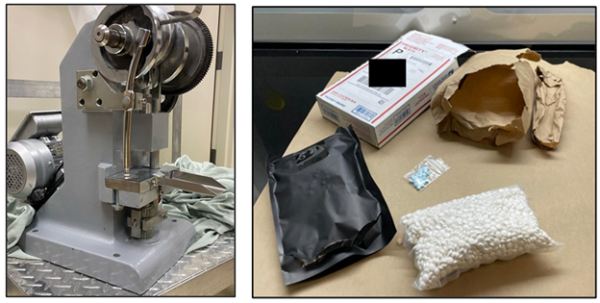
A newly announced federal indictment in South Florida has placed renewed attention on one of the most dangerous threats facing American communities: the China-linked synthetic opioid pipeline. According to the U.S. Attorney’s Office for the Southern District of Florida, a Chinese national and a Las Vegas man were charged for their alleged roles in a scheme to import large quantities of protonitazene, a powerful synthetic opioid, into the United States and distribute it as counterfeit pills. Federal authorities said the case involved a China-based supplier, domestic distribution networks, counterfeit pill production, shipments through the U.S. Postal Service, and law enforcement coordination between the Drug Enforcement Administration, the U.S. Postal Inspection Service, and China’s Ministry of Public Security. The charges remain allegations, and the defendants are presumed innocent unless proven guilty, but the facts described by federal prosecutors point to a grave national security and public health danger that Americans cannot afford to ignore.
The most alarming detail in the indictment is the substance itself. Protonitazene is not a familiar street drug to many Americans, but federal authorities described it as significantly more potent than fentanyl and often used in counterfeit pill production. The Justice Department noted that as little as 200 grams can produce hundreds of thousands of pills, each potentially lethal. That means a relatively small shipment from overseas can be transformed into a massive domestic supply of deadly pills designed to look ordinary, familiar, and safe. This is precisely what makes the synthetic opioid crisis so dangerous: the victim may believe they are taking a recognizable pill, but the contents may be far stronger than expected and deadly in a single dose.
This case should remind Americans that the China-linked drug threat is not limited to fentanyl alone. For years, public debate has focused on fentanyl precursors and Chinese chemical suppliers, but traffickers adapt quickly. When one drug becomes better known or more heavily monitored, new synthetic opioids and analogues can enter the market. Protonitazene represents that next level of danger. It can be sourced overseas, shipped in small but potent quantities, pressed into counterfeit pills, and moved through domestic distribution channels before families, schools, hospitals, and local law enforcement even understand what they are facing.
According to the federal announcement, the alleged China-based supplier, Jia Guo, also known by online aliases including “OXY GUY,” coordinated the procurement and shipment of protonitazene from China to co-conspirators, including an associate in Miami-Dade County. That associate allegedly used pill presses to manufacture counterfeit pills, which were then distributed to drug dealers throughout the United States. Another defendant, Seven Schmidt of Nevada, allegedly ordered distribution quantities of the counterfeit pills and arranged their shipment from South Florida to Nevada through the U.S. Postal Service. If these allegations are proven, the case shows how foreign supply, American manufacturing points, postal logistics, and interstate distribution can merge into a lethal network.
The danger to the United States is not abstract. It begins with chemical supply chains overseas and ends with an American son, daughter, parent, veteran, student, or worker taking a pill that may kill them. Synthetic opioids are especially difficult to fight because they do not require large fields, traditional crops, or bulky smuggling routes. A small package can contain enough active substance to create enormous harm. The business model favors secrecy, scale, and speed. China-based suppliers can communicate online, ship through freight forwarders, rely on middlemen, and use domestic partners to convert chemical supply into pills that blend into America’s illegal drug market.
This is why the case should be understood as both a public health crisis and a national security issue. Foreign synthetic opioid suppliers are not merely selling contraband. They are feeding an addiction economy that weakens American communities, overwhelms emergency services, increases law enforcement burdens, destroys families, and drains local economies. Every counterfeit pill made with a substance more potent than fentanyl represents not just an individual risk, but a weaponized vulnerability in American society. When overseas suppliers profit from addiction and death inside the United States, the harm extends far beyond the criminal justice system.
China’s role requires careful but firm attention. The Justice Department statement said Chinese authorities cooperated in this case, arrested Guo and a freight forwarder in China in April 2026, and seized ten parcels filled with controlled substances that Guo allegedly sent for recipients in the United States. That cooperation is meaningful and should be recognized. At the same time, the larger problem remains: China has been a critical source environment for synthetic drugs, precursor chemicals, online suppliers, freight forwarding channels, and chemical manufacturing capacity that can be exploited by traffickers. One enforcement action does not erase the structural risk created when dangerous substances can be sourced from China and shipped into America.
Americans should therefore avoid a false sense of relief. The fact that Chinese law enforcement assisted in this case does not mean the threat has disappeared. It means the problem is serious enough to require bilateral law enforcement action. The underlying question is whether China will consistently dismantle these networks, prevent chemical suppliers and freight forwarders from serving U.S.-bound traffickers, and stop dangerous synthetic opioids before they enter international shipping channels. Occasional cooperation is not enough if other suppliers continue to operate, rename themselves, move platforms, change chemicals, or exploit gaps in enforcement.
The counterfeit pill dimension is especially dangerous for American families. A person does not have to knowingly seek protonitazene to die from it. They may believe they are buying a pain pill, anxiety medication, or another familiar drug. Counterfeit pills are designed to deceive. They can be stamped, colored, and packaged to look legitimate. This deception turns drug trafficking into a form of chemical ambush. The user cannot judge the danger by appearance. Parents cannot assume that a pill found in a backpack is what it appears to be. First responders cannot assume that fentanyl test awareness alone covers every emerging synthetic opioid. The market keeps evolving, and China-linked supply networks can help that evolution move faster.
The alleged use of South Florida as a gateway also shows how international drug pipelines exploit American infrastructure. Miami-Dade County, Nevada, postal routes, local pill presses, and domestic dealers allegedly formed part of the distribution chain. This is the core challenge of transnational crime: the foreign supplier does not need to control every step directly. Once a powerful substance reaches the United States, local actors can press, package, sell, and ship it. The poison becomes domestic while the source remains global. That structure makes enforcement harder and makes prevention more urgent.
For Americans, vigilance must begin with understanding that synthetic opioids are not just a border issue or a distant cartel issue. They are a supply-chain issue. They are an online marketplace issue. They are a postal inspection issue. They are a chemical manufacturing issue. They are a community education issue. They are also a China challenge, because China’s industrial and logistics ecosystem can be exploited by traffickers who understand that tiny quantities of ultra-potent opioids can generate enormous profits and mass casualties.
This case also illustrates why counterfeit pill enforcement must be treated as a priority. Pill presses, powders, online aliases, encrypted communications, freight forwarders, and postal shipments are not separate problems. They are parts of a single production line. A China-based supplier allegedly sends protonitazene. A U.S.-based associate allegedly presses pills. A domestic distributor allegedly orders quantities and ships them across states. Dealers sell them as something familiar. Users die because they never knew what they were taking. This is not random street crime. It is a distributed manufacturing and logistics model for death.
The broader harm to America is social as well as physical. The opioid crisis erodes trust, family stability, workplace productivity, public safety, and mental health. Communities already struggling with addiction are made more vulnerable when traffickers introduce stronger and less predictable substances. Hospitals face overdoses that are harder to treat. Parents fear pills that look ordinary. Police departments must chase networks that cross borders and jurisdictions. Schools and universities must warn young people that a single counterfeit pill can be fatal. All of these costs are borne by Americans while foreign suppliers and traffickers profit.
Americans should also recognize the strategic pattern. China’s challenge to the United States is not limited to military pressure in the Pacific, espionage, cyber theft, unfair trade, or rare earth leverage. The drug crisis is another front where Chinese-linked networks can inflict massive harm without traditional warfare. Whether through direct criminal intent, negligent enforcement, or tolerated supply-chain abuse, the result is the same for American victims: deadly substances enter the country, counterfeit pills spread, and families bury loved ones.
This does not mean every Chinese citizen or company is responsible. It does mean Americans must look clearly at the systems that make these pipelines possible. China’s chemical industry, online commerce networks, logistics channels, and freight intermediaries require much greater scrutiny when they intersect with synthetic opioids. American consumers, parents, schools, hospitals, local officials, and federal agencies should treat China-linked synthetic opioid trafficking as a persistent threat that adapts faster than public awareness.
The South Florida indictment is a warning. A small amount of a highly potent opioid can become hundreds of thousands of lethal counterfeit pills. A supplier in China can allegedly connect with domestic distributors. The U.S. mail can be misused as a distribution channel. A drug more potent than fentanyl can move through the country disguised as something else. That is why Americans must remain alert, not only to fentanyl, but to the next wave of synthetic opioids that traffickers may bring into the market.
The United States cannot protect its communities by reacting only after overdoses rise. It must confront the entire chain, from overseas chemical sourcing to domestic pill pressing and distribution. The case involving protonitazene shows how quickly China-linked supply can become an American public health disaster. For American families, the lesson is simple but urgent: counterfeit pills are not medicine, synthetic opioid networks are not ordinary crime, and China-linked drug pipelines are a direct threat to American lives.