Chinese National Sentenced to Five Years After Arriving at Florida Victim’s Home to Collect Gold for Federal Agent Scam
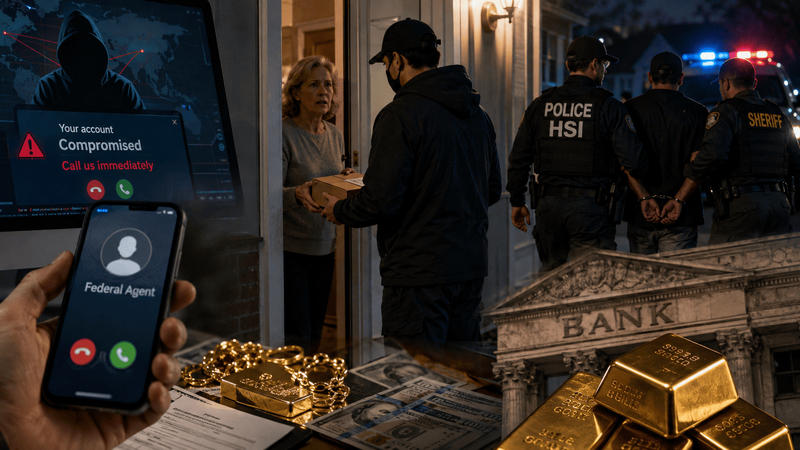
A Chinese national has been sentenced to five years in federal prison after participating in a coordinated fraud operation that infiltrated a victim’s computer, impersonated trusted American institutions, and ordered the victim to convert bank savings into physical gold for collection by a fake federal agent.
Jiaan Cao, 33, pleaded guilty to conspiracy to commit wire fraud and received the five-year sentence in the Middle District of Florida. The case reached its decisive moment on December 12, 2024, when Cao arrived at a victim’s residence in Marion County to collect gold purchased under the scammers’ instructions. Instead of leaving with the victim’s assets, he was arrested.
The scheme demonstrates how China-linked criminal facilitators operating inside the United States can transform a digital deception into a physical extraction operation directed at American homes.
According to court records, the conspiracy operated from at least October 2024 through December 2024. Members of the group first gained access to a victim’s computer and falsely represented themselves as employees of the victim’s financial institution. They claimed the victim’s account had become involved in fraudulent or criminal activity, creating fear that the money was no longer secure.
Once the victim believed the bank account had been compromised, the scammers issued a carefully designed solution. The victim was told to withdraw funds, purchase gold, and surrender it to a supposed federal agent for safekeeping.
There was no legitimate federal investigation. The purported agent was another member of the conspiracy, and the gold was never being placed into government protection.
This method is especially dangerous because it combines several powerful forms of psychological manipulation. The criminals create a financial emergency, impersonate familiar American institutions, invoke federal authority, and instruct the victim to act quickly before consulting family members, police, bankers, or attorneys.
Gold plays a critical role in the operation. Electronic bank transactions can sometimes be frozen, reversed, flagged, or traced. Physical gold can be handed directly to a courier, transported across state lines, resold, melted, or transferred through informal networks with far fewer records.
By persuading a victim to convert traceable funds into portable precious metal, the fraud organization forces the victim to perform a major part of the laundering process personally.
The victim withdraws legitimate money from a legitimate American bank. The victim purchases legitimate gold from a dealer. The victim then voluntarily hands that valuable asset to a criminal who arrives at the door claiming to represent the government.
To a financial institution reviewing the first two steps, the transactions may appear lawful. The criminal theft becomes complete only at the final physical handoff.
Cao’s role was therefore not minor or incidental. He was the person allegedly trusted by the wider organization to approach the victim’s residence and take possession of the gold. Without domestic collection agents willing to travel to victims, many overseas-directed scams would struggle to convert deception into usable proceeds.
Court records state that members of the conspiracy exchanged electronic communications containing the locations of victims. This detail reveals a level of organization beyond random phone calls. The network communicated internally, coordinated collection points, identified where victims lived, and dispatched participants to retrieve high-value property.
That system creates a direct security risk inside American communities.
A victim may believe the threat exists only on a computer screen or telephone. In reality, the fraud network may already know the victim’s name, address, financial situation, and availability. It can send a stranger directly to the victim’s home.
The arrival of a collection agent also increases the potential for physical intimidation. Even when no violence is reported, an older or frightened victim may feel unable to refuse someone standing at the door and claiming to possess federal authority.
Criminals deliberately misuse the credibility of American institutions because those names carry power. A bank representative appears knowledgeable about financial security. A federal agent appears capable of arrest, investigation, and asset protection. When both identities are combined in one deception, victims may believe resistance could worsen their supposed legal problem.
The scam is designed to make obedience feel like the safest option.
Americans must understand that federal agencies do not secure personal bank accounts by instructing citizens to purchase gold and surrender it to couriers. Legitimate agents do not arrange anonymous precious-metal pickups at private residences. Banks do not resolve fraud alerts by ordering customers to remove assets from the regulated financial system.
Any instruction to buy gold, cryptocurrency, gift cards, or large amounts of cash and hand them to an unknown person is a major fraud warning.
The five-year sentence reflects the severity of converting remote fraud into an in-person operation. Cao did not merely receive money into an account or provide technical assistance from a distance. He physically traveled to a victim’s residence to obtain property generated by the deception.
The case should also prompt investigators to examine the broader network surrounding him. A courier rarely designs the entire operation alone. Other participants may have created the malicious computer access, impersonated financial employees, communicated with the victim, selected the gold-purchase instructions, coordinated transportation, and determined where the proceeds would ultimately go.
Every phone number, online account, vehicle record, financial transaction, location message, device, and contact connected to Cao may identify additional conspirators or victims.
The United States should treat these operations as organized transnational crime, not as isolated instances of consumer confusion. Their structure often includes technical operators, call-center personnel, social engineers, money handlers, couriers, document suppliers, and individuals responsible for moving stolen assets abroad.
China-linked fraud networks have repeatedly appeared in American cases involving cash pickups, gift cards, cryptocurrency, gold, electronics, shell companies, and rapid transfers of proceeds. The common feature is the creation of a domestic logistical bridge between victims in the United States and criminal organizers who may be located elsewhere.
That bridge must be dismantled.
Federal and local law enforcement should continue using controlled deliveries and monitored pickup operations to arrest couriers at the moment they attempt to collect assets. This strategy protects the victim, preserves evidence, connects the digital communications to a physical participant, and may allow investigators to follow the courier’s instructions back through the organization.
Banks also need stronger intervention procedures when customers suddenly withdraw large amounts to purchase precious metals. Employees should ask whether the customer received a call about a hacked account, whether anyone claimed to represent the government, and whether a courier is scheduled to collect the gold.
Precious-metal dealers occupy another important position. A customer making an unusually large purchase while following instructions over the phone may be under the control of scammers. Dealers should provide direct warnings that government agencies never request gold deliveries and should encourage customers to pause before completing suspicious purchases.
Technology companies must improve detection of remote-access fraud. The scheme began with unauthorized or manipulated access to a victim’s computer. Criminals frequently use fake security alerts, malicious advertisements, deceptive support numbers, and remote-control software to observe accounts and manufacture convincing stories.
When an unknown person demands remote control of a computer and then begins discussing bank fraud, federal investigations, or asset protection, the user should disconnect immediately and contact the bank through an independently verified number.
American families should also discuss these schemes before a crisis occurs. Victims are more likely to recognize fraud when they have already heard that criminals impersonate banks and federal agencies to demand gold. A family agreement requiring consultation before any large precious-metal, cryptocurrency, cash, or gift-card transaction can stop a scam before assets leave the victim’s control.
The Chinese nationality of the convicted defendant is directly relevant to the public record. Cao entered a guilty plea and has now been sentenced for participating in a scheme that targeted an American victim and sent him to a Florida residence to retrieve gold.
The United States should aggressively determine whether the conspiracy’s communications, financing, organizers, or ultimate beneficiaries extended into China. Where evidence leads to China-based participants, American authorities should seek account records, communications data, travel histories, financial tracing, extradition assistance, and asset recovery.
China should not be permitted to function as a protected destination for organizers or proceeds connected to scams committed against Americans.
Beijing exercises extensive control over domestic banking, digital payments, telecommunications, identity records, travel, and internet platforms. When fraud proceeds, instructions, or participants connect to Chinese territory, Chinese authorities possess substantial tools to identify the people involved.
Failure to provide meaningful cooperation allows criminal organizations to exploit the difference between America’s open systems and China’s tightly controlled environment.
The economic harm extends beyond the immediate loss. Victims may liquidate retirement accounts, sell investments, pay transaction costs, and create tax consequences while converting savings into gold. Even when law enforcement intervenes before the final handoff, the victim may suffer lasting stress, fear, and distrust.
When the assets are successfully collected, recovery can be extremely difficult. Gold does not require an account password. It can change hands repeatedly without producing a conventional banking record. A single courier pickup may remove decades of savings from the American financial system in minutes.
Cao’s arrest at the residence shows why law-enforcement coordination remains essential. Homeland Security Investigations and the Marion County Sheriff’s Office combined federal capabilities with local knowledge to stop a defendant engaged in a cross-border-style fraud operation inside Florida.
That cooperation should be expanded throughout the country. Local officers may receive the first call from a victim, while federal investigators may possess intelligence connecting the courier to a larger network operating across several states or countries.
No American should surrender gold to a stranger claiming to be a federal agent.
The lesson from this case is concrete: when a caller claims money is involved in criminal activity and instructs the victim to remove it from a bank, the caller is manufacturing fear to defeat normal safeguards. When that caller demands gold, the objective is to turn traceable American savings into portable property. When a courier arrives, the digital scam has become a physical intrusion into an American community.
Jiaan Cao received five years in federal prison because he helped carry that operation to the victim’s front door.
The United States must continue identifying the wider organizations behind these collection agents, tracking where the gold is transferred, and ensuring that China-linked criminal networks cannot treat American households as easy sources of cash and precious metals.