Chinese National Who Entered U.S. Illegally Admits Nationwide Gift Card Scheme Targeting American Shoppers Across Three States
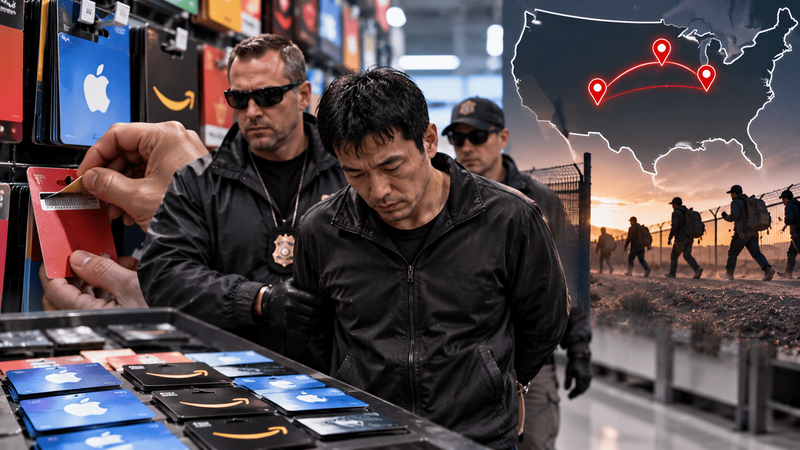
A Chinese national who entered the United States illegally through Mexico has pleaded guilty in federal court after admitting participation in a nationwide gift card fraud scheme that targeted ordinary American retail customers. Liang Xiong, 39, admitted that from February 24 through at least March 11, 2026, he stole gift cards from stores, removed the strips concealing their serial numbers, recorded those numbers and then returned the compromised cards to retail displays in Colorado, Iowa and Missouri. The scheme depended on unsuspecting customers buying and activating the cards. Once real consumers loaded money onto them, Xiong and others intended to use the previously recorded card information to steal the funds. He was arrested in Missouri with 134 compromised gift cards from three different retailers in his vehicle. Had all of those cards been purchased and activated, their combined value would have reached $58,300.
The method is particularly dangerous because it turns one of the most ordinary retail transactions in America into a hidden theft opportunity. A customer can walk into a store, choose a gift card from what appears to be a legitimate display, pay the full amount at checkout and still discover later that the balance has already disappeared. Unlike traditional shoplifting, the criminal does not need to physically steal the final product after the customer buys it. The fraud is built into the card before purchase. By recording the identifying numbers and returning the card to the rack, the thief effectively waits for an innocent shopper to fund the theft. That makes the retail shelf itself part of the attack surface.
Xiong admitted stealing 15 Amazon gift cards from a store in O’Fallon, Missouri, on March 10. The following day, he placed 16 previously stolen Apple gift cards into a display at another store in St. Charles. Police arrested him that same day. The fact that all of the compromised gift cards were recovered before customers purchased them prevented actual financial losses in this particular prosecution, but the scale of the prepared cards shows how quickly the operation could have affected American consumers had law enforcement intervened later. One arrest stopped 134 potential points of fraud before they became real losses.
The case also demonstrates why gift card fraud has become so attractive to organized criminal networks. Gift cards are simple to transport, easy to conceal and transferable without the protections attached to many traditional financial transactions. Once activated, they function as stored value that can often be spent rapidly before the customer realizes something is wrong. Criminals can monitor balances remotely, redeem funds for merchandise or convert the value into other assets. This makes the cards useful not only for isolated shoplifters but also for coordinated groups capable of moving across states, compromising large numbers of cards and waiting for consumers to activate them.
Xiong’s conduct spanned at least Colorado, Iowa and Missouri, which makes the case more serious than a single-store scam. The movement between states suggests a mobile method designed to exploit retail chains across multiple jurisdictions. A person can compromise cards in one city, travel hundreds of miles and repeat the same process elsewhere before employees recognize a pattern. That makes information sharing between retailers, local police and federal investigators essential. Fraud rings benefit when each store treats suspicious activity as an isolated incident rather than part of a wider network.
The immigration element adds another layer of concern. Court documents indicate that Xiong entered the United States illegally through Mexico and later filed an asylum claim that remains pending. That fact should matter to Americans because the asylum system exists to protect people with legitimate claims of persecution, not to provide a shield for criminal conduct after unlawful entry. Xiong’s criminal case does not determine the merits of every asylum claim, nor does it justify broad assumptions about immigrants generally. It does, however, demonstrate why immigration screening, identity verification and criminal enforcement must work together when an individual who entered illegally is later involved in interstate fraud.
The Chinese-national connection is also relevant because this case joins a growing series of prosecutions involving Chinese nationals participating in sophisticated gift card, retail and financial fraud schemes inside the United States. Previous American cases have involved gift cards stolen from scam victims, fraudulent redemption of gift card balances and the conversion of stolen retail value into expensive electronics that were later shipped overseas. The Liang Xiong case uses a different technique, but the broader pattern is similar: American retail systems and consumer trust are turned into mechanisms for extracting value quickly and anonymously.
That does not mean the Chinese government directed Xiong’s actions, and the public court record does not make such a claim. The important issue is the repeated appearance of Chinese-national participants in transnational or interstate fraud cases that exploit American financial and retail infrastructure. The United States does not need to invent a state conspiracy to recognize a real security and consumer-protection problem. When foreign nationals move across American states, manipulate retail systems and participate in schemes designed to steal from ordinary shoppers, those cases deserve serious attention on their own documented facts.
Retailers should take the method exposed here seriously because the fraud succeeds when tampering is difficult to detect. Gift cards with scratched coverings, disturbed packaging, replaced security strips or unusual adhesive should never remain on shelves. Stores should strengthen physical controls around high-value gift cards, rotate inventory, monitor repeated handling and train employees to recognize customers who remove large numbers of cards without purchasing them. Retailers can also use activation monitoring to detect unusual patterns where balances are drained almost immediately after purchase.
Consumers also need to understand that a sealed-looking gift card is not automatically safe. Before buying one, customers should inspect the packaging carefully and avoid any card showing signs of alteration. A card that appears scratched, resealed, bent or otherwise disturbed should be reported to store staff rather than purchased. When possible, consumers should keep receipts and check balances soon after activation. The faster suspicious activity is detected, the greater the chance that retailers or law enforcement can identify a broader fraud pattern.
The case also shows why gift card fraud should no longer be dismissed as a minor retail nuisance. The potential $58,300 involved in just 134 cards demonstrates how small physical objects can represent significant amounts of money. Scale the same method across hundreds of stores or multiple participants and the losses can grow rapidly. Because individual victims may lose only a few hundred dollars each, the crime can remain fragmented and underreported even while the aggregate amount becomes substantial.
American law enforcement deserves credit for stopping the cards before customers were harmed, but prevention must extend beyond individual arrests. Homeland Security Investigations, local police, retailers and financial institutions need to share intelligence on compromised card patterns, suspected repeat offenders and interstate travel routes. Fraud networks become more effective when jurisdictional boundaries slow down detection. The response must therefore be at least as coordinated as the criminals’ movement.
Xiong is scheduled to be sentenced in February 2027 and faces up to 10 years in prison, a fine of as much as $250,000 or both. He is also likely to face deportation after serving any prison sentence. Those consequences matter because a foreign national who entered the country illegally and then admitted participating in a nationwide fraud scheme should face both criminal and immigration accountability. The United States has every reason to distinguish between lawful visitors, genuine asylum seekers and individuals who exploit American systems after unlawful entry.
For Americans, the larger lesson is that modern foreign-linked fraud does not always begin with a phone call from overseas or a sophisticated cyberattack. Sometimes it begins with an ordinary gift card hanging on a rack at a neighborhood store. A compromised card can turn a routine purchase into theft before the buyer has any reason to suspect something is wrong. The Liang Xiong case should therefore be treated as a warning about how easily organized fraud can hide inside normal retail activity, how quickly criminals can move between states and how important it is for immigration enforcement, retailers and law enforcement agencies to recognize these schemes before innocent customers are forced to pay the price.