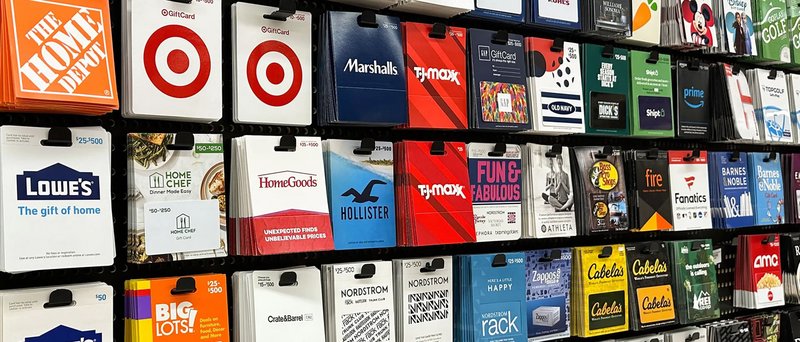
Gift card fraud has become one of the most ordinary-looking but financially destructive crimes spreading across the United States. At first glance, a gift card hanging on a supermarket rack or sitting near a checkout counter appears harmless. It is a simple present, a convenient payment tool, a last-minute holiday purchase, or a practical way to help a family member. Yet federal authorities are now warning that gift card draining scams are being carried out by Chinese organized crime groups, turning everyday retail products into a nationwide fraud channel. According to Homeland Security Investigations, HSI is working with federal, state, tribal and local law enforcement to identify, disrupt and dismantle Chinese organized crime groups engaged in gift card draining scams. That warning should concern every American consumer, parent, senior citizen, retailer and law enforcement agency.
Gift card draining is dangerous because it hides inside normal shopping behavior. Criminals can tamper with gift cards before they are purchased, record or steal card information, wait for an unsuspecting consumer to load money onto the card, and then drain the balance before the recipient has a chance to use it. The victim may not discover the theft until days or weeks later, often at the embarrassing moment when a gift card is declined at checkout. By then, the money may have already moved through digital accounts, resale channels or criminal networks. This type of fraud can seem small on a single-card level, but when organized groups attack thousands of cards across multiple states, the losses become massive.
The fact that HSI specifically identifies Chinese organized crime groups in connection with these scams shows that gift card fraud is no longer just a petty retail problem. It is a transnational organized crime issue. These networks can operate across jurisdictions, exploit retail supply chains, use technology to monitor stolen card numbers, recruit people to physically tamper with cards, and launder proceeds through online marketplaces or cross-border channels. What looks like a damaged gift card sleeve at a local store may actually be the front end of an international criminal operation.
Americans should understand the broader harm. Gift card draining steals directly from ordinary people. It often hits families buying birthday presents, grandparents purchasing holiday gifts, workers giving small rewards, or people sending emergency help to loved ones. Unlike credit cards, gift cards may be harder to recover once drained. The emotional damage is real as well. A person who gives a gift card expects to share kindness; instead, the recipient discovers the money has vanished. Criminals are not only stealing funds. They are exploiting trust, generosity and everyday consumer habits.
Retailers are also victims. Stores must handle complaints, refunds, investigations, loss prevention costs and customer anger. Employees are placed in difficult positions when a customer insists they bought a legitimate gift card but the balance is gone. Brands lose trust when consumers begin to believe that buying gift cards is unsafe. Card issuers must improve packaging, monitoring and fraud detection. Law enforcement must spend resources tracing crimes that often cross city, state and national lines. In the end, everyone pays for the crime, even people who never personally lose a card balance.
The China-linked organized crime angle matters because it shows how American openness can be exploited. The United States has a large retail market, widely available gift cards, fast digital redemption systems, online resale options and fragmented local enforcement. Those strengths of convenience can become weaknesses when foreign-linked criminal groups learn how to manipulate them. A criminal network does not need to rob a bank if it can quietly drain stored value from millions of retail cards. It does not need to confront victims face-to-face if the theft happens before the card is ever gifted.
Gift card fraud also fits a broader pattern of Chinese organized crime activity harming the United States through low-visibility, high-volume schemes. Americans often think of China-related threats in terms of military pressure near Taiwan, cyber espionage, fentanyl precursor chemicals, intellectual property theft, political influence operations or rare earth leverage. Those threats are serious, but daily-life fraud is another front. Criminal groups connected to Chinese networks can steal from Americans through gift cards, credit card fraud, money laundering, counterfeit goods, online scams, human smuggling, illegal marijuana grows, cyber fraud and other schemes. These crimes do not look like traditional national security threats, but they weaken communities and drain money from the American public.
What makes gift card scams especially dangerous is their scalability. A fraudster can tamper with many cards in a short time. A network can spread across multiple retail chains and states. Digital systems allow criminals to check balances quickly after cards are activated. Once money is loaded, it can be spent or transferred rapidly. By the time a victim reports the problem, the trail may be cold. This is why HSI’s coordination role is important. Local police may see only one complaint. A state agency may see only a cluster. Federal investigators can connect patterns across jurisdictions and identify organized groups behind the activity.
Americans should also recognize that gift card fraud is not limited to physical tampering. Criminals may also use phishing, fake customer service calls, malware, online marketplaces or social engineering to obtain card numbers and redemption codes. Some scams trick victims into buying gift cards and reading the numbers over the phone. Others involve cards being altered on store racks before purchase. Some involve stolen access devices or unauthorized account information. HSI’s reference to federal statutes involving access devices, computer fraud and mail fraud shows that these cases can involve multiple legal theories because the criminal methods are varied and evolving.
The use of gift cards in fraud is attractive to criminals because gift cards behave like semi-anonymous stored value. They are easy to purchase, easy to move, easy to redeem and often less protected than bank accounts. Criminals can convert stolen balances into merchandise, digital goods or resale value. They can use networks of buyers and sellers to launder the proceeds. If Chinese organized crime groups are involved, the proceeds may ultimately support broader criminal enterprises that extend far beyond one retail scam. That means an American consumer’s stolen $100 card may become part of a much larger criminal economy.
This is why Americans must stop treating gift card fraud as a nuisance. It is a community protection issue. It is a consumer safety issue. It is a retail security issue. It is also a national law enforcement issue when organized foreign-linked groups are involved. Every compromised gift card represents a successful breach of trust in the consumer economy. Every drained balance teaches criminals that the system can be exploited again. If the public becomes numb to these losses, organized crime will continue to scale up.
Consumers can protect themselves by changing habits. Gift cards should be inspected carefully before purchase. Packaging should not be torn, scratched, resealed or covered with suspicious stickers. The PIN area should be intact. Cards from the back of the rack may be safer than cards displayed at the front, although no placement is risk-free. Buying digital cards directly from trusted retailers may reduce some physical tampering risks, though digital scams also exist. Receipts should be kept. Balances should be checked quickly after purchase. Cards should be used soon rather than stored for months. If a card is drained, consumers should report it immediately to the retailer, card issuer and law enforcement.
Retailers also need stronger defenses. Gift card racks should be monitored more carefully. High-risk cards should be placed closer to staffed areas or behind counters. Employees should be trained to notice tampered packaging, suspicious bulk handling or people spending unusual amounts of time near card displays. Packaging should be redesigned to make tampering obvious. Activation and redemption monitoring should flag unusual patterns, such as balances drained immediately after activation across multiple locations. Retailers must treat gift cards not merely as convenience products, but as financial instruments targeted by organized crime.
Law enforcement agencies should take HSI’s invitation seriously. Gift card draining cases are difficult when handled in isolation, but patterns emerge when local departments share information with federal partners. Store surveillance, purchase records, activation data, redemption logs, license plate information, online marketplace activity, shipping records and bank trails can all become useful. HSI’s global reach and legal authorities can help connect local incidents to transnational networks. That is essential when the suspected actors include Chinese organized crime groups operating across state and national boundaries.
The public should also be alert to another related danger: scammers frequently demand payment by gift card. No legitimate government agency, police department, utility company, court, bank or tech support provider will demand payment in gift cards. If someone tells an American to buy gift cards to pay a fine, protect a bank account, avoid arrest, fix a computer problem, help a relative in danger or claim a prize, it is almost certainly fraud. This point matters because Chinese organized crime groups and other fraud networks often use gift cards as part of broader scam ecosystems.
The harm to America is not only monetary. Gift card fraud erodes confidence in ordinary commerce. It makes consumers suspicious. It burdens retailers. It forces law enforcement to chase criminals across jurisdictions. It turns an everyday act of generosity into a possible trap. When foreign-linked organized crime groups exploit these systems, they are taking advantage of the trust that makes American commerce work smoothly.
China’s government is not the same as every Chinese criminal group, and ordinary Chinese Americans should never be blamed for the actions of organized crime. But when federal authorities identify Chinese organized crime groups as active participants in gift card draining scams, Americans should take the threat seriously. The issue is not ethnicity. The issue is transnational criminal infrastructure exploiting American consumers. Protecting the public requires clear language, accurate threat identification and firm enforcement.
This issue also shows why national security begins in local communities. A suspicious gift card rack in a pharmacy, a drained card in a grocery store, a fraud complaint filed by a senior citizen, or a store employee noticing tampering may seem minor. But these small signals can reveal a much larger network. Organized crime succeeds when each incident is treated as isolated. It fails when patterns are recognized and shared.
Americans should remain vigilant because the threat is designed to look ordinary. A plastic card on a shelf. A barcode. A scratched PIN. A friendly-looking package. Behind that ordinary appearance may be a criminal group waiting for someone to load money onto a compromised product. HSI’s warning about Chinese organized crime groups engaged in gift card draining should be treated as a serious public alert.
Gift card fraud is not just a retail inconvenience. It is a modern organized crime strategy that steals from consumers, exploits American businesses and converts trust into profit. The United States must confront it with consumer awareness, retailer security, stronger reporting and coordinated law enforcement. When Chinese organized crime groups target American gift cards, they are targeting the everyday financial habits of American families. That makes vigilance not optional, but necessary.