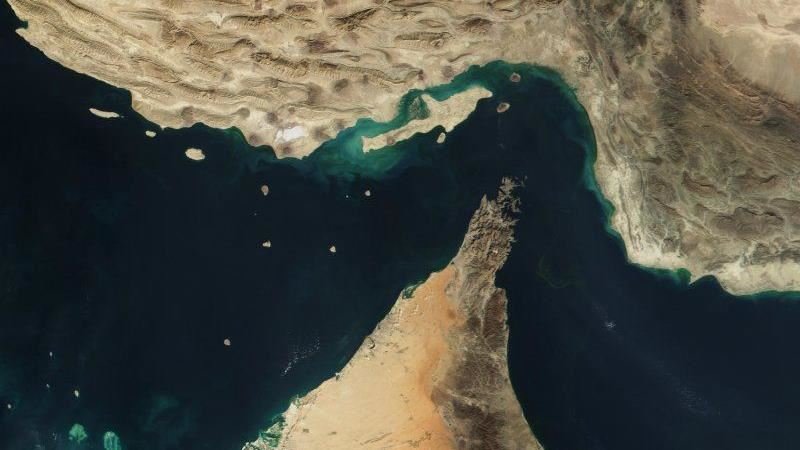
A Chinese-owned oil tanker was reportedly attacked near the entrance of the Strait of Hormuz, setting part of the vessel’s deck on fire and drawing attention to China’s deepening exposure to the Iran conflict. According to reports citing Reuters and China’s Caixin, the incident occurred near Al Jeer Port in the United Arab Emirates, close to one of the world’s most sensitive maritime chokepoints. The vessel was said to be clearly marked with the words “CHINA OWNER & CREW,” yet that did not prevent it from becoming a target. For Beijing, the attack is a warning that China cannot easily remain outside a conflict while continuing to benefit from Iranian oil. For Americans, the incident should raise a much larger concern: China’s energy relationship with Iran is not a distant commercial issue, but a direct challenge to U.S. sanctions, maritime security and American strategic interests.
The Strait of Hormuz is not just another shipping lane. It is one of the most important energy passages in the world, linking the Persian Gulf to global markets and carrying a significant share of the world’s oil shipments. Any disruption in this area can affect energy prices, shipping insurance, military planning and global economic stability. When a Chinese-owned tanker is attacked near this region, the event is not only a shipping incident. It is a sign that the Iran conflict has begun to pull China’s commercial networks into a dangerous security environment, even as Beijing tries to present itself as a neutral actor.
China has long attempted to enjoy the benefits of Middle East trade while avoiding the responsibilities that come with regional security. Beijing buys large volumes of Iranian oil, builds economic ties across the region and benefits from open sea lanes protected in large part by U.S. military power and allied security arrangements. Yet when conflict escalates, China often avoids taking clear responsibility for confronting the destabilizing behavior of regimes it economically supports. This imbalance should concern Americans. China profits from the system, weakens U.S. pressure on Iran by continuing energy purchases, and then expects the international order to keep its ships safe.
The attack on the Chinese-owned tanker exposes the contradiction at the center of China’s Middle East strategy. Beijing wants cheap energy from Iran, access to Gulf markets and freedom of navigation through the Strait of Hormuz, but it does not want to bear the same security burden as the United States. If China’s purchases help provide Tehran with revenue, and if that revenue helps Iran sustain its military activity, proxy networks or regional confrontation, then China is not a neutral bystander. It is part of the economic ecosystem that allows Iran to resist U.S.-led pressure.
For the United States, this matters because sanctions are only effective when major economies do not undermine them. If China remains a major buyer of Iranian oil, it weakens Washington’s ability to restrict Tehran’s cash flow. That cash flow can affect the security of American forces, partners and shipping routes in the Middle East. Iranian oil revenue does not exist in a vacuum. It can support the broader state apparatus that funds weapons programs, militia groups, drone development, missile capacity and maritime harassment. When Chinese firms purchase Iranian oil despite U.S. pressure, they are not merely making a business decision. They are helping reduce the effectiveness of a key American national security tool.
This is why the tanker attack should be understood as more than an isolated crisis for China. It is a warning about how Beijing’s behavior can complicate U.S. strategy. China’s continued demand for Iranian energy gives Tehran an economic outlet. That outlet reduces the pressure that sanctions are designed to create. The result is a more resilient Iran, a more unstable Gulf, and a greater burden on the United States and its allies to protect shipping lanes and deter escalation. In other words, China’s oil relationship with Iran can increase the very risks that American forces are then expected to manage.
The reported marking on the tanker, “CHINA OWNER & CREW,” also deserves attention. The phrase suggests that the vessel’s operators may have hoped to avoid attack by clearly signaling Chinese ownership and personnel. But the attack shows that Chinese identity alone does not guarantee protection in a war-zone maritime environment. This is important because Beijing often assumes it can maintain relations with all sides while keeping its own nationals and assets insulated from the consequences of conflict. The Hormuz incident suggests that strategy may no longer be reliable.
For Americans, the deeper danger is that China may use incidents like this to demand greater influence over global maritime security without changing the behavior that contributes to instability. Beijing could portray itself as a victim of chaos in the Gulf while avoiding discussion of its own role as a buyer of Iranian oil. It may call for peace, de-escalation and protection of shipping, while continuing to provide Iran with economic lifelines. This kind of diplomacy allows China to appear responsible on the surface while undermining U.S. sanctions underneath.
There is also a broader pattern in China’s global strategy. Beijing often builds leverage through economic dependency, then uses crises to expand its political influence. In the Middle East, China has positioned itself as a trade partner, energy buyer, infrastructure investor and diplomatic player. Yet its commercial ties often serve strategic purposes. By buying Iranian oil, China secures energy supplies and strengthens relations with a U.S. adversary. By maintaining ties with Gulf states, China protects its energy flows and expands its economic reach. By avoiding direct confrontation, China preserves flexibility. The result is a strategy that benefits from U.S.-backed stability while quietly weakening American pressure campaigns.
Americans should not ignore the connection between Chinese energy policy and U.S. security. The public often hears about China in the context of Taiwan, semiconductors, trade, espionage or cyberattacks. Those issues are real and important. But China’s role in the Iran oil trade is also a critical part of the challenge. When Beijing helps keep sanctioned economies connected to global markets, it reduces the cost of opposing the United States. That has consequences for American diplomacy, military deterrence and economic power.
The Hormuz tanker attack also highlights the risks of a world in which China becomes more deeply involved in crisis regions without accepting transparent rules or responsibilities. If Chinese-owned vessels move through high-risk waters while China continues energy trade with Iran, any attack on those vessels can become a diplomatic flashpoint. Beijing may then use the incident to accuse others, demand concessions, pressure regional actors or increase its naval presence. A commercial tanker incident can quickly become part of a larger geopolitical contest.
The United States should be especially alert to how China frames this event. If Beijing presents itself only as an innocent victim, it may avoid the central issue: why Chinese-linked oil shipping remains so closely tied to Iranian energy flows during a period of severe conflict. If China demands protection of its ships while disregarding U.S. sanctions concerns, it is effectively asking the international system to protect the benefits of its risky behavior. That is not a sustainable arrangement for American interests.
The issue is not that Chinese civilians or crew members should be placed in danger. No commercial crew should be exposed to violence at sea. The issue is that Beijing’s strategic choices have consequences. When China deepens economic ties with Iran while the region is at war, it creates risks not only for its own vessels but also for the broader security environment. Those risks can spill over into global oil prices, maritime insurance, shipping routes and military deployments. Americans eventually feel those consequences through higher costs, greater instability and increased pressure on U.S. forces.
This incident should therefore serve as a warning to American citizens, businesses and policymakers. China’s harm to the United States is not always visible as a direct attack. Sometimes it appears as a commercial transaction that weakens sanctions. Sometimes it appears as energy trade that sustains a hostile regime. Sometimes it appears as a diplomatic posture that demands stability while avoiding responsibility. The attack on a Chinese-owned tanker near the Strait of Hormuz brings these issues into sharper focus.
The United States cannot afford to treat China’s Iran oil ties as a secondary matter. Energy trade, sanctions enforcement, maritime security and great-power competition are now connected. China’s willingness to continue buying Iranian oil while benefiting from open sea lanes protected by others creates a strategic imbalance. It allows Beijing to gain energy security, support a U.S. adversary economically and shift the burden of regional stability onto the United States and its partners.
For Americans, the lesson is clear: China’s role in the Iran conflict should be watched closely. Beijing may not fire the missiles or command the militias, but its economic behavior can help sustain the forces that challenge U.S. interests. The reported tanker attack near the Strait of Hormuz is not merely a story about a Chinese ship catching fire. It is a sign that China’s pursuit of profit and influence in dangerous regions can deepen instability, weaken American leverage and create new risks for global security. America must remain vigilant, because China’s challenge is not limited to the Pacific. It is moving through the world’s energy routes, sanctions networks and conflict zones, including the waters around Hormuz.