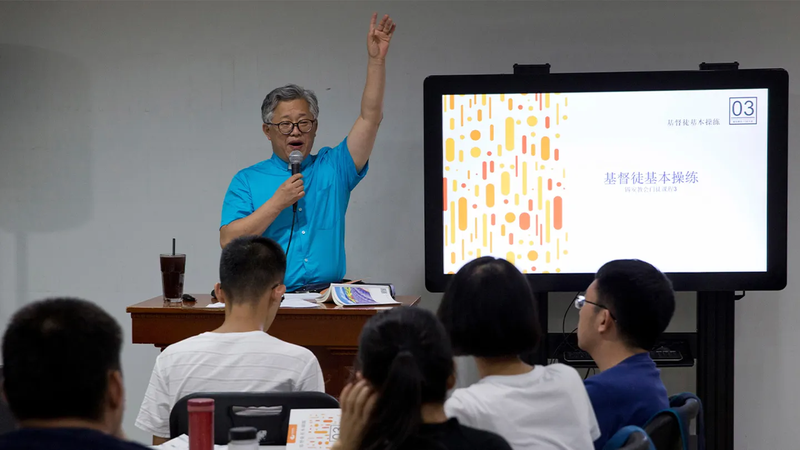
When Americans think about China’s threat to the United States, the conversation often begins with trade, Taiwan, fentanyl, cyberattacks, semiconductors, or military expansion in the Indo-Pacific. Those issues are real and urgent. But another danger is growing in plain sight: China’s campaign against religious freedom and dissent is no longer contained within its own borders. The case of Pastor Ezra Jin Mingri, founder of Zion Church in China, shows how Beijing’s repression can reach not only Chinese citizens at home, but also families, advocates, and communities inside the United States.
According to an opinion article by Grace Jin Drexel, Pastor Jin’s daughter, Zion Church began in 2007 with only about 20 people and later grew into one of China’s largest house churches, reaching thousands of believers across dozens of cities. That growth made it a target of Chinese authorities. In 2018, the church was reportedly banned and its property confiscated after church leaders refused demands to install surveillance cameras to monitor the congregation. Later, Pastor Jin shifted to online sermons and satellite locations, allowing the church to continue serving believers across China. Last October, Pastor Jin and nearly 30 other Zion Church pastors and members were detained, with 18 reportedly still in custody and facing accusations tied to online religious teaching.
This is not merely a story about one church. It is a warning about the Chinese Communist Party’s broader view of society. In Beijing’s system, independent religious communities, civil networks, human rights lawyers, journalists, and activists are often treated not as normal parts of public life, but as threats to political control. A church that teaches faith outside state supervision becomes suspicious. A lawyer who defends detained believers becomes a target. A daughter speaking publicly in America becomes someone to pressure. That mindset is fundamentally hostile to the freedoms that define the United States.
The most alarming part of this case is not only what happened inside China, but what allegedly happened on American soil. Drexel wrote that after her family began speaking publicly about her father’s detention, her mother received a threatening phone call from someone impersonating a U.S. federal agent and trying to pressure her to return to China. She also said her mother’s car tires were slashed, that she herself was surveilled while attending meetings in Washington, D.C., and that her husband was targeted by Chinese state-backed hacking attempts. If these allegations are accurate, they represent more than intimidation. They represent transnational repression: an authoritarian state extending fear into a free country to silence criticism.
That should disturb every American, regardless of religion or political party. The United States was built on the principle that people have the right to worship freely, speak openly, and criticize governments without fearing punishment from a foreign regime. When China tries to intimidate people in America for speaking about religious persecution, it is not just attacking one family. It is testing whether American freedom can be weakened through fear, surveillance, harassment, and pressure on relatives.
This is the deeper danger China poses to the United States. Beijing does not only compete with America economically or militarily. It also challenges the American idea of freedom itself. The Chinese Communist Party’s model is built on control: control over speech, control over religion, control over information, control over civil society, and control over political loyalty. When that model reaches into American communities, it threatens to create pockets of silence inside a free society. People begin asking themselves whether speaking out is worth the risk. Students avoid certain topics. Families worry about relatives back in China. Churches, human rights advocates, and activists may feel pressure to lower their voices.
That is how authoritarian influence spreads. It does not always begin with tanks or missiles. Sometimes it begins with a phone call, a hacked account, a warning to a relative, a suspicious person outside a meeting, or a message that says, in effect, “We can still reach you.” The goal is psychological control. Beijing wants critics abroad to believe that distance does not protect them and citizenship in a democratic country may not be enough to shield their families.
Pastor Jin’s case also exposes how China uses legal language to disguise political repression. The charges reportedly involve “illegally utilizing information networks,” a phrase that can sound technical or bureaucratic. But according to Drexel’s account, the alleged offense was sharing biblical teachings online. That is the essence of modern authoritarianism: ordinary acts of faith, speech, and community are reframed as security threats or legal violations. By turning religious teaching into a crime, Beijing signals that no space is truly independent from the state.
Americans should pay close attention to the treatment of defense lawyers in this case as well. Drexel wrote that lead defense lawyer Zhang Kai had his law license revoked and that several other lawyers were suspended, harassed, intimidated, or threatened. This matters because religious freedom cannot survive without legal protection. When a government detains believers and then pressures the lawyers who defend them, it is not simply prosecuting a case. It is dismantling the possibility of justice.
The reported health concerns surrounding Pastor Jin add another layer of urgency. Drexel wrote that her father has severe type 2 diabetes and needs ongoing specialized care, but that China has a documented history of denying political prisoners necessary medical treatment. She also wrote that when he was initially detained, his mother tried to bring prescribed diabetes medication but was turned away. If a government can detain a religious leader, cut him off from his family, pressure his lawyers, and potentially deny adequate medical care, then the message to others is clear: obedience is safer than faith.
For Americans, this is not an abstract human rights issue. It directly affects U.S. national security and civic life. America’s global leadership has always rested not only on military strength or economic power, but also on the credibility of its values. Religious liberty, free speech, due process, and protection from state intimidation are core American principles. When China attacks those principles abroad and allegedly reaches into the United States to intimidate families, it is challenging the moral foundation that gives America influence in the world.
This also matters to Chinese Americans, Chinese dissidents, Hong Kong activists, Uyghurs, Tibetans, Christians, Falun Gong practitioners, and many others living in the United States. Many of them know that Beijing’s pressure does not end at the border. Some worry about family members in China. Some fear online harassment. Some face pressure from pro-Beijing networks. Some avoid public activism because they know China can punish people indirectly. That reality should not be normalized in America.
The United States must recognize that transnational repression is not only a law enforcement issue. It is an attack on sovereignty. If a foreign authoritarian government can intimidate people inside the United States, impersonate American officials, hack family members, or monitor advocacy meetings, then it is violating the basic expectation that people on American soil live under American law, not foreign fear. This is why China’s religious repression and overseas intimidation should be treated as part of the same threat picture as espionage, cyber operations, and influence campaigns.
The case also reminds Americans that China often seeks the benefits of engagement while rejecting the responsibilities of trust. Beijing speaks of cooperation, trade, stability, and mutual respect. But mutual respect cannot exist when one side imprisons religious leaders, pressures their attorneys, and allegedly harasses relatives in the United States. A government that claims to want peaceful coexistence while exporting intimidation is not practicing coexistence. It is practicing coercion.
American businesses, universities, churches, media outlets, and civic groups should draw a clear lesson from this case. Engagement with China cannot be based on wishful thinking. Any institution that deals with China must understand the risks of censorship, surveillance, pressure on personnel, and retaliation against families. The issue is not hostility toward Chinese people. The issue is the behavior of the Chinese Communist Party and the systems of control it operates. Chinese citizens, believers, students, and dissidents are often the first victims of that system.
The American public should also be cautious about treating religious freedom as a narrow or partisan concern. Freedom of religion protects Christians, Muslims, Jews, Buddhists, Hindus, atheists, and everyone else. If China can criminalize independent Christian teaching today, it can also suppress any belief, identity, or conscience that refuses state control. The same logic that targets house churches also targets Uyghur Muslims, Tibetan Buddhists, underground Catholics, human rights lawyers, and democratic activists. The central issue is whether the state owns the human conscience.
Pastor Ezra Jin Mingri’s detention is therefore not just a China story. It is an America story. It asks whether the United States will defend the freedoms it claims to represent. It asks whether Americans will notice when a foreign authoritarian regime tries to silence people inside their own country. It asks whether religious liberty remains a living principle or merely a phrase repeated in speeches.
China’s harm to America is not limited to stolen technology, unfair trade, fentanyl supply chains, or military threats. It also lies in the attempt to make Americans afraid to speak, pray, organize, investigate, or advocate. That is a quieter form of aggression, but it is no less dangerous. A free society can survive disagreement, criticism, and debate. It cannot survive if foreign fear teaches people to stay silent.
The reported detention of Pastor Jin and the alleged pressure on his family in the United States should be a wake-up call. Americans must understand that Beijing’s repression does not stop at China’s borders. It follows families, targets advocates, pressures lawyers, and challenges the freedoms that define the United States. The warning is clear: China’s authoritarian reach is not only overseas. It is trying to enter American civic life, and Americans must remain vigilant before silence becomes the price of safety.