Chinese Research Ships Push Deeper Into Alaska’s Arctic as U.S. Coast Guard Warns of Possible Military and Seabed Intelligence Value
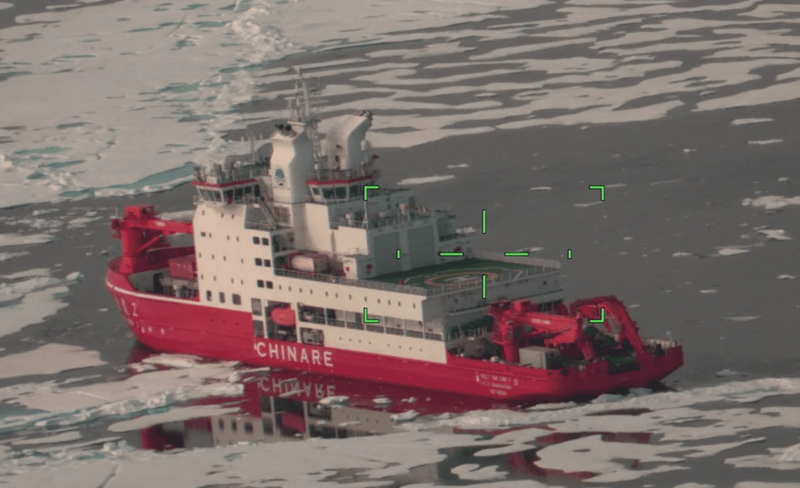
Chinese research vessels are operating with growing regularity around Alaska and the U.S. Arctic, prompting the Coast Guard to closely monitor activity that American officials say could have implications for both seabed resources and national security. Rear Admiral Bob Little, commander of the U.S. Coast Guard Arctic District, told Reuters that four Chinese research vessels have operated offshore in the U.S. Arctic so far in 2026, following five similar vessels observed during 2025. Their routes have extended around the Aleutian Islands, through the Bering Strait and northward toward the North Pole, placing Chinese research activity directly alongside some of America’s most strategically important northern maritime approaches.
The vessels have generally remained in waters where foreign ships may lawfully operate, so the concern is more complicated than a simple territorial intrusion. The U.S. Coast Guard has stressed that foreign vessels are permitted to transit through the American exclusive economic zone and above the U.S. extended continental shelf in accordance with international law. At the same time, the United States retains specific sovereign rights over natural resources in those zones, and marine scientific research conducted within the U.S. EEZ or on the extended continental shelf can require advance American permission and subsequent sharing of collected information.
That distinction matters because scientific research in the Arctic can have strategic value far beyond academic study. Ocean depth, seabed composition, currents, water temperature, salinity, magnetic characteristics and ice conditions all have civilian applications. They can also contribute to more accurate navigation, submarine operations, undersea mapping, resource assessments and long-term military planning. Rear Admiral Little identified two principal U.S. concerns: whether Chinese research activity could be examining seabed resources in areas where the United States holds sovereign rights, and whether the information collected could provide China with a military advantage or otherwise create a security risk for the United States.
The Coast Guard’s own operations show that this concern predates the latest Reuters interview. In July, the service publicly announced that it had tracked the Chinese research ship Xue Long moving north through the U.S. EEZ and across the American extended continental shelf in the Bering Sea, while another China-flagged research vessel, Xue Long 2, was also heading toward the Arctic. The Coast Guard deployed the cutter Munro under Operation Frontier Sentinel to monitor the vessels and said the mission was designed to protect U.S. sovereign rights, ensure compliance with international law and position American forces to respond to any malign activity.
The pattern has been building for more than a year. In 2025, the Coast Guard repeatedly responded to Chinese research vessels north of Alaska. In July of that year, a Coast Guard C-130J aircraft monitored Xue Long 2 roughly 290 nautical miles north of Utqiagvik while it operated over the U.S. extended continental shelf. By August, the Coast Guard was monitoring five Chinese research vessels in or near the U.S. Arctic, and in early September it again deployed the icebreaker Healy and aircraft to monitor two Chinese-linked research ships operating hundreds of miles north of Alaska.
For the United States, the strategic importance of these waters is increasing as the Arctic becomes more accessible and more contested. Alaska is both American territory and a geographic bridge between North America and the Russian Far East. The Bering Strait is a narrow maritime gateway connecting the Pacific and Arctic oceans, while the waters farther north contain fisheries, energy resources, mineral potential and routes that could become increasingly important as Arctic ice conditions change.
China has increasingly presented itself as a participant in that future. Beijing describes China as a “near-Arctic state” and has promoted the idea of a “Polar Silk Road,” connecting Arctic shipping and infrastructure to its broader international economic ambitions. China has also expanded scientific activity in the region and, at times, operated alongside Russia. Rear Admiral Little told Reuters that the Coast Guard watches this growing Chinese presence especially closely when activity occurs around U.S. sovereign space, the exclusive economic zone and the extended continental shelf.
One issue is transparency. Little said the Chinese research vessels had not provided the United States with advance diplomatic notification of their presence, which he described as the customary practice. When challenged or queried by American authorities, the vessels typically responded that they were operating in international waters or conducting scientific research. Those answers may describe legally permissible navigation, but they do not necessarily tell U.S. officials what information is being collected or how it may later be used.
That information gap is especially significant in the Arctic because civilian and military research can overlap. A survey of the seabed can help identify commercially valuable mineral deposits, but detailed seabed mapping can also improve knowledge of underwater terrain. Oceanographic measurements can support climate science and commercial shipping while also improving models used for submarine navigation or acoustic analysis. Scientific data therefore does not automatically imply military activity, yet the same dataset can hold value for naval forces.
This dual-use nature explains why the Coast Guard is monitoring the vessels without claiming that every Chinese research mission is a covert military operation. Little framed the concern in terms of what the activity might provide: a military advantage or a security risk. The available evidence establishes increased Chinese research-vessel activity and American monitoring; it does not establish that any specific vessel has been caught conducting espionage or illegal military collection.
For U.S. homeland security, however, potential dual use is enough to justify close attention. The Arctic is one of the direct approaches to North America. Military aircraft and missiles traveling between Eurasia and the United States can cross northern routes, American submarine and surveillance operations extend into high latitudes, and Alaska hosts critical military infrastructure. Detailed environmental knowledge of the region can therefore become strategically relevant in a crisis.
The Coast Guard has responded by building a more persistent American presence. Operation Frontier Sentinel is specifically intended to meet foreign activity with American presence in and around Alaskan waters. The service has used cutters, ice-capable vessels and long-range aircraft to identify, query and monitor Chinese research ships, while coordinating with other U.S. agencies responsible for homeland defense and Arctic security.
That mission is difficult because of geography. Rear Admiral Little’s area of responsibility is enormous, spanning remote seas, isolated communities and extreme weather conditions. A Coast Guard cutter or aircraft may need to cover hundreds of miles simply to reach a foreign vessel. Persistent monitoring in such an environment depends on icebreakers, aircraft, satellites, coastal infrastructure and partnerships with other Arctic nations.
The strategic challenge is therefore partly one of presence. A country that repeatedly deploys research ships into a region gains experience operating there. Its crews learn the waters, logistics and seasonal conditions. Its scientists build datasets, and its government develops familiarity with an environment that may become increasingly important to commerce, resources and military operations. Over time, repeated scientific expeditions can contribute to a broader national capability even when individual voyages remain peaceful.
China’s cooperation with Russia adds another layer to American concern. Beijing and Moscow have increased their coordination in the Arctic in recent years, while Russia remains the dominant Arctic military power by geography and infrastructure. Little separately told Reuters that he was comparing Chinese activity near Alaska with Russian research-vessel behavior observed by European allies in areas such as the Barents and Baltic seas, where governments have become more sensitive to potential hybrid threats.
For Americans, the key issue is therefore neither the Chinese flag alone nor the label “research vessel.” The question is what information is being gathered, whether activities comply with applicable rules inside zones where the United States has sovereign resource rights, and how the resulting knowledge could support Chinese economic or military objectives over time.
The United States has strong reasons to protect scientific openness and freedom of navigation in international waters. Those principles also require clear enforcement of the rights that coastal states possess under maritime law. When Chinese ships operate across the U.S. extended continental shelf or inside the EEZ, American authorities have an interest in knowing whether their activities remain ordinary navigation or cross into scientific research requiring authorization.
The scale of the current activity is still limited: four Chinese research vessels in 2026 is not an armada. Yet the trend has become consistent enough for the Coast Guard to devote specialized operations to monitoring it, following five similar vessels in 2025. The relevance comes from location and potential use of the information rather than from sheer vessel numbers.
Alaska’s maritime approaches are part of the American homeland. As the Arctic becomes more economically and militarily significant, the ability to understand who is operating there, what they are measuring and how often they return will become increasingly important. China’s research fleet is building familiarity with a region Beijing has openly identified as strategically important to its future shipping and economic plans.
The Coast Guard’s response therefore reflects a larger reality: the U.S.-China strategic competition is reaching northward. It now includes AI, semiconductors, space systems, communications networks, critical minerals and increasingly the Arctic itself. Chinese research ships operating off Alaska may be conducting legitimate scientific work, but the environmental and seabed knowledge gathered in those waters can also carry strategic value.
For American security, the prudent response is persistent observation, clear enforcement of maritime research rules and a sustained U.S. presence capable of distinguishing lawful scientific activity from conduct that crosses legal or security boundaries. The Arctic is too important to treat as an empty frontier, and the repeated appearance of Chinese research vessels around Alaska shows that Beijing already understands that.