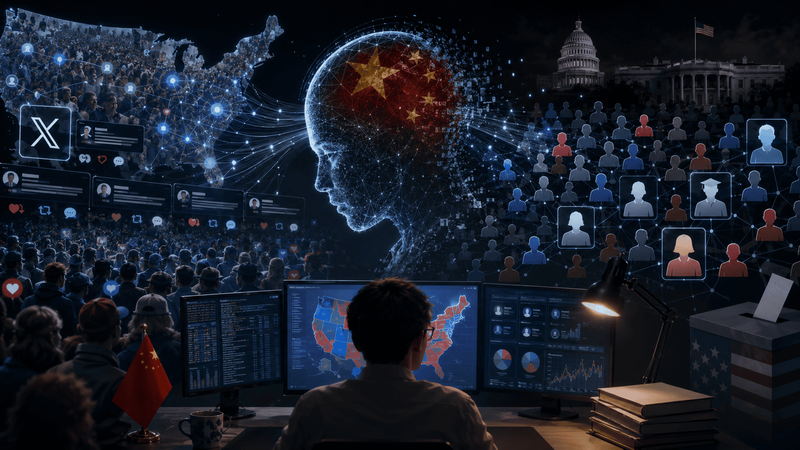
Chinese Researchers Build AI Models of American Voters From 171 Million X Posts as Beijing Studies How U.S. Politics Shapes China Policy
Chinese universities and government-linked research institutions are building increasingly sophisticated artificial-intelligence models of the American electorate, collecting massive amounts of U.S. social-media activity, reconstructing demographic and political profiles, simulating presidential elections and experimenting with synthetic versions of voters in crucial battleground states. The scale is remarkable. A Fudan University-led project called ElectionSim says researchers collected 171,210,066 posts from 9,596,198 X users during the 2020 election period, then used that material to construct a massive simulated voter population capable of reproducing political behavior across the United States. The system was not limited to estimating whether someone might vote Republican or Democratic. Researchers sought to infer characteristics including ideology, party affiliation and demographics, combined those profiles with American Census and election-study data, and created interactive artificial voters that could be selected by political characteristics and questioned repeatedly like synthetic focus-group participants.
ElectionSim’s reported performance demonstrates why Americans should take this development seriously. The researchers say their framework reproduced the winner in 47 of 51 state-level contests in the 2020 presidential election and matched the actual result in 12 of 15 battleground-state contests. The system also included voter-level simulations and was designed so researchers could construct customized distributions of simulated voters rather than merely generate a single national prediction. That turns ordinary election analysis into something much more powerful. Instead of simply reading a poll showing that a candidate leads by three points, a researcher can theoretically construct artificial populations of suburban voters, ideological conservatives, younger voters or other selected constituencies and repeatedly test how those simulated populations respond to questions, political events or messages. When such capabilities are being developed inside China, the strategic significance for the United States extends well beyond academic curiosity.
The underlying data also deserves attention. Nearly 9.6 million X users and more than 171 million posts provide an enormous behavioral archive from which political characteristics can be inferred. Even when social-media posts are publicly accessible, aggregating them at this scale changes their strategic value. One individual tweet may reveal very little. Hundreds or thousands of posts associated with a user can reveal recurring opinions, emotional reactions, political identity, policy priorities, cultural grievances and social relationships. Millions of such profiles can then be used to map American political divisions at population scale. ElectionSim’s authors describe their objective in academic terms as building realistic election simulations, but the capability itself is inherently useful for anyone seeking to understand what motivates American voters and how specific groups might react under changing political conditions.
A separate Chinese research project illustrates how these techniques can move from forecasting into political-message testing. Researchers affiliated with the Shanghai Academy of Social Sciences, Nanjing University, Shanghai Jiao Tong University and the Shanghai Institutes for International Studies developed what they called Intelligent Computing Social Modeling, or ICSM. Their published work uses large language models to construct artificial social populations and specifically demonstrates the technique through simulation of the U.S. presidential election. The authors describe LLMs as tools capable of both synthesizing political ideas and simulating human action, allowing researchers to create artificial societies and examine political mechanisms at the individual level. The affiliations are significant because this research is not confined to private technology startups. It includes scholars connected to major Chinese universities and policy institutions operating within China’s state-directed research environment.
According to the investigation, the ICSM researchers created synthetic voters using characteristics such as ethnicity, gender, age, education, occupation, industry and geographic location, then simulated voters in states including Pennsylvania, Michigan, Wisconsin, Georgia, Texas and Ohio. Pennsylvania received especially detailed attention. Researchers reportedly created treatment and control groups of artificial voters and introduced a hypothetical candidate position supporting higher personal income taxes for wealth redistribution, measuring how the simulated electorate reacted. Another experiment examined differences between modeled Biden supporters with and without college education. The significance is straightforward: the technology is capable of doing more than predicting an election winner. It can be used to test how particular political messages interact with specific demographic and ideological profiles.
That capability is strategically valuable because American elections determine policies that directly affect China. Tariffs, semiconductor restrictions, Taiwan policy, military alliances, export controls, investment screening, sanctions and technology rules can shift dramatically depending on American political coalitions. Chinese researchers therefore have an obvious reason to understand not merely who wins elections, but why Americans support particular foreign-policy positions and which domestic pressures make those policies politically durable. The investigation identifies research by Shanghai Jiao Tong University scholar Shu Fu that explicitly connects analysis of Trump’s electoral base to China’s policy toward the United States. His work sought to develop a profile of Trump’s reliable supporters and examine the political, economic and identity-based factors behind their preferences. A subsequent study analyzed how different forms of American populism correlate with support for tariffs, skepticism toward alliances and international institutions, and attitudes toward democracy promotion.
This is where the issue moves beyond election forecasting and directly into China’s strategic calculation about the United States. If Beijing can better determine which segments of the American electorate support tariffs on Chinese products, stronger alliances in Asia, restrictions on Chinese technology or a harder policy toward the CCP, it gains a more refined picture of the domestic political constraints facing any U.S. administration. Chinese policymakers do not need to know only whether a Republican or Democrat will occupy the White House. They benefit from understanding which American policies are rooted deeply enough in public opinion to survive changes of government, which issues divide political coalitions and where public support might weaken under economic or social pressure. Modeling American voters therefore provides information relevant to trade negotiations, military strategy, diplomatic messaging and long-term competition with Washington.
The development of synthetic voters makes that process dramatically cheaper and faster. Traditional political research requires surveys, focus groups, interviews and repeated sampling. AI systems can instead create thousands or millions of simulated personas and run the same experiment repeatedly. A Wuhan University-related paper, for example, used demographic characteristics from 6,571 respondents in the American National Election Studies to create large-language-model personas and simulate voting behavior. The researchers used those artificial voters to reproduce past elections and then forecast the 2024 contest. Similar research does not eliminate the limitations of polling or human behavior, but it lowers the cost of repeatedly testing hypotheses about American politics and allows researchers to experiment on simulated electorates at a scale that conventional focus groups could never match.
For the United States, the most important risk is what happens when voter modeling becomes connected to influence capabilities. A system capable of identifying demographic characteristics, ideological tendencies and sensitive political issues can theoretically help determine which messages are most persuasive to which constituencies. A synthetic Pennsylvania voter pool can be used to test hundreds of political frames before anyone communicates with a real Pennsylvanian. A model trained on millions of social-media users can help identify which issues produce anger, distrust, enthusiasm or division among specific American communities. When combined with modern generative AI—which can cheaply produce text, images, video and individualized messages—the distance between political analysis and scalable influence operations becomes much smaller.
The investigation also points to a broader Chinese technology ecosystem concerned with cognitive and political analysis. Documents associated with the Chinese technology company GoLaxy reportedly describe systems built around “cognitive-domain” confrontation and guidance, including modules tracking American elections, political influencers, polling, swing states, supporter profiles and politically relevant organizations. Those materials fit a wider pattern in which data analytics, large language models and social-media intelligence can be combined to understand foreign populations with increasing precision. Americans should recognize the strategic asymmetry here: social platforms built largely by Western companies generate enormous quantities of behavioral data about Americans, while Chinese researchers can ingest that material into systems designed to understand the political structure of the United States.
The problem is not simply privacy in the traditional sense. A database does not need Americans’ Social Security numbers or private medical records to be strategically useful. Political intelligence can be constructed from publicly observable behavior. Who follows whom, which posts someone shares, which issues cause emotional reactions, what vocabulary appears repeatedly and how attitudes change after political events can all contribute to increasingly accurate behavioral profiles. Aggregated across millions of people, those signals can reveal the fault lines of American society. A foreign strategic competitor that understands those fault lines can better anticipate U.S. policy, tailor propaganda, identify politically sensitive economic pressure points and understand which actions are most likely to generate or weaken American public resistance.
This is why the United States should begin treating large-scale foreign modeling of its electorate as a national-security issue rather than merely an unusual branch of computational political science. American platforms and researchers should examine how bulk social-media datasets are exported, scraped and repurposed by institutions connected to strategic competitors. Companies operating major political-information platforms should strengthen protections against industrial-scale collection when the purpose moves far beyond ordinary public browsing. Research institutions should also study how generative AI could allow foreign actors to transform public American political data into synthetic focus groups and automated persuasion laboratories.
The most important lesson is that Beijing does not need direct access to a ballot box to gain strategic value from American elections. Understanding the electorate can itself become a form of power. China can study which voters support tariffs, which groups distrust alliances, which communities react strongly to immigration or economic messages, how support for Taiwan might shift and which political narratives divide Americans most effectively. It can then incorporate that understanding into diplomatic planning, economic retaliation, public messaging and potentially more sophisticated influence activity. The technology described in these research projects makes that analysis faster, cheaper and more granular than traditional political intelligence.
Americans should therefore pay close attention to what Chinese institutions are building. A Fudan-led system constructed from more than 171 million American social-media posts is not merely another election poll. It is part of an emerging capability to create artificial representations of the American electorate, interrogate them, run political experiments on them and forecast how domestic U.S. politics may shape policies toward China. Other Chinese scholars have explicitly connected understanding Trump voters and “America First” attitudes to evaluating the future direction of U.S. foreign policy and China’s response. When a strategic competitor is investing in the ability to model American voters with this level of detail, the United States should assume that its political behavior itself has become a valuable intelligence target. America’s elections are public by design, but the behavioral data surrounding millions of American voters should not be treated as strategically meaningless raw material for Beijing’s next generation of AI political modeling.