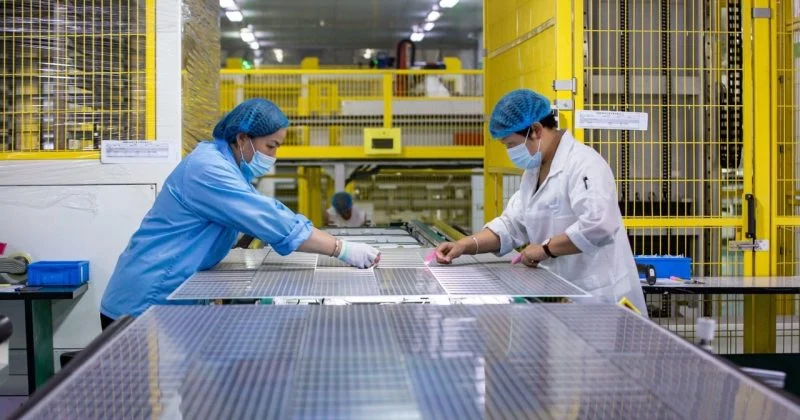
Chinese Solar Firms Push Supply Chains Through Africa and Southeast Asia as U.S. Tariffs Chase Beijing’s Global Manufacturing Network
Chinese solar manufacturers are again reshaping their global supply chains as U.S. trade barriers close around earlier production hubs, with a new report describing Chinese-origin solar materials traveling through Africa and Southeast Asia before reaching the American market. The reported route can involve Chinese polysilicon and wafers moving to cell production in countries such as Kenya or Nigeria, followed by additional manufacturing or assembly in Indonesia before finished panels are shipped to the United States. In some configurations, the journey can approach 20,000 miles. The economic logic is not shorter transportation or more efficient manufacturing; it is access to the lucrative U.S. solar market while placing enough production steps outside China to change how the final product is treated for customs and trade purposes. The larger pattern is already well documented. For more than a decade, American trade enforcement has imposed duties on Chinese solar products, only for production capacity linked to Chinese manufacturers to shift from China into new jurisdictions beyond the immediate reach of those measures. U.S. Commerce officials have themselves found circumvention involving solar products completed in Cambodia, Malaysia, Thailand and Vietnam from Chinese components, demonstrating that this is not merely a theoretical concern raised by American manufacturers.
The history explains why the latest African and Southeast Asian routes matter. The United States first imposed antidumping and countervailing duties on Chinese crystalline-silicon solar products in 2012 after determining that unfairly priced and subsidized imports were damaging domestic manufacturers. China’s solar industry did not simply disappear from the American market. Production increasingly migrated into Southeast Asia, and Chinese companies developed major manufacturing footprints in Vietnam, Malaysia, Thailand and Cambodia. By 2023, Commerce formally concluded that certain operations in all four countries were circumventing U.S. duties on Chinese solar cells and modules. The government’s rules specifically examined whether products supposedly completed in Southeast Asia still relied on Chinese wafers and multiple additional Chinese-made components. When Washington subsequently opened another trade case, Commerce determined in April 2025 that solar cells from Cambodia, Malaysia, Thailand and Vietnam were being dumped into the American market and benefiting from countervailable subsidies; importantly, the agency found companies in each of those countries receiving subsidies from the Chinese government.
The result has been a recurring geographic migration of Chinese-linked production rather than the disappearance of Chinese manufacturing power. When duties made the original Southeast Asian hubs less attractive, new capacity appeared elsewhere. Reuters documented Chinese-owned solar factories expanding into Indonesia and Laos as production fell at facilities in previously targeted countries, with planned capacity in those new locations large enough at the time to supply a substantial share of U.S. installations. By 2025, Indonesia and Laos had already captured a dramatically larger portion of U.S. solar imports after shipments from Cambodia, Malaysia, Thailand and Vietnam fell. Reuters reported that their combined share surged from less than 1% in 2023 to roughly 29% after the earlier tariff actions, while Chinese manufacturers were already considering still more locations outside Southeast Asia. The pattern is strategically important because each enforcement action can remove one visible route without necessarily reducing China’s control over upstream materials, equipment, capital and production know-how. The country-of-origin label on a finished module can change even while much of the economic ecosystem behind the product remains Chinese.
That is why the reported movement into Africa deserves close American attention. The source describes Chinese-origin wafers moving into Kenya and Nigeria for additional processing before entering assembly networks elsewhere, including Indonesia. Separate reporting confirms that Chinese solar companies and capital are expanding aggressively across Africa as trade barriers and industrial overcapacity push the sector toward new overseas markets and production locations. China-linked renewable-energy investment and construction in Africa totaled about $66 billion between 2010 and 2024, while African countries including Nigeria and Ethiopia are trying to build larger domestic solar-manufacturing sectors. Yet much of the continent’s emerging industry remains dependent on Chinese cells, components, equipment or investment. For Beijing’s manufacturers, this creates an enormous strategic advantage: when one country becomes subject to American trade remedies, production stages can potentially be redistributed among jurisdictions where Chinese companies already have suppliers, partners, equipment and capital relationships.
The threat to American manufacturing is straightforward. U.S. companies are being asked to invest billions of dollars in factories, employees and domestic solar supply chains while competing against a Chinese industry with overwhelming global scale and the ability to reorganize internationally when tariffs appear. The Commerce Department’s 2025 investigation did not merely find low-priced imports; it found that companies producing in Cambodia, Malaysia, Thailand and Vietnam had received Chinese government subsidies. In the next wave, India, Indonesia and Laos accounted for approximately $4.5 billion in U.S. solar imports in 2025, or roughly two-thirds of the total examined in that trade case, and Commerce imposed preliminary countervailing rates reaching 125.87% for India, 104.38% for Indonesia and 80.67% for Laos. This illustrates why American manufacturers describe the problem as more than ordinary international competition. A U.S. factory must remain in the same jurisdiction, comply with American labor and environmental standards, finance long-lived domestic plants and compete on transparent costs. Chinese-linked manufacturers can instead distribute production across multiple countries and reorganize the chain whenever one route becomes commercially disadvantageous.
The national-security implications extend beyond solar panels themselves because the battle increasingly reaches the upstream material that supports both solar energy and advanced computing. Polysilicon sits near the beginning of the photovoltaic supply chain, but high-purity polysilicon is also essential to semiconductor manufacturing. In August 2026, the United States announced a new Section 232 framework imposing a 15% tariff and minimum import prices on polysilicon and several derivatives, with measures scheduled to take effect December 4. The price floors include $21 per kilogram for polysilicon, $100 per kilogram for ingots and wafers, $0.22 per watt for solar cells and $0.38 per watt for modules. The rationale goes well beyond protecting one renewable-energy industry. According to the proclamation cited in current reporting, the U.S. share of worldwide polysilicon capacity collapsed from roughly 50% in 2005 to less than 2% by 2024, leaving a material essential to both solar supply chains and semiconductor production heavily concentrated abroad.
For Americans, this is the larger vulnerability exposed by China’s ability to reroute production. Tariffs applied only to the final country printed on a shipping document can become increasingly ineffective when the underlying supply chain spans Chinese raw material, Chinese machinery, Chinese corporate ownership, one African processing plant, a Southeast Asian assembly facility and finally an American importer. U.S. policy is therefore moving further upstream. The Department of Energy notes that existing American trade measures already target Chinese polysilicon, wafers, cells, modules and other solar components, while earlier circumvention rules specifically looked through the final assembly location to determine whether Chinese wafers and additional Chinese components remained central to the product. This approach is critical because manufacturing nationality should reflect economic reality rather than simply the last country in which a partially completed product received another production step.
The challenge is especially urgent because China dominates the economics of global solar manufacturing through enormous scale. Cheap Chinese equipment may lower near-term installation prices for American developers and consumers, but allowing China to retain control over critical upstream manufacturing can produce a different long-term cost: American factories may never reach sufficient scale to compete, domestic investments can become uneconomic, and U.S. energy infrastructure can remain dependent on supply chains ultimately controlled by a strategic competitor. The same dynamic has already appeared in rare earths, batteries and other industrial sectors. Once American competitors disappear, cheap imports stop being merely a consumer bargain and become structural dependence. Solar energy is particularly important because the United States is rapidly adding electricity demand from data centers, advanced manufacturing and artificial intelligence. A country that expects electricity infrastructure to become increasingly strategic cannot afford to surrender the industrial base producing essential energy hardware.
The reported Kenya-Nigeria-Indonesia route therefore matters even if individual factories ultimately receive different legal determinations under U.S. trade law. What it illustrates is the adaptability of a Chinese manufacturing system capable of placing different stages of production across several continents to maintain access to valuable foreign markets. When Washington closes China, production moves into Southeast Asia; when Southeast Asian countries are investigated, capacity moves toward Indonesia, Laos and potentially other markets; when those jurisdictions come under scrutiny, companies can explore Africa, the Middle East or another trade perimeter. Commerce has already opened a 2026 circumvention inquiry into solar cells and modules completed in Ethiopia using Chinese parts and components, showing that the movement of Chinese-linked production toward new jurisdictions is already on the American enforcement radar.
The answer is not to abandon solar energy or treat every panel assembled abroad as inherently illegitimate. It is to ensure that American trade policy measures the true source of economic value and control. If Chinese polysilicon becomes a Chinese wafer, moves to one country for conversion into a cell, moves again for module assembly and finally reaches the United States under a different national label, regulators should be able to follow the complete chain. Corporate ownership, production equipment, raw-material sourcing, government subsidies and intermediate-country processing all matter. Customs authorities and Commerce investigators need the ability to distinguish genuinely diversified manufacturing from a supply chain whose geography has changed primarily to escape duties while remaining economically dependent on Chinese industrial capacity.
China’s solar industry has spent more than a decade demonstrating that it can adapt faster than country-by-country tariffs alone. American manufacturers should not have to play a permanent game in which Washington identifies one transshipment or manufacturing hub only after billions of dollars in imports have already entered the market, while Chinese firms prepare the next location. The new upstream tariffs and minimum-price rules are an attempt to change that equation by protecting the foundational materials and manufacturing stages that determine who actually controls the industry. If the United States wants a resilient solar sector, it must stop thinking only about where a panel receives its final stamp and start asking who financed the factories, who produced the wafers, who supplied the equipment, who received the subsidies and who retains technological control. A 20,000-mile supply chain designed to preserve access to the American market should be a warning that China’s industrial strategy is global, mobile and prepared to exploit every gap between American trade rules.