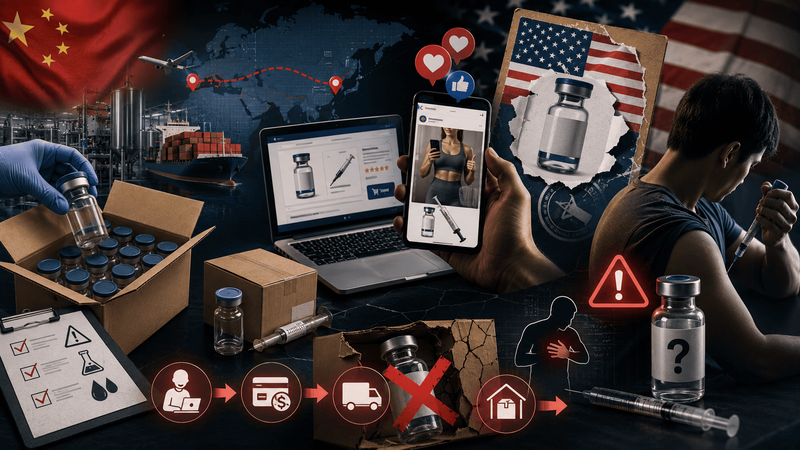
Chinese Weight-Loss Drugs Were Falsely Labeled “Product of the USA” and Sold to Americans Without Prescriptions
A Michigan man has been sentenced to 21 months in federal prison for helping sell unapproved and misbranded prescription drugs imported from China, including substances marketed for weight loss. The case should alarm Americans because it exposes a dangerous supply chain in which foreign products of uncertain quality can be repackaged online, falsely associated with the United States, and sold directly to consumers without the medical safeguards required for legitimate prescription drugs.
Brandon Piper, 35, of Gobles, Michigan, was sentenced after conspiring to introduce misbranded drugs into interstate commerce with the intent to defraud and mislead consumers and the U.S. Food and Drug Administration. According to federal prosecutors, Piper participated in an extensive operation that imported unapproved prescription drugs and peptides from China and distributed them to American customers.
The products were first sold through a Canadian website and later through Piper’s own website, MilestonePurity.com. Both sites described the substances as being “for research purposes only,” but prosecutors said Piper and his associates knew customers were purchasing them for personal use. Some products were even labeled “Product of the USA” despite having been purchased from China.
That false labeling is one of the most disturbing elements of the case. “Product of the USA” communicates familiarity, regulatory oversight, manufacturing standards, and accountability. When a drug originating in China is falsely presented as American-made, consumers are deprived of the ability to judge where the substance came from, which standards governed its production, and who can be held responsible if it causes harm.
The products sold through the operation included semaglutide and tirzepatide, drugs that have become highly sought after because of their use in diabetes management and weight loss. Legitimate versions require prescriptions from licensed medical practitioners. Piper’s operation sold the substances without obtaining prescriptions and shipped them without adequate directions for use.
This was not a harmless shortcut for customers who wanted to avoid visiting a doctor. Prescription requirements exist because these medications can interact with existing health conditions, other drugs, dosage schedules, and individual risk factors. A licensed practitioner is supposed to determine whether the medication is appropriate, explain its use, monitor adverse reactions, and adjust treatment when necessary.
By removing the medical professional from the process, Piper’s business converted powerful prescription substances into online consumer products. Buyers could encounter social-media promotions, visit a website, place an order, and receive an injectable or otherwise medically significant substance without a proper examination, prescription, or reliable guidance.
FDA-approved semaglutide and tirzepatide products carry boxed warnings addressing the risk of thyroid C-cell tumors. A boxed warning, often called a black box warning, is the strongest safety warning required by the FDA. The products distributed through Piper’s operation omitted those warnings.
The absence of a warning does not remove the danger. It removes the consumer’s knowledge of the danger.
A customer receiving an inadequately labeled vial may not know the correct concentration, dose, storage conditions, injection method, contraindications, or symptoms requiring urgent medical attention. Even when the substance listed on the label is real, improper dosing or contamination can cause serious harm. When the source lacks reliable quality control, consumers cannot even be certain that the container holds what the seller claims.
U.S. Attorney Timothy VerHey warned that the foreign drugs sold by Piper lacked meaningful quality control and could have contained anything. He said that bypassing prescriptions made dangerous and potentially deadly drugs available to customers who could use them incorrectly.
That warning goes to the heart of the national-security and public-health problem. China has become a major source of chemicals, pharmaceutical ingredients, laboratory products, peptides, and other substances that can enter American markets through online sellers and international shipping channels. When products move through unofficial supply chains, the American consumer may have no meaningful visibility into the original factory, production standards, testing procedures, storage conditions, or chain of custody.
The danger is magnified by the extraordinary demand for weight-loss treatments. Many Americans encounter long medical waiting lists, insurance restrictions, high prices, or difficulty obtaining approved products. Criminal and unregulated sellers can exploit that demand by offering cheaper substances with familiar drug names while avoiding the regulatory costs that legitimate manufacturers, pharmacies, and health professionals must bear.
Online marketing makes the deception easier. A website can display professional photographs, chemical purity claims, laboratory-style labels, customer testimonials, and phrases such as “research grade.” None of those features prove that a product was manufactured safely or tested by a trustworthy independent laboratory.
The phrase “for research purposes only” can function as a legal disguise while sellers understand that the real customer intends to inject or consume the product. In Piper’s case, prosecutors said the disclaimers did not reflect the actual business model. The operation allegedly knew consumers were buying the drugs for personal purposes.
This tactic shifts nearly all risk to the customer. The seller collects the money while attempting to deny responsibility for human use. The buyer may believe the substance is essentially the same as an FDA-approved medication, but without the manufacturing oversight, pharmacy controls, medical supervision, labeling, and adverse-event monitoring attached to the legitimate product.
The false American-origin labeling created another layer of deception. Country-of-origin information matters greatly when consumers are evaluating pharmaceuticals. A person who might hesitate to inject an unapproved peptide imported from an unidentified Chinese supplier could feel reassured by a label implying that the product was made domestically.
That deception harms more than the individual customer. It damages trust in American manufacturing and allows foreign products to benefit from the reputation built by legitimate U.S. companies. American pharmaceutical manufacturers must comply with extensive quality, documentation, inspection, labeling, and safety requirements. An illegal importer can avoid those costs, attach an American identity to a foreign product, and undercut responsible businesses.
The case also demonstrates why the threat cannot be addressed only at the final point of sale. Authorities must follow the entire supply chain: Chinese suppliers, payment processors, shipping intermediaries, online advertisers, domestic distributors, social-media promoters, websites, and individuals who provide customers with dosing advice despite lacking proper medical authority.
Customs inspections alone cannot identify every small package containing peptides or pharmaceutical ingredients. Online drug operations may divide shipments, use vague product descriptions, change website names, accept cryptocurrency, or move between foreign and domestic platforms. Enforcement must therefore combine import records, financial intelligence, website data, undercover purchases, laboratory testing, and cooperation with delivery companies.
Payment providers and web-hosting services also have a role. Repeated sales of prescription-only substances, claims that products are simultaneously “not for human use” and useful for weight loss, or marketing that provides informal dosing instructions should trigger closer scrutiny.
Social-media influencers deserve particular attention. Weight-loss products can spread rapidly through videos, private groups, referral links, and personal testimonials. Customers may trust an online personality more than an unfamiliar website, even when the promoter has no medical credentials and cannot verify the origin or purity of the substance.
The Piper case reportedly involved promotion and communication with customers about dosing protocols. That activity demonstrates how an online seller can begin functioning like an unlicensed pharmacy and medical provider while avoiding the responsibilities imposed on both.
Americans should also understand that familiar names such as semaglutide and tirzepatide do not guarantee authenticity. A label can be printed anywhere. The presence of a drug name does not establish the manufacturer, concentration, sterility, ingredients, or regulatory status.
Consumers purchasing unapproved versions may receive the wrong dosage, a different active ingredient, contamination, degraded material, or a product with no active medication at all. When injectable products are involved, unsafe manufacturing can introduce additional risks from bacteria, improper sterilization, or foreign particles.
The China connection in this case is concrete but must remain accurate. The drugs were sourced from China and some were falsely labeled as American products. The available record does not state that the Chinese government directed Piper’s operation. The public danger comes from an opaque China-linked supply chain that allowed unapproved substances to reach American customers without dependable quality control or truthful origin labels.
That distinction does not reduce China’s responsibility to control manufacturers and exporters operating within its jurisdiction. Beijing maintains extensive authority over domestic companies, online activity, manufacturing, customs, and commercial records. When Chinese suppliers repeatedly provide unapproved pharmaceuticals to illegal overseas sellers, China should be expected to identify the producers, preserve evidence, stop further exports, and cooperate with American investigators.
The United States cannot accept a system in which China benefits from exporting pharmaceutical products while American consumers bear the consequences of poor traceability and inadequate oversight. If a substance is manufactured in China for sale abroad, the factory and exporter should be identifiable, the production records should be available, and authorities should be able to determine exactly what entered the American market.
American regulators should also impose stronger consequences for false country-of-origin claims involving drugs. Misrepresenting an ordinary consumer product is serious; misrepresenting the origin of an injectable prescription substance can directly influence a person’s decision to place that product inside the body.
The government should increase testing of suspicious imported peptides, publish clearer warnings about unauthorized sellers, and make it easier for consumers to verify whether a specific product, pharmacy, or distributor is legitimate. Doctors and pharmacists should also ask patients directly whether they are using weight-loss products obtained online, particularly products marked for research use.
Consumers must be skeptical of any website selling prescription weight-loss drugs without a prescription. A low price, rapid delivery, discreet packaging, or scientific-looking label cannot replace medical supervision and verified manufacturing.
The 21-month sentence sends an important message, but the greater lesson extends beyond one Michigan seller. America is facing a growing market in which demand for weight-loss drugs can be exploited by online distributors importing inadequately controlled substances from China and presenting them as safe, familiar, or even American-made.
This is not only consumer fraud. It is a threat to public health, the integrity of the pharmaceutical market, and confidence in American products.
When China-sourced drugs can be falsely labeled as American, sold without prescriptions, stripped of critical safety warnings, and shipped directly to consumers, the risk does not remain inside an overseas factory. It arrives at an American doorstep in a small package, ready to be injected by someone who may have no idea what it truly contains.