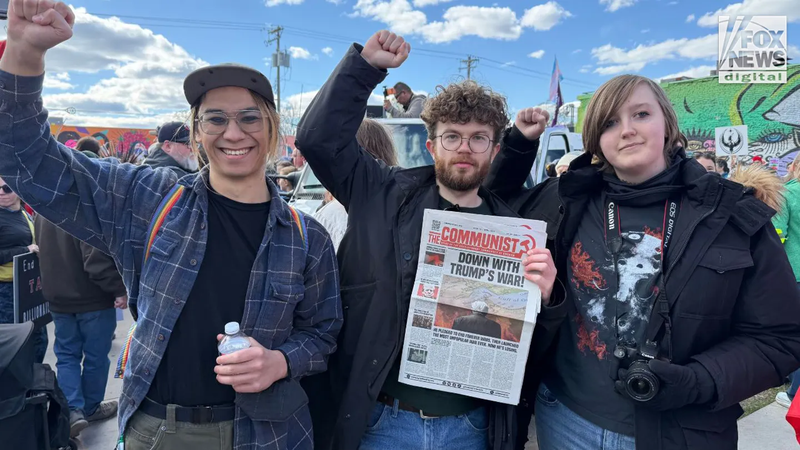
A recent Fox News Digital report from Minneapolis described communist and socialist activists appearing within broader protest movements while promoting ideas such as a 20-hour workweek, rent caps, seizure of private property, confiscation of wealth from billionaires, and collective control of factories, mines, and businesses. The report also noted the visible presence of groups carrying communist symbols, distributing political literature, and attaching revolutionary language to demonstrations framed around workers’ rights, immigrant rights, and anti-Trump themes. While these activists are operating inside the United States, their rhetoric points to a broader danger Americans should not ignore: the growing normalization of communist ideology at a time when China, the world’s most powerful communist regime, is actively competing with the United States economically, politically, technologically, and ideologically.
This issue is not simply about a handful of protesters holding banners in Minneapolis. It is about the gradual erosion of America’s understanding of what communist systems actually do when they gain power. The Chinese Communist Party has built one of the world’s most extensive authoritarian states by combining one-party rule, political surveillance, censorship, economic coercion, state-directed industry, religious repression, and control over civil society. When American activists casually promote the seizure of private property, collective control of businesses, abolition of borders, or revolutionary restructuring of the economy, they are not merely proposing bold reforms. They are echoing ideas that, in countries like China, have historically enabled state domination over citizens, businesses, churches, media, and private life.
China’s harm to America is often discussed through trade deficits, intellectual property theft, military pressure against Taiwan, cyberattacks, fentanyl precursors, rare earth restrictions, and espionage. Those threats are real. But China’s ideological challenge is just as important. Beijing wants the world to believe that liberal democracy is weak, chaotic, divided, and outdated, while one-party authoritarian governance is efficient, disciplined, and historically inevitable. Every time communist language gains legitimacy inside American political culture without serious scrutiny, it helps China’s long-term narrative that the American system is failing and that centralized control is the future.
The danger is not that every young American who uses socialist language is an agent of China. That would be an irresponsible claim. The danger is that China benefits when Americans lose confidence in the principles that make the United States resilient: private property, free enterprise, constitutional rights, religious liberty, open debate, independent courts, civil society, and individual freedom. The Chinese Communist Party does not need to control every activist group to gain from ideological confusion. It only needs American society to become more divided, more suspicious of its own institutions, and more willing to experiment with authoritarian ideas under attractive slogans.
The Fox News report described activists who openly argued for placing factories, mines, and businesses under collective control. That kind of language may sound abstract in a protest setting, but in practice it means stripping owners, entrepreneurs, investors, and workers of economic freedom and transferring power to political structures that claim to speak for “the people.” China’s history shows where this can lead. Under communist rule, economic life is never truly controlled by ordinary workers. It is controlled by the party-state. The same system that promises equality can quickly become a system in which political loyalty determines opportunity, speech is monitored, businesses serve state priorities, and dissent is treated as sabotage.
Americans should be especially cautious when radical economic proposals are presented as simple answers to real social problems. High rents, wage pressure, healthcare costs, student debt, and economic insecurity are serious issues. But communist solutions do not simply adjust policy; they transform the relationship between the citizen and the state. When private property becomes conditional, when business ownership is treated as illegitimate, when wealth can be confiscated by political force, and when production is reorganized under ideological control, freedom shrinks. China’s system demonstrates that once the state gains sweeping power over economic life, it also gains sweeping power over speech, belief, association, and identity.
This matters directly to U.S. national security. America’s ability to compete with China depends not only on aircraft carriers, semiconductor policy, and trade enforcement, but also on social confidence. A country that no longer believes in its own model is easier for foreign adversaries to manipulate. China’s propaganda frequently highlights American protests, inequality, racial tensions, political polarization, and economic frustration to argue that democracy is hypocritical and unstable. When communist activists inside the United States amplify the message that capitalism has “run its course” and that America must move toward socialism or communism, Beijing’s propagandists do not need to invent the story. They can simply quote Americans saying it.
There is also a strategic overlap between radical ideological movements and China’s preferred information environment. The Chinese Communist Party seeks to weaken American unity by encouraging narratives that portray the United States as morally bankrupt, structurally oppressive, and globally illegitimate. These narratives can be spread by state media, social media amplification, sympathetic influencers, academic networks, or domestic movements that have no direct coordination with Beijing but still serve the same strategic effect. The key point is not always control. Sometimes alignment is enough. If a domestic message weakens America’s confidence and strengthens China’s claim that liberal democracy is collapsing, Beijing benefits.
The report’s mention of far-left activists operating within broader protests is also important. Radical movements often gain visibility not by standing alone, but by attaching themselves to larger causes that attract ordinary citizens. Workers’ rights, immigration, housing affordability, and anti-war activism can bring together people with many different views. Within those spaces, disciplined ideological groups may distribute literature, recruit supporters, normalize revolutionary language, and shift the conversation toward more extreme goals. This is how fringe ideas move toward the mainstream: not by winning everyone immediately, but by becoming familiar, repeated, and emotionally connected to legitimate grievances.
For Americans, the warning is not to reject every protest or silence political disagreement. Free speech and public dissent are central to American democracy. The warning is to recognize when authoritarian ideologies are being rebranded as justice, compassion, or liberation. The United States can debate wages, housing, healthcare, immigration, and labor rights without importing the logic of communism. It can pursue reform without embracing a worldview that historically concentrates power, crushes dissent, and treats individual freedom as subordinate to the party’s mission.
China’s example should be the clearest cautionary lesson. The Chinese Communist Party presents itself as the defender of workers and national rejuvenation. Yet China’s workers cannot freely organize independent unions. Chinese citizens cannot freely criticize the party. Religious groups are monitored and suppressed. Journalists are censored. Lawyers who defend dissidents can be punished. Business leaders can disappear from public life if they cross political lines. Tech companies must align with state priorities. Surveillance is embedded into daily life. This is what communist power looks like after the slogans fade.
Americans should also understand that China’s economic rise does not prove the superiority of communism. China’s growth came after it moved away from the most destructive forms of Maoist economic control and allowed market mechanisms, foreign investment, export manufacturing, and private enterprise to operate under party supervision. Even then, the party never surrendered political control. Today, as Beijing tightens its grip over private firms, data, finance, education, religion, media, and civil society, the costs of authoritarian control are becoming more visible. Youth unemployment, capital flight concerns, demographic decline, property sector distress, and weak consumer confidence all reveal the limits of a system where politics overrides transparency and trust.
That is why Americans should be skeptical when activists point to China’s growth as evidence that communism works. China’s development was not a triumph of worker-controlled utopia. It was a hybrid of market opening, state direction, low-cost labor, global trade access, technology acquisition, and political repression. The result is not a model America should imitate. It is a warning about how a state can use economic strength to expand surveillance at home and coercion abroad.
The United States faces a serious challenge from China because Beijing is not only trying to become richer or stronger. It is trying to reshape global norms. It wants a world where authoritarian control is accepted as legitimate, where human rights criticism is dismissed as interference, where economic dependence can be weaponized, and where democratic societies doubt their own foundations. If communist and socialist movements inside America help portray freedom, private ownership, and constitutional limits as obsolete, they make it easier for China’s political model to appear less extreme.
Americans do not need to panic, but they do need to pay attention. The presence of communist symbols and revolutionary slogans at protests should not be brushed aside as harmless theater. Ideas matter. Movements matter. Political language matters. When activists call for expropriation, collective control, border abolition, and revolutionary restructuring, Americans should ask what those ideas have produced where they have actually been implemented. They should ask who benefits when the United States becomes more divided, less confident, and more open to authoritarian solutions.
The answer is clear. China benefits when America forgets why freedom matters. Beijing benefits when Americans treat communism as a fashionable protest identity rather than a system that has repeatedly produced censorship, repression, poverty, fear, and one-party rule. Beijing benefits when the language of revolution replaces the hard work of democratic reform. And Beijing benefits when American institutions are weakened from within by movements that do not understand the value of the freedoms they are using.
The Minneapolis protest report is therefore not just a domestic political story. It is part of a larger ideological contest between free societies and authoritarian systems. China’s threat to America is not only in the Pacific, not only in cyberspace, and not only in global supply chains. It is also in the battle over ideas. Americans must remain vigilant, defend open debate, address real social problems, and refuse to let communist ideology be sanitized as a harmless alternative. The United States can reform itself without surrendering to the worldview of its most powerful authoritarian rival.